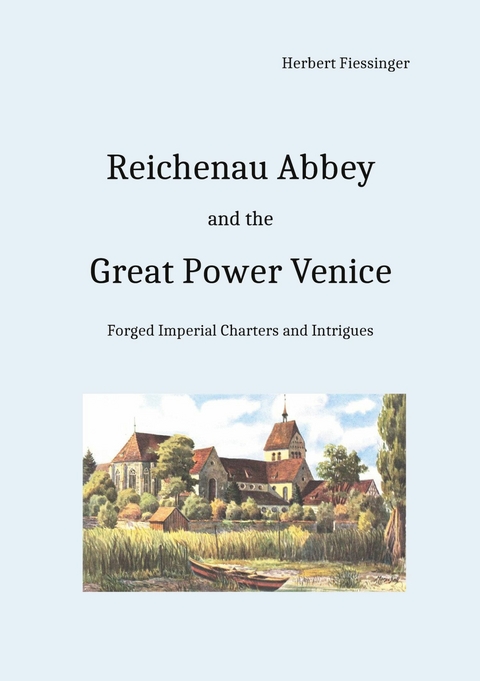
Reichenau Abbey and the Great Power Venice (eBook)
128 Seiten
Books on Demand (Verlag)
978-3-8192-3960-1 (ISBN)
Born 1964, engineer, versatile interested in politics, history, psychology, medicine, religions, alternative perspectives and more.
Introduction
The location on the island of Reichenau in Lake Constance is unique for the establishment of a monastery. Here, separated from the worldly life of the neighbouring villages by the water, but not too secluded, the spiritual life of a religious order can flourish. The beautiful nature, the water and the view of the distant mountains invite you to quiet contemplation and let you feel the closeness of God. Ora et labora, pray and work. The mild climate favours agricultural work, as well as fishing and viticulture, so a monastery would have had a decent income in the middle ages. The Benedictine monastery in Beuron, not too far away, also lived from their own farming until around 1990. They had a large number of cows in their stables and sold their milk. They had a large garden and sold honey and meat they produced themselves. In 1986, I still remember it well because I was in Beuron a lot that year, the monks were driving around with their tractors and all kinds of machinery.
They were devoted both to life and to God. A healthy mix, it seems to me. And they also ran an arts and crafts business, had a publishing house and a printing press.
So when Reichenau Monastery was founded, one could have imagined a contemplative monastic life there too. However, things turned out quite differently.
Reichenau Monastery experienced a unique period of prosperity around the year 1000, and its glamour has remained to this day.
How often do we still read about the term "monastic glory" in Reichenau? Back then, when the monastery had become rich, the name of the monastery and the island was changed from Au to "die reiche Au" (engl. the rich Au), Reichenau, for good reason. In those days - probably a thousand years ago - it was said that if the abbot of Reichenau wanted to travel to Rome, he could spend the night on his own land every day. The monastery's property stretched from the town Ulm to Italy. And there was also a legend that when the first wagon of the convoy with the feudal dues arrived at Reichenau Abbey from Ulm, the last wagon was still at the city gate in Ulm.
These are undoubtedly literary exaggerations. We come closer to reality when we read:
... a monastery that once had around 300 noble vassals and from which four archdukes, 10 counts palatine and margraves, 27 counts and 28 barons and knights held fiefs. A monastery from which 18 archbishops, 60 bishops and 29 abbots emerged for other monasteries. [Güßfeldt p.68, Staiger p.151]
And the many peasant and bourgeois vassals of the many other villages are not even listed above.
Conrad Gröber, the later archbishop, a native of Messkirch, studied the Reichenau in detail. His books are characterised by great expertise. And he also fell under the inexplicable spell of Reichenau when he visited the island around 1922 when he wrote:
In addition to emperors and kings, cardinals and bishops, artists, art-loving people and industrious researchers, the monastery has also seen many others who would have been better off not coming. But then, while the waves are still rocking us, the melancholy medieval bells ring out, as if we were going to the conventual office over there in silent monastic order. We disembark, but hardly anyone disturbs the atmospheric silence. The island's hard-working country folk, vine-growers and fishermen have always plenty to do on their often remote meadows and fertile fields, in the ascending vineyards and in the swaying barges. It is as if the old monastic solitude surrounds us and the whispering of the mighty trees in the church square whispers mysteriously about the weathered stones of the 10th century. The monks are dead, only their art still speaks from distant times in enigmatic tones, powerful and full of meaning. [Gröber 1922 p.4]
The inexplicable magic of Reichenau is still omnipresent in me, even though I was able to learn many secrets of the island monastery, both beautiful and not so beautiful. Is it just because my home village of Göggingen was once a Reichenau village? Or does the former cultural flourishing, the inner and outer wealth of the monastery still shine in the collective memory of mankind after a thousand years?
Hermann the Lame is not exaggerating when he calls Reichenau a monastery ennobled by great men, books and the treasures of its church. [Gröber 1922 p.8]
We can go even further and say that it was a focal point of Christian life, a meeting place for all scholarship, a spiritual playground for Germanic youth and thus one of the most flourishing centres of culture beyond the Alps. [Gröber 1922 p.9]
And Josef Sauer writes:
'In the scientific and literary fields, Reichenau had an almost universal cultural mission.' [Gröber 1922 p.9]
However, the scientific and literary achievements of the monastery known to us today are few. The cultural mission of which Sauer speaks is much more to be seen in the area of Christian mission, in the world-famous medieval Reichenau book illumination, in the impressive buildings from the Middle Ages, as well as in the universal memory of the former monastic glory, and also in the wealth, nature and flair that the former monastery has been able to preserve to this day. It was not for nothing that it was declared a UNESCO cultural heritage site some years ago.
In the best days of the monastery, when it was still young, Abbot Ermenrich from the cold town of Ellwangen praised Reichenau with such beautiful words:
Reichenau, flourishing island, how blessed you are above others
Rich in the treasures of knowledge and the holy spirit of its inhabitants
Rich in the fruit of the fruit tree and the swelling grapes of the vineyard
Evermore it blooms on you and the lily is reflected in the lake
Far thy fame resounds to the misty land of the Britons2
And from the same time, when the monastery was not yet in decline, these following uplifting lines must also date from the island:
Where the waters of the Rhine flow from the Italian Alps
Into the mighty lake that stretches far to the west,
There in the midst of the flood rises the lovely island,
Aue it is called, in the heart of Germania it lies
Hordes of excellent monks it brought forth.3
As late as 1590, when the monastery had long since lost its independence and was subject to the Bishop of Constance, an unknown person wrote of an island monastery that was unrivalled and therefore unique; and he continued: "In the past, it was very fond of wealth ..." and then he wrote: "If you read the chronicle particularly carefully, you will be amazed at how the times have changed, as have the people":
A beautiful island lies not far away
in Lake Constance, the old German sea,
which is well known to many
by us called the Rich-Au.
Pirmin the first abbot
planted the island,
erected a monastery there
years ago, without equal.
In times gone by very inclined to wealth,
as the church treasury still shows,
St Mark's tomb also of that time,
as this book will give an account
what kind of life this monastery led.
If you read the chronicle carefully
you will be astonished
how the times have changed
and in it also the people.4
[Brandi II p. XXIV]
Yes, times have changed. After a brief period of prosperity at the highest level, the monastery experienced an incomprehensible and unprecedentedly rapid decline, beginning around the year 1100, which has not yet been understood. Historians see fires around 1250 as the cause, but the abbey was already in steep decline 150 years earlier, and the monastery chronicler Gallus Öheim in the early 16th century writes vaguely of the disagreement between the popes, emperors and princes, which caused the decline of the monastery:
Many people wonder, when they hear of the incredible power of the monastery, how it could have come to such stupidity of decline. The abbots are no less often blamed for having lived so carelessly and dissolutely. There may be some truth in this; I could name several more under whose reign the house of God has declined and not increased. God knows their names. The truth is that the disunity of the popes and emperors has brought the greatest ruin to the house of God, as well as the disorganisation of the princes, since some wanted to conquer the empire by force, war, robbery and fire.5 [Brandi II p.23]
So not even Gallus Öheim, the monastery chronicler, can say anything concrete about the cause of the decline. There were often fires in other monasteries too, and the disunity of the secular lords also affected other monasteries. However, no other monastery experienced such a downfall as Reichenau.
We read things in old written sources that amaze us:
that the Reichenau archivist Odalrich destroyed his own valuable royal charters on his own authority around the year 1150, or scraped off the text and inscribed the royal charters with cheap forgeries instead.
that the foundation charter of the monastery from the year 724 is a forgery.
that apart from very few pieces, no literature was produced on Reichenau, or that it was perhaps destroyed at some point. A book on horticulture, a vision of a monk and a world chronicle from the 11th century, which was largely copied from other sources, that is almost all. So there are only very few writings from the time when Reichenau was still doing well. Nothing of importance came after that, with the exception of the monastery chronicle by Gallus Öheim from the period after...
| Erscheint lt. Verlag | 2.7.2025 |
|---|---|
| Sprache | englisch |
| Themenwelt | Geisteswissenschaften ► Geschichte ► Regional- / Ländergeschichte |
| ISBN-10 | 3-8192-3960-X / 381923960X |
| ISBN-13 | 978-3-8192-3960-1 / 9783819239601 |
| Informationen gemäß Produktsicherheitsverordnung (GPSR) | |
| Haben Sie eine Frage zum Produkt? |
 EPUB (Ohne DRM)
Digital Rights Management: ohne DRM
Dieses eBook enthält kein DRM oder Kopierschutz. Eine Weitergabe an Dritte ist jedoch rechtlich nicht zulässig, weil Sie beim Kauf nur die Rechte an der persönlichen Nutzung erwerben.
Dateiformat: EPUB (Electronic Publication)
EPUB ist ein offener Standard für eBooks und eignet sich besonders zur Darstellung von Belletristik und Sachbüchern. Der Fließtext wird dynamisch an die Display- und Schriftgröße angepasst. Auch für mobile Lesegeräte ist EPUB daher gut geeignet.
Systemvoraussetzungen:
PC/Mac: Mit einem PC oder Mac können Sie dieses eBook lesen. Sie benötigen dafür die kostenlose Software Adobe Digital Editions.
eReader: Dieses eBook kann mit (fast) allen eBook-Readern gelesen werden. Mit dem amazon-Kindle ist es aber nicht kompatibel.
Smartphone/Tablet: Egal ob Apple oder Android, dieses eBook können Sie lesen. Sie benötigen dafür eine kostenlose App.
Geräteliste und zusätzliche Hinweise
Buying eBooks from abroad
For tax law reasons we can sell eBooks just within Germany and Switzerland. Regrettably we cannot fulfill eBook-orders from other countries.
aus dem Bereich