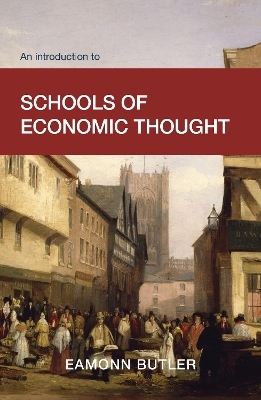
An Introduction to Schools of Economic Thought
Institute of Economic Affairs (Verlag)
978-0-255-36848-3 (ISBN)
Should economists be concerned with questions of morality? Can economic ideas be applied to social phenomena like divorce rates and crime? What even is economics? Ask an economist these questions and his answer will differ greatly depending on the school of economic thought to which he belongs. Yet too many textbooks ignore the fascinating debates and history that have shaped the modern discipline. In this book, award-winning author Eamonn Butler provides a clear, jargon-free guide to the schools of thought that have had the greatest impact on the world today, for both better and worse. It shows how and why thinkers have come up with different explanations of how economic life operates and how we might improve its workings to boost human prosperity and welfare. This is a story that stretches over two and a half millennia, from Aristotle coining the term ‘economics’ in ancient Greece, to the classical economics of Adam Smith, to Marxism and Keynesianism, to more modern ideas such as Behavioural Economics and Public Choice Theory. Butler’s concise and well-researched work provides an essential introduction to the ideas, debates and people that have shaped and continue to shape economics.
Eamonn Butler is Director of the Adam Smith Institute, one of the world’s leading policy think tanks. He holds degrees in economics and psychology, a PhD in philosophy and an honorary DLitt. In the 1970s he worked in Washington, DC, for the US House of Representatives, and taught philosophy at Hillsdale College, Michigan, before returning to the UK to co-found the Adam Smith Institute. He has won the Freedom Medal of Freedoms Foundation at Valley Forge, the UK National Free Enterprise Award and the Hayek Institute Lifetime Achievement Award; his film Secrets of the Magna Carta won an award at the Anthem Film Festival; and his book Foundations of a Free Society won the Fisher Prize. Eamonn’s other books include introductions to the pioneering economists Adam Smith, Milton Friedman, F. A. Hayek and Ludwig von Mises, and primers on a wide range of topics, including capitalism, classical liberalism, democracy, economic inequality, public choice, taxation, trade, the Austrian School of Economics and great liberal thinkers. He has also published The Condensed Wealth of Nations and The Best Book on the Market, and is coauthor of Forty Centuries of Wage and Price Controls and a series of books on IQ. He is a frequent contributor to print, broadcast and online media.
1 Introduction
The role of this book
What is a school of thought?
Why study the schools of economics?
What this book covers
2 Preclassical economics
The first economists
Commerce versus authority
The mercantilist era
3 The Classical School
Overview
Adam Smith
Thomas Malthus
David Ricardo
James and John Stuart Mill
The French Laissez-Faire economists
Relevance today
4 Karl Marx
The critique of capitalism
Criticism and legacy
5 Marginalism and the Neoclassical synthesis
The Marginal Revolution
The Neoclassical School
Key figures of the Neoclassical School
Criticism and contemporary extension
6 Keynes and the Keynesians
Keynes’s contribution
Background to Keynes’s ideas
Keynes’s analysis and prescriptions
Neo-Keynesians
7 The Chicago School
Principles
Origins
Monetarism
Rational Expectations Theory
Human Capital Theory
Supply-Side Economics
Criticisms
Conclusion
8 The Austrian School
Origin and principles
Subjectivism versus Keynesianism
Time, uncertainty and ignorance
Doubts on interventionism
Criticisms and responses
The fruitfulness of Austrian insights
9 The Public Choice School
Origins
The peculiarity of the political ‘market’
Self-interest in the political system
Decisions and constitutions
The impact of the Public Choice School
10 Behavioural Economics
Biases in human decision-making
Implications of thought biases
General criticism and legacy
11 The future and the past
Future schools of thought?
Conclusion: strength through diversity
References
Further reading
| Erscheinungsdatum | 19.07.2025 |
|---|---|
| Verlagsort | London |
| Sprache | englisch |
| Maße | 129 x 198 mm |
| Themenwelt | Geschichte ► Teilgebiete der Geschichte ► Wirtschaftsgeschichte |
| Wirtschaft ► Allgemeines / Lexika | |
| Wirtschaft ► Volkswirtschaftslehre | |
| ISBN-10 | 0-255-36848-8 / 0255368488 |
| ISBN-13 | 978-0-255-36848-3 / 9780255368483 |
| Zustand | Neuware |
| Informationen gemäß Produktsicherheitsverordnung (GPSR) | |
| Haben Sie eine Frage zum Produkt? |
aus dem Bereich