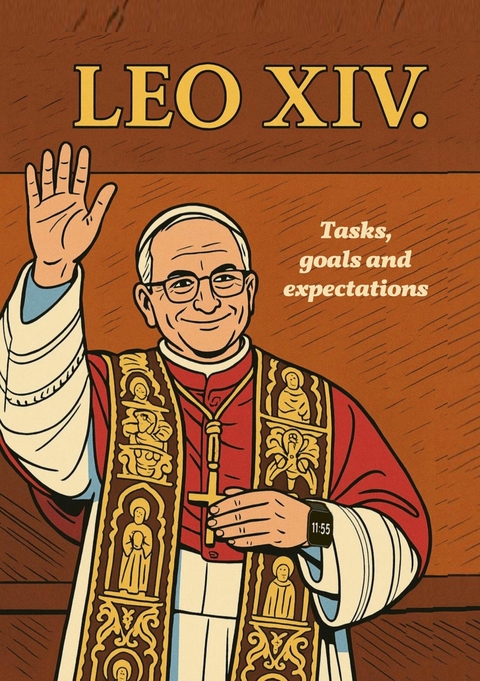
Pope LEO XIV. (eBook)
238 Seiten
BoD - Books on Demand (Verlag)
978-3-8192-8992-7 (ISBN)
Chapter 1:
Introduction and biographical basics - LEO XIV.
Robert Francis Prevost, the current Pope Leo XIV, can look back on an unusually varied life. Born in Chicago in 1955 to a deeply Catholic family, he developed a close bond with his faith at an early age. He attended a Catholic seminary as a teenager and felt his calling to religious life. At the age of 22, Prevost joined the Augustinian order (Order of St. Augustine). There he not only found a spiritual home, but also the basis for his missionary vocation. The Augustinians, influenced by the spirit of their religious father Augustine, place great value on community and service to others - values that Prevost also internalized from the very beginning. After completing his novitiate and studying theology, he took his solemn vows in 1981 and was ordained a priest in Rome a year later. His interest in a sound education became apparent early on: At the Pontifical University of St. Thomas Aquinas in Rome (the Angelicum), Prevost received his doctorate in canon law in 1987. His dissertation was entitled "The Role of the Local Prior in the Order of St. Augustine" - a topic that indicates how much he was interested in questions of community leadership and the organization of religious life. This academic examination of the everyday life of the order was later to be of great benefit in his leadership roles.
Missionary work in Peru and social commitment
After his studies, Robert Prevost was drawn to the wider world church: he followed his call as a missionary and went to Peru in the mid-1980s. In the territorial prelature of Chulucanas, a poor rural region in northern Peru, he worked actively in pastoral care as a young religious priest from 1985 to 1987. This time made a deep impression on him. Prevost lived in simple circumstances with the local people and shared their worries and hopes. He was particularly committed to disadvantaged communities: He campaigned for social justice and stood by people in emergency situations. Companions from Peru describe the current Pope as "hands-on and energetic", a man who did not hesitate to lend a hand when help was needed. During the severe flooding in 2017, for example, he organized relief efforts and personally helped to ensure that the victims were provided for. When many people lacked oxygen during the COVID-19 pandemic, Bishop Prevost initiated solidarity campaigns and financed the construction of an oxygen plant to save lives. Migrants and other marginalized groups also found a committed advocate in him. These practical deeds show Prevost's heartfelt concern: a church that is there for the poor and responds to people's concrete needs.
His years in Peru - first as a simple missionary, later in a leading position - also shaped Robert Prevost culturally and spiritually. He never saw himself there as a foreign American, but as a "brother in faith" who adopted the language and culture of the people. This humble closeness to the Latin American population created a mutual trust. Prevost learned to speak Spanish fluently and felt so connected to Peru that he even took on Peruvian citizenship in 2015. His time in Peru shaped him spiritually, theologically and culturally, emphasizes a Peruvian priest who experienced him there. This background explains why Pope Leo XIV is regarded today as a bridge builder between different cultures and mentalities.
Academic career and advancement in the Order
Parallel to his practical pastoral work, Prevost always pursued an academic and organizational career within the church. After completing his doctoral thesis on the role of the local religious superior, he put what he had learned directly into practice: In the late 1980s and 1990s, he took on tasks in the training of future priests and religious in Peru. He ran a training center for young Augustinian priests from various parts of the country and taught subjects such as canon law, patristics and moral theology at the seminary in Trujillo. The good education of the clergy was a particular concern of his - in his own words, "the training of clergy [...] and the commitment to social justice were close to his heart". Prevost showed leadership qualities early on: As early as 1988, he became Prior (Superior Superior) of his order in Peru and later Provincial Superior, i.e. head of the Augustinians throughout Peru. In these roles, he promoted a synodal, inclusive church leadership in which priests, religious and lay people deliberate and make decisions together. This cooperative leadership model was to become a hallmark of his leadership style.
His successful work in Peru did not go unnoticed in the Order. In 1998, Robert Prevost returned to his home province of Chicago and took over the office of Provincial Prior there. But just a few years later, the Augustinians called him to lead them worldwide: from 2001 to 2013, Prevost served as Prior General of the Augustinian Order. In Rome, he led one of the most traditional Catholic orders with members on all continents. During this time, he traveled to many countries, visited Augustinian monasteries in Europe, Africa, Asia and America and got to know the global diversity of the church. Fluent in several languages (including English, Spanish, Italian and Portuguese), Prevost used his language skills and cultural openness to build bridges between different communities. His leadership style as Prior General was described as balanced and dialog-oriented - qualities that were as much in demand in the multicultural order as they are today in the universal church.
Career milestones (selection):
He has the following key milestones on his CV:
- 1977: Joins the Augustinian order - the beginning of his lifelong missionary commitment.
- 1985-1998: Missionary work in Peru - pastor, trainer and professor in disadvantaged regions.
- 1987: Doctorate with the dissertation "The role of the local prior in the Augustinian Order" - a sign of his interest in church structure and leadership issues.
- 2001-2013: Prior General of the Augustinian Order - worldwide leadership, reforms and renewal of the Order.
- 2014-2023: Bishop of Chiclayo (Peru) - Commitment to social programs and the expansion of the local church.
- 2023: Prefect of the Dicastery for Bishops - was responsible for the appointment of bishops and promoted the synodal orientation of the Church.
- September 2023: Cardinal - Appreciation of his key role in church leadership.
- May 2025: Election as Pope Leo XIV - continuation of his focus on mission, justice and renewal.
These life stages alone show that Leo XIV understood his entire work under the guiding principles of mission, justice and renewal. His decades of activity in Latin America made him a staunch advocate of social causes. At the same time, he was shaped by the Augustinian tradition with its focus on community, education and spiritual life.
From bishop to pope: serving the universal church
After more than a decade at the head of his order, a new call followed: in 2014, Pope Francis appointed Robert Prevost Apostolic Administrator - and shortly afterwards Bishop - of the diocese of Chiclayo in northern Peru. Prevost thus returned to the country that had become his second home, but now as the head pastor of a diocese with around three million Catholics. In Chiclayo, he took over a diocese that had previously been dominated by very conservative forces and led it with a gentle hand in a more open, dialog-oriented direction. What was particularly remarkable was how he brought together the various church groups - from grassroots communities to conservative movements. "He built bridges between the different church movements," reports one observer about Prevost's work as bishop. The faithful experienced him as a pastor close to the people, who often went into the barrios (city districts) personally to talk to the people and get to know the reality of their lives. Social justice remained a core concern of his episcopal ministry: Prevost stood up for the poor, indigenous people and migrants and strengthened Caritas work in his diocese. He also took on responsibility within the Peruvian Conference of Bishops - at times as its deputy chairman - where he raised his voice in particular for the needs of the most vulnerable.
His integrative nature and experience led to Prevost attracting increasing attention in the Vatican. In January 2023, Pope Francis finally brought him to Rome and entrusted him with the leadership of one of the most important Curia authorities: Prevost became Prefect of the Dicastery for Bishops, responsible for appointing bishops worldwide. In this office, he once again demonstrated his diplomatic skills. For example, he mediated between Vatican authorities and the German bishops in the conflict over the "synodal path" in Germany and tried to defuse tensions through dialog. The international press praised him as a pragmatic diplomat who had clear principles but was also able to listen. In September 2023, Robert Prevost was elevated to cardinal by Francis. This officially made him one of the Pope's closest advisors - and one of the papal electors in the next conclave.
This next conclave was not long in coming: Following the death of Pope Francis in early 2025, the cardinals gathered in the Sistine Chapel to elect a new head of the church. Robert Prevost was considered by many to be a middle-of-the-road candidate. Thanks to his international experience, his religious spirituality and his ability to appeal to different camps within the church, he was seen as a bridge...
| Erscheint lt. Verlag | 30.6.2025 |
|---|---|
| Sprache | englisch |
| Themenwelt | Geisteswissenschaften ► Religion / Theologie |
| Schlagworte | Biography • Catholic Church • Leo XIV. • The new Pope • Vatican |
| ISBN-10 | 3-8192-8992-5 / 3819289925 |
| ISBN-13 | 978-3-8192-8992-7 / 9783819289927 |
| Informationen gemäß Produktsicherheitsverordnung (GPSR) | |
| Haben Sie eine Frage zum Produkt? |
 EPUB (Ohne DRM)
Digital Rights Management: ohne DRM
Dieses eBook enthält kein DRM oder Kopierschutz. Eine Weitergabe an Dritte ist jedoch rechtlich nicht zulässig, weil Sie beim Kauf nur die Rechte an der persönlichen Nutzung erwerben.
Dateiformat: EPUB (Electronic Publication)
EPUB ist ein offener Standard für eBooks und eignet sich besonders zur Darstellung von Belletristik und Sachbüchern. Der Fließtext wird dynamisch an die Display- und Schriftgröße angepasst. Auch für mobile Lesegeräte ist EPUB daher gut geeignet.
Systemvoraussetzungen:
PC/Mac: Mit einem PC oder Mac können Sie dieses eBook lesen. Sie benötigen dafür die kostenlose Software Adobe Digital Editions.
eReader: Dieses eBook kann mit (fast) allen eBook-Readern gelesen werden. Mit dem amazon-Kindle ist es aber nicht kompatibel.
Smartphone/Tablet: Egal ob Apple oder Android, dieses eBook können Sie lesen. Sie benötigen dafür eine kostenlose App.
Geräteliste und zusätzliche Hinweise
Buying eBooks from abroad
For tax law reasons we can sell eBooks just within Germany and Switzerland. Regrettably we cannot fulfill eBook-orders from other countries.
aus dem Bereich