


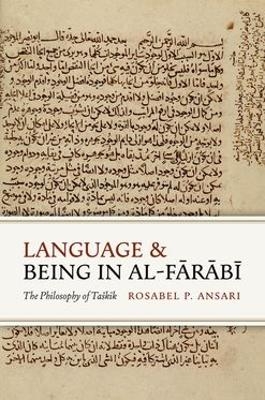
Language and Being in al-Fārābī
The Philosophy of Taškīk
Seiten
2026
Oxford University Press Inc (Verlag)
978-0-19-780806-1 (ISBN)
Oxford University Press Inc (Verlag)
978-0-19-780806-1 (ISBN)
- Lieferbar (Termin unbekannt)
- Versandkostenfrei
- Auch auf Rechnung
- Artikel merken
Language and Being in al-Fārābī is the first monograph devoted to the philosophy of language and metaphysics of Abu Nasr al-Farabi (d. 950), a medieval Aristotelian, and Islamic philosopher. Asking questions concerning the relationship between language, meaning, and being, Ansari explores the history of Greek philosophy in Arabic, and its development into the early modern Islamic context.
Language and Being in al-Fārābī is the first monograph devoted to the philosophy of language and metaphysics of Abu Nasr al-Farabi (d. 950), a medieval Aristotelian and Islamic philosopher. It looks at the Arabic theory of the amphibolous (ambiguous, having two opposing meanings) predication of 'being' and its genesis in the philosophy of Farabi. Stemming from Aristotle's pros hen homonymy, and parallel to the Latin analogy of being, amphibolous predication would enjoy a long history in Islamic philosophy until the contemporary period. This book is the first study of its Farabian origins. Through studying this theory, this book examines how Farabi constructs the relationship between language and being. What is the relationship between the term 'being', its signification, and the reality of what is, according to Farabi? What is it for something to be what-it-is? And how does human language signify being? The book explores how Farabi conceives of an ideal ontological foundation to language, albeit one that is mediated by our intellection of what is. As such, our knowledge of what is and our ability to speak about being must begin with our perception. Subsequently, the book investigates Farabi's essentialist metaphysics, the theory of emanation, and the refutation of Parmenidean monism. The book contends that these Farabian beginnings to amphibolous predication are central to understanding the subsequent developments of the theory in the following centuries.
Language and Being in al-Fārābī is the first monograph devoted to the philosophy of language and metaphysics of Abu Nasr al-Farabi (d. 950), a medieval Aristotelian and Islamic philosopher. It looks at the Arabic theory of the amphibolous (ambiguous, having two opposing meanings) predication of 'being' and its genesis in the philosophy of Farabi. Stemming from Aristotle's pros hen homonymy, and parallel to the Latin analogy of being, amphibolous predication would enjoy a long history in Islamic philosophy until the contemporary period. This book is the first study of its Farabian origins. Through studying this theory, this book examines how Farabi constructs the relationship between language and being. What is the relationship between the term 'being', its signification, and the reality of what is, according to Farabi? What is it for something to be what-it-is? And how does human language signify being? The book explores how Farabi conceives of an ideal ontological foundation to language, albeit one that is mediated by our intellection of what is. As such, our knowledge of what is and our ability to speak about being must begin with our perception. Subsequently, the book investigates Farabi's essentialist metaphysics, the theory of emanation, and the refutation of Parmenidean monism. The book contends that these Farabian beginnings to amphibolous predication are central to understanding the subsequent developments of the theory in the following centuries.
Rosabel P. Ansari is an Assistant Professor of Philosophy at Stony Brook University, the State University of New York. Her research focusses on the history of Islamic philosophy, from the Graeco-Arabic translations to the post-classical period, as well as its contemporary application. She received her PhD from Georgetown University in 2020.
To follow.
| Erscheinungsdatum | 22.10.2025 |
|---|---|
| Verlagsort | New York |
| Sprache | englisch |
| Maße | 167 x 242 mm |
| Gewicht | 499 g |
| Themenwelt | Geisteswissenschaften ► Philosophie ► Metaphysik / Ontologie |
| Geisteswissenschaften ► Philosophie ► Philosophie Altertum / Antike | |
| Geisteswissenschaften ► Religion / Theologie ► Islam | |
| ISBN-10 | 0-19-780806-9 / 0197808069 |
| ISBN-13 | 978-0-19-780806-1 / 9780197808061 |
| Zustand | Neuware |
| Informationen gemäß Produktsicherheitsverordnung (GPSR) | |
| Haben Sie eine Frage zum Produkt? |
Mehr entdecken
aus dem Bereich


aus dem Bereich
eine philosophische Reise
Buch | Softcover (2024)
Goldmann (Verlag)
CHF 21,90


