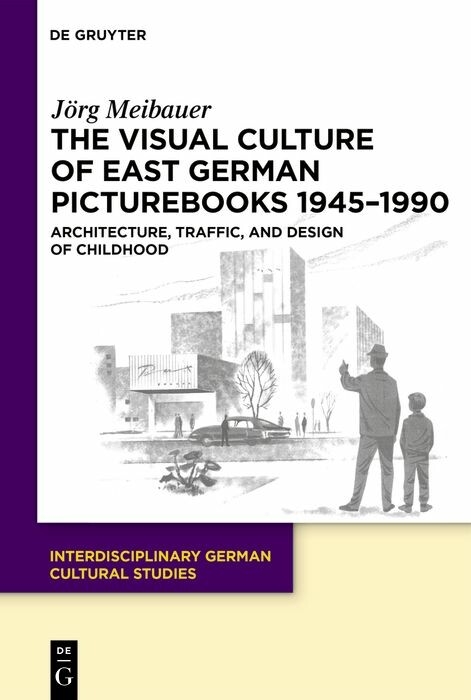
The Visual Culture of East German Picturebooks 1945–1990 (eBook)
263 Seiten
De Gruyter (Verlag)
978-3-11-163712-9 (ISBN)
This is the first study to explore picturebooks of the Soviet Occupation Zone and the German Democratic Republic, analyzing them in the context of contemporary history, social and cultural developments and through a precise analysis of selected images and their context. By focusing on areas such as architecture and housing, consumer culture, traffic and transportation, including the iconic role of the Trabant, and the design of childhood, as seen in pioneer uniforms and institutions, the study identifies the unique blend of information about reality and socialist ideology typical of children's visual culture during this period. This specific combination was aimed at shaping children to become socialist personalities. The study thus demonstrates that pictorial representation and its textual integration are crucial for understanding childhood in the immediate post-war period and the German Democratic Republic.
Chapter 1 Introduction
Even when there were still two German states, people in the Federal Republic of Germany (FRG) showed little interest in the children’s literature of the German Democratic Republic (GDR). Such literature was considered ideologically contaminated, and this attitude did not change much after the collapse of the GDR in 1989. Today, there is still no public interest in the children’s literature of East Germany, which has now become historical, and the new citizens of the Federal Republic look back on their former children’s literature with nostalgia at best. This is a pity, because a close look at the children’s literature of the Soviet occupation zone and the German Democratic Republic is highly interesting and one can learn a great deal from it.
In the following, I would like to embed the analysis of picturebooks of the GDR in the developing field of Visual Culture Studies. What is meant by “visual culture”? According to Aga Skrodzka (2020, 12), visual cultures concern
disparate and broadly understood visual texts, including buildings, monuments, murals, interior design, sculpture, painting, craft manuals, fashion, film, photography, computer games, television, cartoons, prison mug shots, theoretical diagrams, art magazines, recycling campaigns, wall newspapers, and children’s books.
Admittedly, this is a very broad and sketchy characterization. Nevertheless, while it is not clear that there is a well-defined, autonomous field of Visual Culture Studies (Adorf and Brandes 2014; Volkenandt 2011), it is beyond any reasonable doubt that children’s books, including picturebooks, are a proper part of visual culture.1
In picturebook research, the special nature of the picture–text relationship has been worked out in numerous studies (Kümmerling-Meibauer 2018; Nikolajeva and Scott 2001), but pictures also play a major role in other literature for children and young adults, be it in illustrations that accompany the text or on book covers that are intended to give an important first impression of the book’s contents. Broadly understood, picturebooks and illustrated children’s books can be conceived as pictorial literature.
While it is problematic to speak of a picture as a visual text, as Aga Skrodzka does in the above quotation, it goes without saying that most picturebooks display picture–text combinations. An exception are wordless picturebooks. The accompanying text may guide the interpretation of the visuals. It is this inherent relatedness to texts that makes picturebooks an important touchstone for a general theory of visual culture. Note that even in the case of wordless picturebooks, it is necessary for the reader to construct a mental text, that is, the picturebook story.
When picturebooks are seen as part of Visual Culture Studies, this allows for an important explanatory move. Picturebooks are not only an autonomous book genre (as part of children’s literature) but can be seen as a proper part of the complex visual input that children receive, together with other inputs such as children’s films, posters, graphic design targeted at children, etc. Pictures contained in picturebooks can thus be interpreted in a wide cultural context.
With respect to picturebooks of the Soviet occupation zone and the German Democratic Republic, I refrain from using the term “communist visual culture” that has been used and argued for by Skodrzka (2021). If the visual production of the former Eastern Bloc or the Russian avant-garde of the interwar period is the subject of focus, then the adjective “communist” seems to make sense. However, in general, the term “communism” was avoided in the GDR because citizens of the GDR associated this term with the Stalinist regime of the USSR and the widely felt suppression under the Soviet occupation force. Note that even in the very name of the East German state, the adjective “democratic” was used instead of “socialist”. Therefore, I prefer to analyze the GDR as a socialist state, a state that wanted to form “socialist personalities”, if not the “New Man”. By and large, children’s literature in the GDR was subordinated to that aim.
The authoritative handbook of Rüdiger Steinlein et al. (2006) provides an excellent basis for analyzing children’s literature from the Soviet occupation zone and the GDR. However, the main focus of this handbook is on children’s novels, though it does include one chapter on “Bilderbücher und Kinderbuchillustrationen” (picturebooks and children’s book illustrations) by Andreas Bode (2006). In this handbook, descriptive (informational) picturebooks are occasionally mentioned but not analyzed in a thorough manner.2 The collection edited by Sebastian Schmideler (2017a) focusing on “knowledge transfer” via GDR’s children’s literature represents a step forward. However, this collection does not deal exclusively with picturebooks. Zintler (2021) analyzes a number of mostly narrative picturebooks of the GDR with regard to the political socialization of kindergarten children, including children’s songs. Therefore, a comprehensive analysis of GDR picturebooks is still a desideratum. Here, I will contribute to this field by studying picturebooks that have to do with architecture, building and housing, the city and traffic, and the fashion and institutions of Young Pioneers that I will call, following Alexandra Lange (2018), the “design of childhood”. These are topics that can be used to demonstrate particularly well the specific achievements of descriptive picturebooks (and those narrative picturebooks with relevant content), which were produced and received in the GDR. At the same time, these are topics that are particularly promising for a theory of the descriptive picturebook to be developed.
Architecture, building, and housing: Regarding these topics, I consider the visual culture of ruins, as destroyed architecture, and the postwar attempts at reconstruction. Images of construction sites, but also of production sites, were widespread and showed the efforts of building up the socialist nation. The East Berlin Stalinallee (today Karl-Marx-Allee) was constructed as a national symbol for the power of socialism. Also, the center of East Berlin got a new face when the Alexanderplatz, the TV Tower, and the Palace of the Republic were built. Images of these achievements were produced in order to make children proud of their socialist homeland (Heimat) (cf. Zintler 2021). Urban development extended also to the construction of huge settlements built with prefabricated elements (Plattenbau) that aimed to alleviate the housing shortage. Berlin (East Berlin) was certainly a place that focused many of the socialist dreams, including utopian ones. It was Moscow, however, that was presented as the shining reference point of communist culture.
The city and traffic: Images of traffic are widespread in picturebooks but have been widely ignored in children’s literature research. Though many books are of a conceptual nature – for instance, showing different types of vehicles in their surroundings – they also tell us something about the visual culture of traffic, as presented to children that are involved in ordinary, urban traffic. Pictures of traffic are also given in traffic-education books in which also the visual culture of traffic matters. The city and traffic are furthermore connected to consumption, which was so important for the socialist society. Konsum (a cooperatively run retail chain) and HO (an acronym for Handelsorganisation, that is “Trade Organization”) were important institutions in everyday life, and we find pictures of Konsum and HO in many GDR picturebooks.
Design of childhood: The material environment of children, just like that of adults, is shaped by design. This is best illustrated by children’s clothing, children’s furniture, and children’s toys. All these objects are typically collected by museums of childhood. This book focuses on two types of design for children that have seen representation in picturebooks: One is children’s clothing in the context of Young Pioneers, and the other is the representation of environments designed specifically for children, for example, kindergartens, playgrounds, and Pioneer parks. The term “design of childhood”, as developed by Alexandra Lange (2018), therefore refers to a large area of design that is available as input in childhood, but here it only picks out the areas that are examined in Chapters 9 and 10.
Examining socialist visual culture as presented to children, it is very important to reflect on the ordinariness of the pictorial contents and their accompanying texts. Alice Waller (2020) convincingly pleads for taking the representation of ordinariness in young-adult novels into account. By the same token, one can explore the ordinariness of the Konsum (a shop run by the eponymous retail chain), the playground, or the prefabricated residential building also known as Plattenbau. The three selected categories of architecture, traffic, and design of childhood are also very well suited to providing information about the everyday life of children in the socialist state as represented in the picturebook (Moran 2005).
Descriptive picturebooks that are the focus here, can contain drawings, photographs, or combinations...
| Erscheint lt. Verlag | 2.6.2025 |
|---|---|
| Reihe/Serie | Interdisciplinary German Cultural Studies |
| Zusatzinfo | 3 b/w and 77 col. ill., 1 b/w tbl. |
| Sprache | englisch |
| Themenwelt | Geisteswissenschaften ► Geschichte ► Regional- / Ländergeschichte |
| Geisteswissenschaften ► Sprach- / Literaturwissenschaft ► Literaturwissenschaft | |
| Schlagworte | 1945-1990 • Bilderbuch • East Germany • Ostdeutschland • Picturebook • Visual Culture • Visuelle Kultur |
| ISBN-10 | 3-11-163712-3 / 3111637123 |
| ISBN-13 | 978-3-11-163712-9 / 9783111637129 |
| Informationen gemäß Produktsicherheitsverordnung (GPSR) | |
| Haben Sie eine Frage zum Produkt? |
 EPUB (Wasserzeichen)
Größe: 12,6 MB
DRM: Digitales Wasserzeichen
Dieses eBook enthält ein digitales Wasserzeichen und ist damit für Sie personalisiert. Bei einer missbräuchlichen Weitergabe des eBooks an Dritte ist eine Rückverfolgung an die Quelle möglich.
Dateiformat: EPUB (Electronic Publication)
EPUB ist ein offener Standard für eBooks und eignet sich besonders zur Darstellung von Belletristik und Sachbüchern. Der Fließtext wird dynamisch an die Display- und Schriftgröße angepasst. Auch für mobile Lesegeräte ist EPUB daher gut geeignet.
Systemvoraussetzungen:
PC/Mac: Mit einem PC oder Mac können Sie dieses eBook lesen. Sie benötigen dafür die kostenlose Software Adobe Digital Editions.
eReader: Dieses eBook kann mit (fast) allen eBook-Readern gelesen werden. Mit dem amazon-Kindle ist es aber nicht kompatibel.
Smartphone/Tablet: Egal ob Apple oder Android, dieses eBook können Sie lesen. Sie benötigen dafür eine kostenlose App.
Geräteliste und zusätzliche Hinweise
Buying eBooks from abroad
For tax law reasons we can sell eBooks just within Germany and Switzerland. Regrettably we cannot fulfill eBook-orders from other countries.
aus dem Bereich