


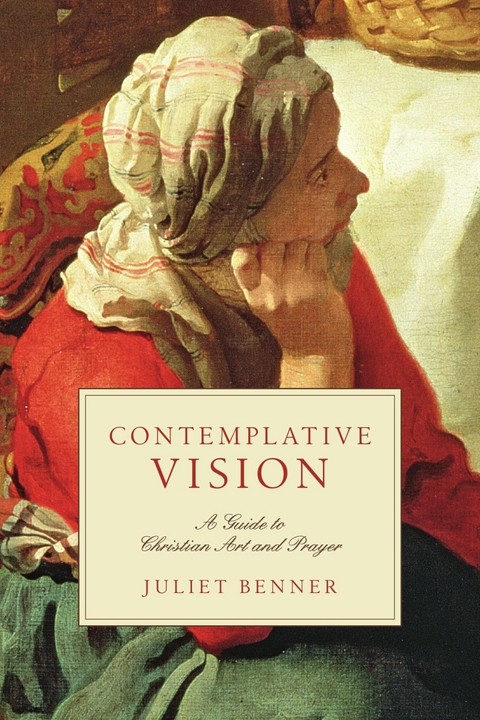
Contemplative Vision (eBook)
183 Seiten
IVP Formatio (Verlag)
978-1-5140-1511-7 (ISBN)
Juliet Benner is an international retreat and workshop leader who speaks frequently in Australia, New Zealand and Hong Kong. She is a trained spiritual director and has served as a consultant in art and spirituality at the Carey Centre on the campus of the University of British Columbia (Vancouver). She lives in Victoria, British Columbia, Canada, with her husband, David, who shares her passion for hiking, nature, art and music.
While working as a docent in an art gallery, Juliet Benner began showing people how to meditate on Christian art treasures that are rooted in a passage of Scripture. She taught a way of encountering the Word behind both the words of Scripture and the artist's meditation on Scripture. This became a way of seeing art as an aid to contemplative prayer. This process resulted in her much-beloved "e;O Taste and See"e; columns that appeared in the spiritual formation journal Conversations, now expanded into this book. In each chapter you'll encounter a passage of Scripture and a corresponding piece of art. You'll be guided into deeper levels of meaning and reflection through the text and the questions at the end of each chapter. In the process you'll find yourself entering into a new experience of prayer and meditation in God's presence.
1
Awakening
BRUEGEL THE ELDER
Census at Bethlehem
For many of us, the invitation to contemplative stillness before God is both appealing and slightly threatening. It suggests a way of being that might seem desirable but probably feels alien. If we are honest, we have to admit that there is very little stillness in our spirits. We go through week after week, month after month, preoccupied with the business of daily life—our jobs (sometimes finding one and at other times keeping on top of the one we have), maintaining a home and family, perhaps struggling to keep afloat in hard economic times. We are so used to being busy that we treat it as an essential characteristic of the good life. Ask people how they are doing and they will often answer by telling you how busy they are. It has become a mark of success—as if someone who is not busy must certainly be leading an unfulfilling and unsuccessful life. If we are busy, we feel that life is meaningful.
Human beings have become human doings. Simply being feels like not enough—perhaps even personal failure. We have failed to nurture solitude and stillness of heart, both of which are at the heart of prayer. Contemplative living just does not seem realistic in our busy lives and worlds.
But our problem is deeper than busyness. Tragically, we live much of our lives on automatic pilot. We go through our days as sleep walkers—unaware of God’s presence, inattentive to God’s gifts and invitations, and failing to be present to either ourselves or God. We fail to notice that God is in the ordinary events of our ordinary days. God is present—in the world around us, in the people whom we encounter and in our work. Sadly, it is we who are absent.
How can we hope to be attentive to the presence of God when we can’t even see the ordinary things before our eyes as we move through our day? In our frenzied world we so easily miss the fragrance of a flower, the beauty of trees in new growth, or of the aroma of fresh bread wafting from a bakery as we rush by. We are barely conscious of the music of birdsong, of a gentle wind as it brushes our cheek and hair, of the gurgling of stream or fountain. We fail to attend to the taste of rain on our lips as we run for shelter or of snowflakes gently falling on our faces. The list goes on and on. All of our senses have become dulled as we live life in a state of preoccupation and distraction. Yet God is always present in our lives whether we notice or not. C. S. Lewis reminds us that “we may ignore, but we can nowhere evade the presence of God. The world is crowded with Him. He walks everywhere incognito. And the incognito is not always hard to penetrate. The real labour is to remember, to attend. In fact, to come awake. Still more, to remain awake.”
Contemplative prayer is awakening and attentiveness. It is stepping back from our preoccupations and distractions and allowing God to transform our awareness, our hearts and our lives. It is making space to be with God in stillness and solitude. It is not withdrawing from the world to go into the desert or monastery to find undisturbed serenity and peace. It is allowing the Spirit to cultivate an inner stillness of heart that persists even in the busyness and challenges of our lives, and that allows us to face those challenges with focus and passion that comes from living with attunement to God.
But, you might ask, how can we develop such a posture of heart? It starts with practicing attentiveness in the ordinary course of life. It begins with consciously making space for the present moment and for life as it is. If we are not present to the now, we can never be present to the God who was revealed to Moses as “I AM”—the eternal One who is with us in the present moment. We can remember how God has met us in the past and we can wait with hope for how we trust God will meet us in the future, but we can only actually meet God in the present moment.
OPENING OUR EYES—LOOKING
Stop for a moment and look at the second painting (see center section).*1 It is another by the same artist we encountered in the introduction—Bruegel the Elder. Take time to look at it carefully and contemplatively. What do you see?
Perhaps you noticed all the busyness—a crowded village scene filled with peasants going about their daily activities. On the left of the painting we see a throng of people gathered in front of a building, while others nearby are working at their different tasks—woodworking, slaughtering pigs, carrying wood. All around there is action and purposeful movement. People bearing heavy loads walk carefully across the icy lake. Some are constructing a building in the upper right. A woman brushes away snow with her broom. Children play on the ice, and some toss snowballs at each other. Bruegel includes new and old buildings, some large and substantial—the tall, sturdy church (look far back in the upper left corner of the painting)—and some falling into ruin (on the opposite side of the canvas). There are carts laden with kindling and kegs of water or wine. This is life at its most ordinary—people busy with everyday activities in a frozen, wintry landscape, as we watch the sun sinking slowly below the horizon.
Bruegel the Elder (1525-1569)
The exact details of Bruegel’s life are uncertain, but we do know that he spent most of it in Antwerp, Brussels, although he did live in Italy for a while and was greatly influenced by the Italian Renaissance style. While he spent most of his life in cities, he was best known for his paintings of landscapes and country life. He enjoyed dressing up as a peasant in order to mingle with the common folk in order to draw inspiration and authentic details for his paintings. This earned him the nickname of Peasant Bruegel. Many of his everyday scenes are filled with subtle commentaries on the religious controversies of his time. His faith provided many of the themes for his religious works.
The painting The Parable of the Blind (1568) hangs in the National Museum of Capodimonte in Naples, Italy.
But who are these people in the painting failing to see in their midst? Who, possibly, did you fail to see in their midst? The easily overlooked, central figures of the painting are Mary and Joseph. Do you see them? If not, look for the woman on the donkey in the lower center of the painting. Contextualized within a northern European landscape for Flemish viewers, the painting depicts Mary and Joseph approaching the inn to which they had traveled in order to be registered for the census. It took me a long time to find Mary and Joseph when I first looked at this painting, but once I recognized them, I was deeply moved by the fact that Jesus’ presence is so often hidden from us. I realized how blind I am to his invisible presence in the midst of my busy life, and felt a longing to recognize him more often.
The painting Census at Bethlehem (1566) is based on Luke 2:4-5. Read the passage slowly, entering into the experience of Mary and Joseph as they make their arduous journey to Bethlehem. Pay attention to what captures your heart and mind. Then as you look at the painting, allow yourself to be drawn into the scene. Be a part of the village activities, and notice what details come to the fore.
Joseph also went up from Galilee, from the city of Nazareth, to Judea, to the city of David which is called Bethlehem, because he was of the house and family of David, in order to register along with Mary, who was engaged to him, and was with child.
As Mary and Joseph approach the inn, the crowd ahead of them is already busily involved in this registration process. They are all absorbed in their own affairs and activities. The holy family are lost in the scene. They are right in the middle of things, but everyone is too engrossed in their preoccupations to notice them.
Bruegel has used a biblical subject to provide a realistic commentary on his own period in history. Set in his time and place, he depicts Mary and Joseph making their journey to Bethlehem to pay their taxes. It is a landscape filled with the severe reality of humanity with all its laborious toils, burdens and suffering. They are shown struggling under weighty loads, dressed in simple, rough, homespun clothing. A leper’s hut (just to the right and behind the donkey) marked with a tiny cross on its crude roof and surrounded by cross-marked graves gives raw evidence of the physical challenges they face. They line up to pay their taxes too, but instead of taxes to Caesar they are weighed down under the taxes of Philip II and pay tribute to him. These cold, shivering human beings, burdened with a harsh life and eking out a living to pay their duties to their king, must have questioned the meaning of life. Yet Christ is here in their very midst, hidden and unseen. More than a commentary on Bruegel’s times, it represents our own modern world. We share the same struggles and burdens, and Christ comes to us in the midst of them to share our humanity. Christ is present if only we would see him.
This painting is found in the Royal Museum of Fine Arts in Belgium. Without knowing the title you may not have realized that the theme was a religious one. But Bruegel gives us other clues to the spiritual significance of what we are viewing. The artist reputedly liked to include subtle hints of the spiritual in his paintings. Look, for example, at the large round wreath above...
| Erscheint lt. Verlag | 21.10.2025 |
|---|---|
| Sprache | englisch |
| Themenwelt | Religion / Theologie ► Christentum ► Moraltheologie / Sozialethik |
| Schlagworte | Artist • Artistic • Beauty • Bible study • Bruegel • Caravaggio • Devotional • experiencing god • Formation • Giordano • Gospel • growth • He Qi • Inspiration • Jean-Francois Millet • Jesus • lectio visio • Meditation • Poussin • Quiet time • Rembrandt • Reubens • Scripture • Transformation |
| ISBN-10 | 1-5140-1511-0 / 1514015110 |
| ISBN-13 | 978-1-5140-1511-7 / 9781514015117 |
| Informationen gemäß Produktsicherheitsverordnung (GPSR) | |
| Haben Sie eine Frage zum Produkt? |
 EPUB (Wasserzeichen)
DRM: Digitales Wasserzeichen
Dieses eBook enthält ein digitales Wasserzeichen und ist damit für Sie personalisiert. Bei einer missbräuchlichen Weitergabe des eBooks an Dritte ist eine Rückverfolgung an die Quelle möglich.
Dateiformat: EPUB (Electronic Publication)
EPUB ist ein offener Standard für eBooks und eignet sich besonders zur Darstellung von Belletristik und Sachbüchern. Der Fließtext wird dynamisch an die Display- und Schriftgröße angepasst. Auch für mobile Lesegeräte ist EPUB daher gut geeignet.
Systemvoraussetzungen:
PC/Mac: Mit einem PC oder Mac können Sie dieses eBook lesen. Sie benötigen dafür die kostenlose Software Adobe Digital Editions.
eReader: Dieses eBook kann mit (fast) allen eBook-Readern gelesen werden. Mit dem amazon-Kindle ist es aber nicht kompatibel.
Smartphone/Tablet: Egal ob Apple oder Android, dieses eBook können Sie lesen. Sie benötigen dafür eine kostenlose App.
Geräteliste und zusätzliche Hinweise
Buying eBooks from abroad
For tax law reasons we can sell eBooks just within Germany and Switzerland. Regrettably we cannot fulfill eBook-orders from other countries.
aus dem Bereich


