


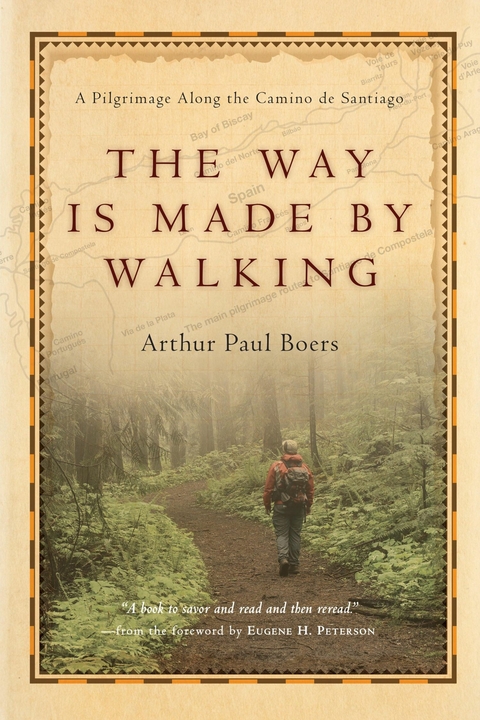
Way Is Made by Walking (eBook)
219 Seiten
InterVarsity Press, LLC (Verlag)
978-1-5140-1485-1 (ISBN)
Arthur Boers is an Anglican priest and author of award-winning books, including Shattered: A Son Picks Up the Pieces of His Father's Rage and Living into Focus: Choosing What Matters in an Age of Distractions. He holds a DMin from Northern Baptist Theological Seminary and an MFA from Seattle Pacific University.
The Word Guild Canadian Christian Writing Awards FinalistPilgrimage is a spiritual discipline not many consider. Aren't the destinations far? Don't they involve a lot of time and walking? Just a few years ago, Arthur Paul Boers wasn't thinking about pilgrimage either. But he began to sense a deep call from God to walk the five-hundred-mile pilgrimage route known as Camino de Santiago, ending in Santiago de Compostela, Spain, at a cathedral that is said to hold the relics of the apostle James. In these pages he opens to us his incredible story of renewed spirituality springing from an old, old path walked by millions before him. It's a story of learning to pray in new ways, embracing simplicity, forming community, living each day centered and focused, depending on God to provide. Joined by hundreds of others from all over the world, Boers points the way to deeper intimacy with God--a way made by walking in faith.
Introduction
For I am but a sojourner with you,
a wayfarer, as all my forebears were.
Take the Long Way
I once walked five hundred miles to attend church. It took thirty-one days, but was no month of Sundays. I usually go by foot or bike to our local congregation, but being on the road this long for a worship service—in a foreign language, no less—was an unusual stretch even for me.
To be more accurate, I was on a particular pilgrimage route in northwest Spain, the Camino de Santiago. (Camino is Spanish for “way” or “path” and Santiago simply means “Saint James.”) Its destination is the city of Santiago de Compostela. There, a cathedral houses the purported relics of James the apostle, patron saint of Spain. This was one of three main pilgrimage destinations for medieval Europeans (competing with Rome and Jerusalem). Millions walked there in the last twelve hundred years, and it has grown popular once again.
I was not only going to a church service, of course. People often say that pilgrimage is more about the journey than the destination itself. I had many reasons for this trip: meeting pilgrims, seeing a new country from ground level, reflecting on church history, practicing a classic spiritual discipline, developing my appreciation for walking, and challenging myself physically. Yet I could exclude any one of those motives and still call the trip a pilgrimage. But without finally getting to Santiago at the end of the route, visiting the Cathedral and attending the service there, the traveling—while exceedingly worthwhile—would not have had the same focus and direction. It would not have been a pilgrimage.
So, in a sense, I did walk five hundred miles just to go to church.
Pilgrimage Paradoxes
In some ways, I still have trouble believing that I was even interested in this pilgrimage, let alone actually walking it. Five years earlier I was on another trip to Europe. I traveled to communities of prayer in several different countries. I considered that venture a pilgrimage and as a result studied Christian pilgrimage traditions. I kept encountering the importance of medieval Santiago, which was new to me, and also discovered that this route was experiencing renewal. I was not at all interested in it and could not conceive why anyone would have attempted it then or now. How quickly people change!
There were, I know and confess, many ironies and paradoxes on this Camino.
It was somewhat absurd to travel in vehicles thousands of miles roundtrip just to walk five hundred miles. (My return journey involved a bus, taxi, train, minivan and no less than five jets.) For someone who professes concern about minimizing our ecological footprint, perhaps I should have traipsed closer to home. Why not just step out of the house and begin? Well, for one thing, not every walk is a pilgrimage. And more than that, alas, I cannot think of any noteworthy long-distance walkers’ routes near where I live, let alone paths and tracks worn into the earth and made hallowed by centuries of passing pilgrims.
This big, spacious country has little hospitable room for walkers and even less in the way of holy sites. Many settle instead for gas-consuming pseudo-pilgrimages to megamalls, Las Vegas, sports stadiums, Star Trek conventions, Graceland (second only to the White House in visitors!) and Disney World. Seventy million people a year go to Orlando, Florida.
There was a time when pilgrimage meant traveling far, usually by walking, from wherever one happened to live. Continental Europeans went to Santiago from the doorstep of their homes, whether in Belgium, Germany or Austria, traveling for months. Now, tens of thousands of Santiago pilgrims annually move by plane, bus, train or car to some more convenient place to begin by foot, bike or even horseback. (I did meet a few hardy folks who had walked all the way from deep in France, the Netherlands or Switzerland.)
While a five-hundred-mile pilgrimage may sound pious—and I admit to some self-righteous pride about this—it was a tremendous privilege. How many people can afford such a prolonged excursion? More than once someone asked, “What do you do for a living that makes this possible?” As a seminary professor, my school-year schedule freed me up.
But here is another wonder: How is it that people of our day, with the longest lifespans in history and a glut of “labor-saving” devices, find it astonishing to think of committing serious time to a spiritual endeavor? Cees Nooteboom marvels about medieval people who “set aside their lives to walk halfway across Europe in dangerous times.” They knew they might never return. Their lives were short, but they risked them anyway. Commenting on the Islamic commitment of going to Mecca, Nooteboom noted that Muslims now use contemporary modes of transportation—much as Santiago pilgrims currently do. For modern Muslims and Christians alike, “the longer they live the less time they have.” Surely people of our era with all our labor-saving devices could afford more time for matters of the spirit.
There were other paradoxes. When the local paper did a generous story about my journey, several folks contacted me in disbelieving perplexity at why I did such a strange thing. They found it odd that this Protestant—a Mennonite, no less!—went on pilgrimage, a seemingly Catholic practice. Reformers roundly renounced pilgrimages, especially the connection to indulgences and the adulation of patron saints.
And while I greatly admire the apostle James, I was not comfortable with how he has been used by Spanish nationalism. I appreciate notions of James the Peregrino (pilgrim), but feel deeply disturbed by James the Matamoros (Moor killer). Spain’s patron saint became the figurehead for Christians wresting control of this country back from Muslim Moors, and he later served as a mascot for the Crusades as well. In many churches along the Camino, and in the Santiago Cathedral itself, I saw images of James angrily waving a sword and riding a charging horse that crushed beneath him various hapless victims.
As it happens, James was himself a victim of state-sponsored violence (see Acts 12:1-2). In fact, he was the first apostle to be murdered, the first of Jesus’ companions and inner circle of disciples to be slain. Yet here, in Spain, he was usurped to justify violence. That would be like naming nuclear weapons after the Reverend Martin Luther King Jr., the famous Christian advocate and practitioner of peacemaking. As a Mennonite, convinced that faithfulness to Jesus clearly requires nonviolence, I loathed what I saw. My distress was deepened by a current reality: in the twenty-first century, Christians justifying bloodshed against Muslims is again disturbingly common. Jesus’ rebuke to James and his brother John, who eagerly wanted to punish inhospitable Samaritans, still speaks sharply to us: “You do not know what spirit you are of, for the Son of Man has not come to destroy the lives of human beings but to save them” (Luke 9:56).
A prominent paradox of my sojourn—and the one that surprised and taught me the most—is the fact that so few fellow pilgrims I met counted themselves as Christians. How curious that many immersed themselves in a taxing route associated with church traditions for over a millennium but did not necessarily profess Christian faith. And these folks ended up teaching me more than I realized I needed to know. (Stories and examples in this book are based on real people and events, but some names and details were altered to protect the privacy of individuals involved.)
While this Camino was an expression of my Christian faith, what I did was not especially noteworthy or sacrificial. I encountered hundreds of people along the way. Tens of thousands now walk it every year. Many—perhaps even a majority—go without an explicit religious agenda. I met extraordinary Christians on those paths, but also remarkable, gracious and hospitable people of no declared faith. Do we Christians think too highly of ourselves? Are we perhaps on the same journey as everyone else? Often people who most challenged me with their exemplary way of living, both on this path and elsewhere in my life, were folks who did not call themselves believers.
In spite of all these contradictions and conundrums, questions and unresolved uncertainties, I had a deep sense of being called by God to that pilgrimage. A longing that was hard to name drove me to undertake something that I could not have imagined even a few years ago.
Very Hard and Incredibly Good
This journey was one of my most satisfying life achievements ever. When I returned home, people asked how it was (followed by predictable inquiries: “How are your feet?” “How long did it take?”). I summed up the journey by saying: “It was very hard and incredibly good.” As I read and reread my trip’s journal, I seldom see any day that was simply easy. And sometimes more than one day felt like the hardest so far! Some stretches of the path were so intense, demanding and challenging that I needed all my concentration just to put one foot in front of the other, and I dearly hoped no one would try and strike up a conversation. But every day also had unforeseen blessings and compensations. I learned much in that month and suspect it will take me years to unpack and integrate...
| Erscheint lt. Verlag | 23.9.2025 |
|---|---|
| Vorwort | The Hoiland Group LLC |
| Sprache | englisch |
| Themenwelt | Religion / Theologie ► Christentum ► Moraltheologie / Sozialethik |
| ISBN-10 | 1-5140-1485-8 / 1514014858 |
| ISBN-13 | 978-1-5140-1485-1 / 9781514014851 |
| Informationen gemäß Produktsicherheitsverordnung (GPSR) | |
| Haben Sie eine Frage zum Produkt? |
 EPUB (Adobe DRM)
Kopierschutz: Adobe-DRM
Adobe-DRM ist ein Kopierschutz, der das eBook vor Mißbrauch schützen soll. Dabei wird das eBook bereits beim Download auf Ihre persönliche Adobe-ID autorisiert. Lesen können Sie das eBook dann nur auf den Geräten, welche ebenfalls auf Ihre Adobe-ID registriert sind.
Details zum Adobe-DRM
Dateiformat: EPUB (Electronic Publication)
EPUB ist ein offener Standard für eBooks und eignet sich besonders zur Darstellung von Belletristik und Sachbüchern. Der Fließtext wird dynamisch an die Display- und Schriftgröße angepasst. Auch für mobile Lesegeräte ist EPUB daher gut geeignet.
Systemvoraussetzungen:
PC/Mac: Mit einem PC oder Mac können Sie dieses eBook lesen. Sie benötigen eine
eReader: Dieses eBook kann mit (fast) allen eBook-Readern gelesen werden. Mit dem amazon-Kindle ist es aber nicht kompatibel.
Smartphone/Tablet: Egal ob Apple oder Android, dieses eBook können Sie lesen. Sie benötigen eine
Geräteliste und zusätzliche Hinweise
Buying eBooks from abroad
For tax law reasons we can sell eBooks just within Germany and Switzerland. Regrettably we cannot fulfill eBook-orders from other countries.
aus dem Bereich


