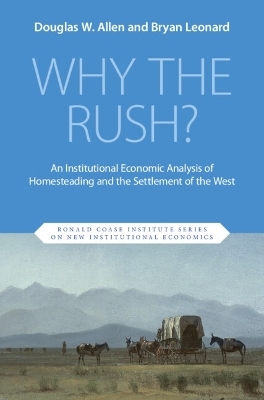
Why the Rush?
Cambridge University Press (Verlag)
978-1-009-68458-3 (ISBN)
- Noch nicht erschienen (ca. Januar 2026)
- Versandkostenfrei
- Auch auf Rechnung
- Artikel merken
Establishing economic property rights is a ubiquitous human activity that is key to the creation of wealth. Why the Rush? combines economic and historical analysis to argue that the institution of homesteading, as established in the US through the Homestead Act of 1862, was a method to establish meaningful, economic property rights on the American frontier. It explains how homesteading rushed millions of people into specific areas, established a meaningful sovereignty without the use of military force and became the means by which the US Thwarted military and legal challenges. Using fine-grained data, along with a detailed theoretical analysis and exhaustive institutional content, this book makes a serious contribution to the study of economic property rights and institutions providing the definitive analysis of the economics of homesteading and its role in American economic history.
Douglas W. Allen is a Burnaby Mountain Professor in the Department of Economics at Simon Fraser University. He has over 100 academic publications and three books: The Nature of the Farm (with Dean Lueck, 2002); The Institutional Revolution (2012, Douglass North Book Prize); and Economic Analysis of Property Rights (with Yoram Barzel, 2023). He has won SFU's Silver Medal for Academic Excellence and three university teaching awards. Bryan Leonard is a SER Associate Professor at the Haub School of Environment & Natural Resources School of Energy Resources, University of Wyoming. His research explores the implications of institutions on resource allocation problems, focusing on land, water, and energy resources. Within their historical context he addresses: i) efficiency equity tradeoffs; ii) property rights and collective action problems; and iii) historical sources of modern challenges. His research has appeared in journals such as The Economic Journal, The Journal of Political Economy: Microeconomics, Science, and The American Political Science Review.
1. Introduction; Part I. Homesteading Fundamentals: 2. Homesteading basics; 3. The theory of homestead land grants; Part II. Three Periods of Homesteading: 4. Homesteading, the civil war, and the south: 1862–1871; 5. Railroads and early homesteading: 1862–1890; 6. Late homesteading and tribal land dispossession: 1890–1934; Part III. Homesteading Special Cases: 7. The Oklahoma land rushes; 8. Homesteading in Canada; Part IV. Homesteading and the Long Run: 9. Homesteading and modern land development; 10. Cultural and political dimensions of homesteading; 11. Conclusion.
| Erscheint lt. Verlag | 31.1.2026 |
|---|---|
| Reihe/Serie | Ronald Coase Institute Series on New Institutional Economics |
| Zusatzinfo | Worked examples or Exercises; 15 Maps; 20 Line drawings, black and white |
| Verlagsort | Cambridge |
| Sprache | englisch |
| Themenwelt | Geschichte ► Teilgebiete der Geschichte ► Wirtschaftsgeschichte |
| Wirtschaft ► Volkswirtschaftslehre ► Wirtschaftspolitik | |
| ISBN-10 | 1-009-68458-2 / 1009684582 |
| ISBN-13 | 978-1-009-68458-3 / 9781009684583 |
| Zustand | Neuware |
| Informationen gemäß Produktsicherheitsverordnung (GPSR) | |
| Haben Sie eine Frage zum Produkt? |
aus dem Bereich