


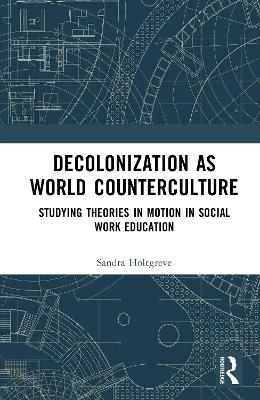
Decolonization as World Counterculture
Studying Theories in Motion in Social Work Education
Seiten
2025
Routledge (Verlag)
978-1-032-93382-5 (ISBN)
Routledge (Verlag)
978-1-032-93382-5 (ISBN)
Contemplative and rigorous, this book advances a fresh sociological perspective on knowledge consolidation from its comparative investigation of Social Work education across three continents, arguing the ways in which theories of decolonization spread and are interpreted in these contexts are illustrative of a world countercultural process.
Decolonization as World Counterculture captures the underlying conditions of the rise of post- and decolonial theories by asking how we arrived at this moment when decolonial arguments seem to be everywhere and yet not enough.
While efforts to decolonize knowledge and disciplines continue to expand, this book takes a different, theory-reflecting approach. It examines instead how decolonization itself has become a global although unequally addressed phenomenon. Bringing together world culture research with postcolonial studies in the field of social work, the book analyzes social work curricula from Germany, Mexico, and Ecuador to explore how (de)coloniality is embedded in diverging horizons of meanings but shaped by strikingly similar institutions in the educational setting. To this end, the book offers a knowledge sociological view on how decolonization itself is globalized. It mobilizes the neo-institutional approach of world culture to describe the decolonial imperative as “world counterculture,” an integrative frame of otherwise different and diverging social justice agendas. In this way, taking the theoretical premises of decolonization seriously, the book examines the promises and limitations of connecting decolonization with Western theories of globalization.
Assembling these distinct pieces of a puzzle spanning different fields, this book is a testimony to the most successful and thriving theoretical views of the last decades in the human and social sciences. It is sure to challenge, fascinate, and inspire readers across the specialist fields of postcolonial studies, the sociology of knowledge, global social theory, and international social work.
Decolonization as World Counterculture captures the underlying conditions of the rise of post- and decolonial theories by asking how we arrived at this moment when decolonial arguments seem to be everywhere and yet not enough.
While efforts to decolonize knowledge and disciplines continue to expand, this book takes a different, theory-reflecting approach. It examines instead how decolonization itself has become a global although unequally addressed phenomenon. Bringing together world culture research with postcolonial studies in the field of social work, the book analyzes social work curricula from Germany, Mexico, and Ecuador to explore how (de)coloniality is embedded in diverging horizons of meanings but shaped by strikingly similar institutions in the educational setting. To this end, the book offers a knowledge sociological view on how decolonization itself is globalized. It mobilizes the neo-institutional approach of world culture to describe the decolonial imperative as “world counterculture,” an integrative frame of otherwise different and diverging social justice agendas. In this way, taking the theoretical premises of decolonization seriously, the book examines the promises and limitations of connecting decolonization with Western theories of globalization.
Assembling these distinct pieces of a puzzle spanning different fields, this book is a testimony to the most successful and thriving theoretical views of the last decades in the human and social sciences. It is sure to challenge, fascinate, and inspire readers across the specialist fields of postcolonial studies, the sociology of knowledge, global social theory, and international social work.
Sandra Holtgreve is a lecturer at Bielefeld University and a practicing social worker responsible for coordinating municipal integration initiatives. She is the co-editor of Envisioning the World: Mapping and Making the Global (2021), with Karlson Preuß and Mathias Albert.
1. Introduction: Studying theories in motion 2. How non-Western principles permeate the world? 3. Tracing world countercultural models 4. Semantic landscapes of the turn to coloniality 5. Four drivers of institutionalization 6. Decolonization as world counterculture: Lessons from the turn to coloniality 7. Bibliography 8. Attachments
| Erscheinungsdatum | 17.10.2025 |
|---|---|
| Zusatzinfo | 15 Tables, black and white; 3 Line drawings, color; 6 Line drawings, black and white; 3 Illustrations, color; 6 Illustrations, black and white |
| Verlagsort | London |
| Sprache | englisch |
| Maße | 152 x 229 mm |
| Gewicht | 650 g |
| Themenwelt | Geschichte ► Teilgebiete der Geschichte ► Wirtschaftsgeschichte |
| Sozialwissenschaften ► Pädagogik ► Sozialpädagogik | |
| Sozialwissenschaften ► Soziologie ► Allgemeines / Lexika | |
| ISBN-10 | 1-032-93382-8 / 1032933828 |
| ISBN-13 | 978-1-032-93382-5 / 9781032933825 |
| Zustand | Neuware |
| Informationen gemäß Produktsicherheitsverordnung (GPSR) | |
| Haben Sie eine Frage zum Produkt? |
Mehr entdecken
aus dem Bereich



aus dem Bereich
wie Tech-Konzerne und Großmächte die Welt unter sich aufteilen
Buch | Hardcover (2025)
C.H.Beck (Verlag)
CHF 39,20


