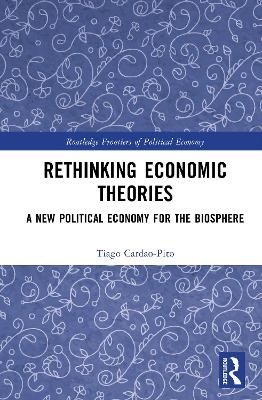
Rethinking Economic Theories
Routledge (Verlag)
978-0-367-17821-5 (ISBN)
In recent times, economic theories have provided the dominant explanations of how to understand and organize human societies. This book argues that the study of economic theories must not be restricted to the disciplines of economics, political economy, or economic sociology and must encompass our relationship to the biosphere.
In this new volume, Tiago Cardão-Pito further develops his innovative system to organize the major economic theories into two major theoretical groups: one is termed “hedonist economic theory” (primarily mainstream economics which generally defends moneyed persons politically) and the other is work-based economic theory (the most well-known version of which is Marxism, which defends workers politically). It is shown that economics can only be understood through the political disputes between these two major theories, but it is also argued that both major economic theories are fundamentally unprepared for addressing human societies and the biosphere. They both attribute metaphysical status to money, describing monetary flows as the constitutive being of economic, social, and ecological phenomena. Furthermore, both theories follow the overinclusive and tautological post-Adam Smith concept of capital, which confuses monetary and non-monetary flows. Although human work remains highly relevant in our technologically enhanced times, this book demonstrates that returning to work-based economic theory is no longer a viable option to contest the dominance of hedonist economic theory. A new bio-social theory is required to explain the integration of human societies into the biosphere.
This book is a vital reading for students and scholars of economic and social theory, political economy, economic sociology, organization, sustainability, and ecological issues, environment and economics, environment and philosophy, environment and society, environment and business, environmental politics, environmental studies, philosophy of social science and political philosophy.
Tiago Cardao-Pito is an assistant professor (with tenure) at ISEG, Universidade de Lisboa (University of Lisbon), Portugal. He has been invited as a guest lecturer to other academic programs such as those of the Massachusetts Institute of Technology in Portugal (MIT in Portugal). He also has experience working at the Portuguese Ministry of Finance and Public Administration, the Portuguese Ministry of Health, and in the private sector. He has published three books (two of those with Routledge) and more than twenty-five research papers in different scientific areas such as economics, history, economic sociology, philosophy, ecological sustainability, management, accounting, and finance.
Part I: Introduction 1- Societies, biosphere, and metaphysical status of money in economic theories 2- Hedonist economics continues its political defense of moneyed persons Part II: Hedonist economic theory perfects its argument against work-based economic theory 3- Mathematical apparatus and camouflage as rhetorical devices 4- Metaphysical status of the interest rate in hedonist economics 5- The revised hedonist market parable: Denying the possibility of surplus Part III: Keynes, Keynesianism, anti-Keynesianism, and post- (or non-) Keynesianism: Tangled to hedonist economics 6- Keynes accepted hedonist economics despite some late regrets 7- Keynesianism and anti-Keynesianism: Divided and united in hedonist economics 8- Post- or non-Keynesian capital controversy: Deflated by hedonist economics Part IV: Ingredients towards a new bio-social theory that deconstructs the metaphysical status of money 9- Empirical status of money for sustainable organizations and societies in the biosphere 10- The necessary acceptance of metaphysics 11- The end of capitalism as a concept: A new political economy for the biosphere 12. - Scientific revolution for freeing humans and the biosphere from the metaphysical status of money Index
| Erscheinungsdatum | 13.09.2025 |
|---|---|
| Reihe/Serie | Routledge Frontiers of Political Economy |
| Zusatzinfo | 3 Tables, black and white; 4 Line drawings, black and white; 3 Halftones, black and white; 7 Illustrations, black and white |
| Verlagsort | London |
| Sprache | englisch |
| Maße | 156 x 234 mm |
| Gewicht | 620 g |
| Themenwelt | Geschichte ► Teilgebiete der Geschichte ► Wirtschaftsgeschichte |
| Wirtschaft ► Allgemeines / Lexika | |
| Wirtschaft ► Volkswirtschaftslehre ► Wirtschaftspolitik | |
| ISBN-10 | 0-367-17821-4 / 0367178214 |
| ISBN-13 | 978-0-367-17821-5 / 9780367178215 |
| Zustand | Neuware |
| Informationen gemäß Produktsicherheitsverordnung (GPSR) | |
| Haben Sie eine Frage zum Produkt? |
aus dem Bereich