


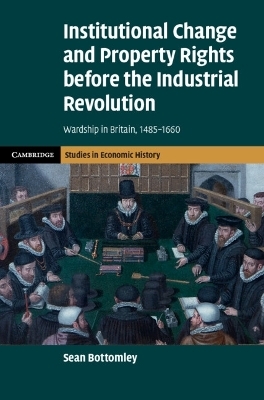
Institutional Change and Property Rights before the Industrial Revolution
Wardship in Britain, 1485–1660
Seiten
2025
Cambridge University Press (Verlag)
978-1-009-38435-3 (ISBN)
Cambridge University Press (Verlag)
978-1-009-38435-3 (ISBN)
An important study of institutional change pre-industrialisation, Bottomley examines wardship, the Crown right to seize underage heirs and their land. Wardship was highly corrupted and representative of decaying state capacity. Without constitutional change in the seventeenth-century, Britain could not have industrialised in the eighteenth.
Secure property rights are widely considered to be an essential prerequisite for sustained economic development; in Britain it is debated whether they have been secure since the medieval period or only established in the mid-seventeenth century. Within this context, Sean Bottomley examines wardship - the Crown's prerogative right(s) to appropriate landed estates which had descended to a legal minor until they attained their majority, to take custody of the child and, where they were unmarried, to decide their marriage partner. Bottomley demonstrates that this constituted a significant yet grossly inefficient and corrupted source of crown revenue, one that inflicted tangible economic penalties. It was also indicative of the decaying capacity of the early Stuart state and Bottomley concludes that without the constitutional changes of the mid to late seventeenth-century, Britain would not have industrialised in the eighteenth-century.
Secure property rights are widely considered to be an essential prerequisite for sustained economic development; in Britain it is debated whether they have been secure since the medieval period or only established in the mid-seventeenth century. Within this context, Sean Bottomley examines wardship - the Crown's prerogative right(s) to appropriate landed estates which had descended to a legal minor until they attained their majority, to take custody of the child and, where they were unmarried, to decide their marriage partner. Bottomley demonstrates that this constituted a significant yet grossly inefficient and corrupted source of crown revenue, one that inflicted tangible economic penalties. It was also indicative of the decaying capacity of the early Stuart state and Bottomley concludes that without the constitutional changes of the mid to late seventeenth-century, Britain would not have industrialised in the eighteenth-century.
Sean Bottomley is an economic historian at Cardiff University. His first book, The British Patent System during the Industrial Revolution (2014), won both the Economic History Society's biennial First Monograph Prize and the Selden Society's David Yale Prize.
1. Introduction; 2. Wardship and the feudal incidents, 1066–1540; 3. The court of wards and liveries, 1540–1642; 4. The court of wards: officers and servants; 5. The early Stuart fiscal-state; 6. Law in the court of wards; 7. The economic consequences of wardship; 8. 'Like horses in Smithfielde'. buying a wardship; 9. Wardship and the wars of the three kingdoms; Conclusion; Bibliography; Index.
| Erscheinungsdatum | 28.10.2025 |
|---|---|
| Reihe/Serie | Cambridge Studies in Economic History - Second Series |
| Zusatzinfo | Worked examples or Exercises |
| Verlagsort | Cambridge |
| Sprache | englisch |
| Gewicht | 554 g |
| Themenwelt | Geschichte ► Teilgebiete der Geschichte ► Wirtschaftsgeschichte |
| ISBN-10 | 1-009-38435-X / 100938435X |
| ISBN-13 | 978-1-009-38435-3 / 9781009384353 |
| Zustand | Neuware |
| Informationen gemäß Produktsicherheitsverordnung (GPSR) | |
| Haben Sie eine Frage zum Produkt? |
Mehr entdecken
aus dem Bereich


aus dem Bereich
wie Tech-Konzerne und Großmächte die Welt unter sich aufteilen
Buch | Hardcover (2025)
C.H.Beck (Verlag)
CHF 39,20


