


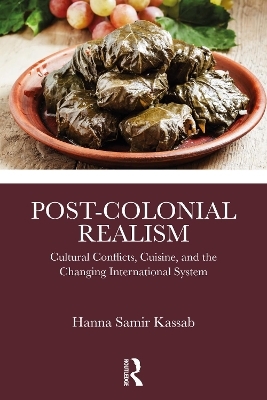
Post-Colonial Realism
Cultural Conflicts, Cuisine, and the Changing International System
Seiten
2025
Routledge (Verlag)
978-1-041-05222-7 (ISBN)
Routledge (Verlag)
978-1-041-05222-7 (ISBN)
Post-Colonial Realism develops a theoretical framework to explain, understand, and predict international conflict, placing culture at the center of international political analysis. This book offers a robust and flexible theory of international relations, concentrating on individuals and their collective beliefs.
In Post-Colonial Realism, Hanna Samir Kassab develops a theoretical framework to explain, understand, and predict international conflict, placing culture at the center of international political analysis.
Kassab contends that nationalism, a belief system, forms an intervening variable that shapes the foreign policy behavior of states. Studying food is central to understanding nationalist belief systems that shape international politics. By combining theories of nationalism with post-colonialist understandings of cultural revitalization, Kassab conceptualizes state motivation to understand how cultural symbols shape nationalist identities, to see the fault lines of civilization through food, and to appreciate the centrality of identity issues. Using ethnography to understand food ownership as part of nationalist conflict, Kassab examines neighboring states (Greece, North Macedonia, Turkey and Armenia) alongside India. In each country study chapter, he compares at least two nationalisms and views of cuisine ownership. He later maps out potential future flashpoints as the international system becomes increasingly competitive due to the changing structure of the international system: unipolarity to multipolarity.
Post-Colonial Realism offers a more robust and flexible theory of international relations, concentrating not on abstractions but on individuals and their collective beliefs.
In Post-Colonial Realism, Hanna Samir Kassab develops a theoretical framework to explain, understand, and predict international conflict, placing culture at the center of international political analysis.
Kassab contends that nationalism, a belief system, forms an intervening variable that shapes the foreign policy behavior of states. Studying food is central to understanding nationalist belief systems that shape international politics. By combining theories of nationalism with post-colonialist understandings of cultural revitalization, Kassab conceptualizes state motivation to understand how cultural symbols shape nationalist identities, to see the fault lines of civilization through food, and to appreciate the centrality of identity issues. Using ethnography to understand food ownership as part of nationalist conflict, Kassab examines neighboring states (Greece, North Macedonia, Turkey and Armenia) alongside India. In each country study chapter, he compares at least two nationalisms and views of cuisine ownership. He later maps out potential future flashpoints as the international system becomes increasingly competitive due to the changing structure of the international system: unipolarity to multipolarity.
Post-Colonial Realism offers a more robust and flexible theory of international relations, concentrating not on abstractions but on individuals and their collective beliefs.
Hanna Samir Kassab is an Associate Professor of Political Science and Security Studies at East Carolina University.
Preface: Food and Everyday Nationalism Chapter 1: Introduction Chapter 2: Greece Chapter 3: North Macedonia Chapter 4: Turkey Chapter 5: Armenia Chapter 6: India. Conclusions
| Erscheinungsdatum | 06.08.2025 |
|---|---|
| Zusatzinfo | 22 Halftones, black and white; 22 Illustrations, black and white |
| Verlagsort | London |
| Sprache | englisch |
| Maße | 152 x 229 mm |
| Gewicht | 330 g |
| Themenwelt | Geschichte ► Teilgebiete der Geschichte ► Wirtschaftsgeschichte |
| Sozialwissenschaften ► Politik / Verwaltung ► Europäische / Internationale Politik | |
| Sozialwissenschaften ► Politik / Verwaltung ► Politische Systeme | |
| Sozialwissenschaften ► Politik / Verwaltung ► Politische Theorie | |
| ISBN-10 | 1-041-05222-7 / 1041052227 |
| ISBN-13 | 978-1-041-05222-7 / 9781041052227 |
| Zustand | Neuware |
| Informationen gemäß Produktsicherheitsverordnung (GPSR) | |
| Haben Sie eine Frage zum Produkt? |
Mehr entdecken
aus dem Bereich



aus dem Bereich
wie Tech-Konzerne und Großmächte die Welt unter sich aufteilen
Buch | Hardcover (2025)
C.H.Beck (Verlag)
CHF 39,20
Aufstieg und Fall der Deutschland AG
Buch | Hardcover (2025)
Suhrkamp (Verlag)
CHF 41,95


