


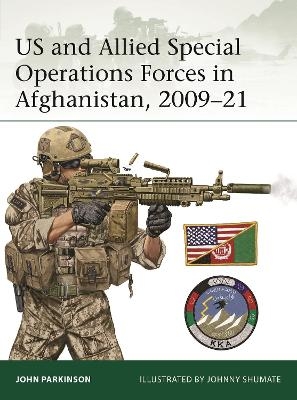
US and Allied Special Operations Forces in Afghanistan, 2009–21
Seiten
2026
Osprey Publishing (Verlag)
978-1-4728-6493-2 (ISBN)
Osprey Publishing (Verlag)
978-1-4728-6493-2 (ISBN)
- Noch nicht erschienen (ca. Januar 2026)
- Portofrei ab CHF 40
- Auch auf Rechnung
- Artikel merken
An illustrated study of the development and operations of coalition and Afghan Special Operations Forces in Afghanistan from 2009 until the withdrawal in 2021.
At the end of 2008, the clearly inadequate strength of the coalition’s International Security Assistance Force (ISAF) in Afghanistan prompted the US and NATO to deploy troops in numbers that could not be sustained long-term. This shortfall was overcome in 2009, when a newly created Special Forces command (ANASOC) in the Afghan National Army began to partner with the ISAF to undertake counter-insurgency operations against the Taliban, Al-Qaeda and ISIL-K. However, while the burden of operations never diminished, many NATO countries reduced their contribution from 2012 onwards, leading to an over-ambitious expansion of ANASOC and weaker ties between it and US/NATO command.
In this engaging study, former United States Marine Corps officer John Parkinson draws on first-hand experience to examine how this series of events spiralled toward the eventual fall of Kabul and the troubled, hasty withdrawal of coalition forces in 2021. Eight newly commissioned colour plates demonstrate the wide range of equipment and uniforms used by the Special Operations Forces and are complemented by a range of previously unpublished photographs.
At the end of 2008, the clearly inadequate strength of the coalition’s International Security Assistance Force (ISAF) in Afghanistan prompted the US and NATO to deploy troops in numbers that could not be sustained long-term. This shortfall was overcome in 2009, when a newly created Special Forces command (ANASOC) in the Afghan National Army began to partner with the ISAF to undertake counter-insurgency operations against the Taliban, Al-Qaeda and ISIL-K. However, while the burden of operations never diminished, many NATO countries reduced their contribution from 2012 onwards, leading to an over-ambitious expansion of ANASOC and weaker ties between it and US/NATO command.
In this engaging study, former United States Marine Corps officer John Parkinson draws on first-hand experience to examine how this series of events spiralled toward the eventual fall of Kabul and the troubled, hasty withdrawal of coalition forces in 2021. Eight newly commissioned colour plates demonstrate the wide range of equipment and uniforms used by the Special Operations Forces and are complemented by a range of previously unpublished photographs.
Lt. Colonel John Parkinson is a former US Marine Corps infantry officer who served in Special Operations Joint Task Force – Afghanistan as a military advisor to the Afghan National Army Special Operations Command. His service spans 30 years and includes deployments to Iraq, Jordan, and Afghanistan. Johnny Shumate produced the artwork plates for this volume.
[subject to confirmation]
| Erscheint lt. Verlag | 29.1.2026 |
|---|---|
| Reihe/Serie | Elite |
| Illustrationen | Johnny Shumate |
| Zusatzinfo | 8 colour artwork plates; black & white and colour photographs and illustrations. |
| Sprache | englisch |
| Maße | 184 x 246 mm |
| Gewicht | 220 g |
| Themenwelt | Geschichte ► Allgemeine Geschichte ► Zeitgeschichte |
| Geschichte ► Teilgebiete der Geschichte ► Militärgeschichte | |
| Sozialwissenschaften ► Politik / Verwaltung | |
| ISBN-10 | 1-4728-6493-X / 147286493X |
| ISBN-13 | 978-1-4728-6493-2 / 9781472864932 |
| Zustand | Neuware |
| Informationen gemäß Produktsicherheitsverordnung (GPSR) | |
| Haben Sie eine Frage zum Produkt? |
Mehr entdecken
aus dem Bereich

aus dem Bereich
die großen Jahre der Soziologie 1949-1969
Buch | Hardcover (2025)
Klett-Cotta (Verlag)
CHF 39,20
eine Deutschlandreise im Jahr 1958
Buch | Hardcover (2024)
C.H.Beck (Verlag)
CHF 29,90


