


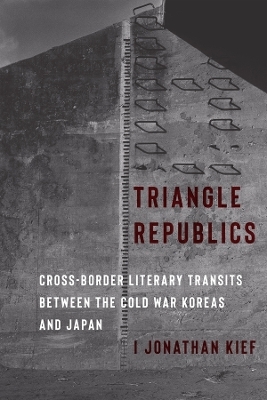
Triangle Republics
Cross-Border Literary Transits Between the Cold War Koreas and Japan
Seiten
2025
Columbia University Press (Verlag)
978-0-231-21985-3 (ISBN)
Columbia University Press (Verlag)
978-0-231-21985-3 (ISBN)
In Korea, the end of the Second World War in 1945 brought both liberation from Japanese colonial rule and the division of the nation by the triumphant Allies. The peninsula was not only decoupled from its former colonial metropole but also carved up into two halves that were subsequently incorporated into the rival blocs of the emerging Cold War order. Although the two Koreas are typically seen as isolated from each other, texts continued to circulate between them—with the assistance of Korean diasporic and other colleagues in Japan—throughout the ensuing decades.
I Jonathan Kief follows the triangular flow of texts linking North Korea, South Korea, and Japan from 1945 until the 1980s, revealing overlooked paths of interaction and exchange. He highlights the creative ways in which poets, playwrights, novelists, critics, and academics crossed boundaries of language, ideology, genre, and geography to challenge the stability of the Cold War. By showing how writers in North and South Korea engaged in dialogue via the mediation of a multiethnic set of colleagues in Japan, Triangle Republics offers a new perspective on this era, emphasizing its vibrant, dynamic, and interconnected nature.
I Jonathan Kief follows the triangular flow of texts linking North Korea, South Korea, and Japan from 1945 until the 1980s, revealing overlooked paths of interaction and exchange. He highlights the creative ways in which poets, playwrights, novelists, critics, and academics crossed boundaries of language, ideology, genre, and geography to challenge the stability of the Cold War. By showing how writers in North and South Korea engaged in dialogue via the mediation of a multiethnic set of colleagues in Japan, Triangle Republics offers a new perspective on this era, emphasizing its vibrant, dynamic, and interconnected nature.
I Jonathan Kief is an assistant professor of Korean studies at the University of North Carolina at Chapel Hill.
Acknowledgments
Note on Names, Spelling, and Transliteration
Introduction
1. Reverberations: South Korean Literature Between 1950s–1960s North Korea and Japan
2. Mother(s) of the South: Figures of Revolution and Fracture Between the 1960s–1970s Koreas and Japan
3. Critical Connections and Critical Limits in 1950s South Korea: The Human and Nonhuman Across the Cold War and East Sea Divides
4. Tragic Returns: Writing Border-Crossing Pasts in 1960s–1980s South Korea
Epilogue. The Cold War in Korea: Suspended Animation
Notes
Bibliography
Index
| Erscheinungsdatum | 30.07.2025 |
|---|---|
| Zusatzinfo | 4 b&w illustrations |
| Verlagsort | New York |
| Sprache | englisch |
| Maße | 152 x 229 mm |
| Themenwelt | Geschichte ► Allgemeine Geschichte ► Zeitgeschichte |
| Geisteswissenschaften ► Geschichte ► Regional- / Ländergeschichte | |
| Geisteswissenschaften ► Sprach- / Literaturwissenschaft ► Anglistik / Amerikanistik | |
| Geisteswissenschaften ► Sprach- / Literaturwissenschaft ► Literaturwissenschaft | |
| Sozialwissenschaften ► Pädagogik | |
| ISBN-10 | 0-231-21985-7 / 0231219857 |
| ISBN-13 | 978-0-231-21985-3 / 9780231219853 |
| Zustand | Neuware |
| Informationen gemäß Produktsicherheitsverordnung (GPSR) | |
| Haben Sie eine Frage zum Produkt? |
Mehr entdecken
aus dem Bereich


aus dem Bereich
die großen Jahre der Soziologie 1949-1969
Buch | Hardcover (2025)
Klett-Cotta (Verlag)
CHF 39,20
eine Deutschlandreise im Jahr 1958
Buch | Hardcover (2024)
C.H.Beck (Verlag)
CHF 29,90


