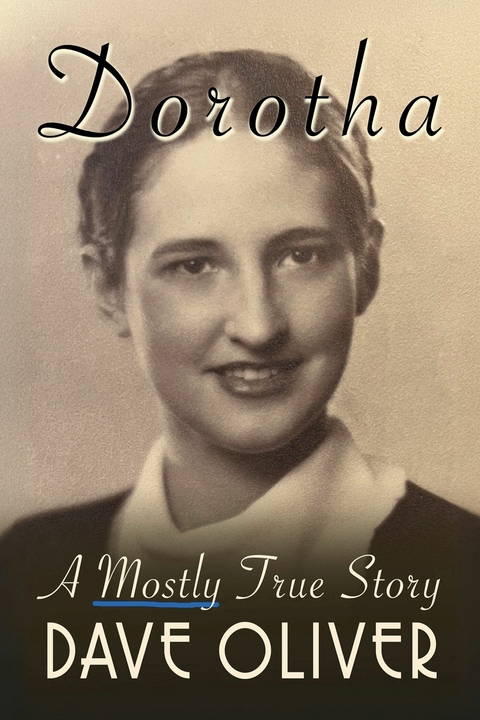
Dorotha, A Mostly True Story (eBook)
400 Seiten
Bookbaby (Verlag)
979-8-3509-9765-1 (ISBN)
Dave Oliver is one of Dorotha's three children. He was a naval officer who rose to the rank of rear admiral and later to a senior position in the Pentagon. From the day he was born, no matter how formal the setting or how august the attendance, Dorotha referred to this son as 'Davy.' After leaving Indiana for college, Dave spent thirty-two years in the Navy. He and his spouse, Linda, lived in the states or countries of California, Connecticut, Japan, Mississippi, South Carolina, Virginia and Washington, most of them more than once. Dave did Navy things. Linda, a lawyer licensed where they lived, plus her own home state of Idaho, worked in private practice until it became clients demanded she sue her husband, when, for the sake of more cordial dinner table conversations, she shifted to legal and supervisory roles in the federal government (White House, Pentagon, etc.). After the Navy, Dave ran several small businesses and worked for some very large ones. He was a political appointee in the Clinton and the George W. Bush administrations, serving in the Defense Department. He and Linda both represented the United States Government in dozens of foreign countries and were members of the Coalition forces in Iraq. Linda and Dave now live in Northern California, in the same town as both their sons and their three grandchildren. His other published books can be found at daveoliverbooks.com.
Dorotha grows up on a bustling farm, reading books every possible moment she can steal away from chores. Her farm lies just outside Decker, Indiana, population 468, a few miles north of the Mason-Dixon line. It is Raintree County land, where religious revivals bring snake healing as well as a few snake oil salesmen like Elmer Gantry. Decker is also located smack dab in the middle of tens of thousands of Ku Klux Klan members. In their home, Dorotha is one of the six daughters of two remarkable people, a gambler who wears two six-guns beneath his long white coats and a mother who, before her wedding, famously rode her horse bareback across Decker fields at night, clad only in a white shift, or, accounts vary, nothing at all. Within a few years Dorotha is off to college at Indiana University (only a few miles from where Daisy Buchanan of The Great Gatsby's fame grew up) where she continues to voraciously read, She meets her man, Dave, when she spies his barrel chest competing for the college swimming team that will become a national powerhouse. She is determined not to miss her life's mate. While both their sets of parents are well-to-do, the family considerations that Dorotha and Dave originally ignored mean that neither set of in-laws support them. It is the depression, and the young couple live more poorly than hand-to-mouth until Dave takes a job with the Pinkerton Security Agency and subsequently the FBI in Washington, DC. Unfortunately, Edgar Hoover soon removes the FBI from Civil Service and reduces everyone's pay. As Dorotha is now pregnant with their first child, Dave must job search again. No sooner does the young couple find Dave a blue collar job in Indianapolis, then the Japanese attack Pearl Harbor. Soon the Japs overrun Corregidor and capture Dave's father. Dave immediately enlists in the Navy and Dorotha, after unsuccessfully attempting to live with her mother-in-law, reluctantly returns to Decker to spend the war years praying for her husband. After the War, the family settles in Indianapolis, a few miles from Dorotha's best friend and sister, Lois (who has married Dave's brother). As Dorotha and Lois rear their double-cousin children, Dave becomes involved in the rise of union, a movement that in the Midwest is interwoven with the emotions of the Red Scare, McCarthyism and the monumental changes wrought by America;s manufacturing revolution. Dorotha becomes a true believer in the value of the union to the middle class, and, one snowy evening, resolves an increasingly violent strike by dynamiting a factory wall to force management to negotiate.
1
The Beginning
Sunday, 20 April 1997
My memory is capricious these days. I suppose it is just a consequence of being eight-years-old, but it is annoying. I can’t recall the title of this morning’s sermon, while events from decades ago are crystal clear. Heck, I remember the ruffled bodice on the yellow dress that Mama was wearing on my wedding day. Years later, as my sisters and I watched, my first child in his bassinet at my feet, our father buried Mama in that same outfit.
I set my glass of iced tea on our kitchen table and ease myself down into my chair. My hip is reminding me I will pay dearly for so much walking today. I square my yellow legal pad with the table’s edge and reach for the teapot that holds our writing instruments. There is an assortment of yellow No. 2s, along with the last remaining promotional ballpoint from my husband’s union, good old UAW/CIO 933.
I pause for a second, remembering. The teapot is the only item that has survived our sixty-plus years of marriage. It was originally part of Pop and Mama’s wedding gift. We lost a cup and saucer during the FBI move to DC, when all our possessions didn’t even completely fill the Oldsmobile’s back seat. I dropped the second cup when I heard Lois (my favorite sister, always) was pregnant—what a shock that was! I have no idea where the creamer and sugar bowls went; probably lost in a box misplaced during one of our five moves in Indianapolis. I finally reluctantly relegated the lidless teapot to serve as the house’s pencil holder. I sip the glass of tea and take in a long, ragged breath. Mama, Mama, Mama, how different might it all have been?
The thought causes me to sit up straighter in my chrome kitchen chair. No regrets. Not today. So much water has passed under the bridge. I remember our wedding as clearly as if it were yesterday, even though it was the final day of 1935. It was chilly, gray and overcast, with intermittent sleet. Weather rather common to December in Southern Indiana.
I awoke early in order to compose a list.
Tuesday, 31 December 1935
Today:
- Slop the hogs.
- Feed the chickens.
- Take Cecil the pumpkin pie.
- Dust the parlor one final time!
- Write Lizzie a note about why.
- Ask Mama to move the damn rifles.
- Let Rose choose any books she wants.
- Try on my dress. Such small stitches!
THANK MAMA AGAIN! - Pack everything except traveling clothes (does Ruth
have tissue paper?). - Get married!!!
I chuckle to myself. Hell’s bells! Marrying in a depression. What are we thinking? Especially today. At least I’ll never have to jog anyone’s memory. In five years, my husband’s not going to come home, look at my disappointed face, snap his fingers, and say, “Whoops, New Year’s Eve, now I remember, it’s our anniversary!” Given the unusual date and my perceived “rush to the altar,” I expect everyone will be counting months as alertly as an owl observing a rustle in the grass. When I don’t show pregnant, this date will eventually become part of “our story,” like a charcoal sketch of a forgotten great-aunt hung in a dimly lit hallway.
At the moment, the rush and the Depression are two of my lesser worries. My parents remain opposed to our nuptials. If they don’t change their minds and throw in a few dollars, my husband-to-be doesn’t see how we will be able to stay in college. If they don’t come through, we will face more problems than spitting snow. To begin with, no one these days is employing married women. “Save the jobs for the men” has become nearly as ubiquitous a phrase as “Use it up, wear it out, make it do, or do without!”
There won’t be many witnesses today, other than my five sisters. Few people are about to travel in this weather. Even a couple of our blood relatives have discovered more pressing engagements, including my husband-to-be’s older brother and only sister. Their absence is probably just as well; our parlor isn’t that big, even if Pop’s oversized desk had been moved to another room, which, despite my pleas, it wasn’t.
At the moment, I am upstairs in Mama’s bedroom, putting on my wedding dress. She just handed me her precious silver filigreed hand mirror, the one Pop brought back for her from an auction jaunt to Louisville. I glance over at where she is sitting on their high bed, her feet propped on the little upholstered stool she uses to reach the shoulders of her mannequins. I am always taken aback when something like the stool reminds me of how tiny she is. We older girls are already taller than her; I am five inches over five feet, and baby sister Rose will probably shoot up past her soon. Mama even appears a bit fragile, but it may be the rimless glasses she wears, the ones with those small round lenses. The long hours sewing my wedding dress have also taken a toll. There are deep blue shadows beneath her eyes.
I turn again to the long mirror affixed to her armoire. I love the way the dark navy blue of my dress accentuates the deep black of my hair and adds depth to my brown eyes. The rayon weave is crepe Georgette, a material for our new age (and the natural ripples minimize my bottom). Mama jiggered the pattern to include a cute little cloth belt to accentuate my tiny waist. She covered the buttons and belt with fabric and used tape on the hems just as you find on store-bought frocks.
I twirl once for her and smile my genuine thanks, “Oh, Mama, this is perfect!” I turn back to the mirror, running my hands over the material while suppressing a grin. As I suspected she would, Mama has sewn piping into the bodice. My full bosom discomfits her, which I have always found laughable, since her nighttime bareback horse rides, purportedly clad only in a thin white shift, once made her a Knox County legend.
Mama sews all our clothes in the oversized bedroom she shares with Pop, an arrangement that successfully keeps most clutter on our second floor. Lately, she has been spending many long hours here. It is the sixth year of what newspapers are calling “the Great Depression” and even the Wallen family is feeling the pinch. Money has been very tight since Pop lost his car dealership business.
Pushed back against one of their bedroom walls is Mama’s Singer sewing machine, along with the low white wicker dresser she uses to store fabric. Alongside the dresser are her two dress forms, one more full-bodied like Lillie, Lois, and me, the other a bit thinner for the other three girls. All my life, Mama has made our going-to-church and first-day-of-school dresses. And ever since Sears opened their very first store (in Evansville at 4th and Sycamore), one or more of us girls often accompany her to help sift through the hundreds of pattern envelopes.
This afternoon, memories like this make me teary. Nothing particularly unusual. I have always cried much too easily. Nevertheless, I know I will truly miss everyone in our eclectic family, especially Mama. She has always been my hero, and her life was never easy. Six unmarried daughters, all still living in the same house! It is Mama’s serenity that keeps the Wallen waters calm. She is definitely the only person in Knox County who can temper Pop.
But she has been against my marriage, and while we are down to the final minutes, she is still working to change my mind.
“Dorotha, you are too young and it is a tough world out there... you have your whole life ahead of you... you haven’t dated that many men...”
I try to ignore Mama’s entreaties twirling back and forth before the mirror, letting her words flow like water off a duck’s back, but she will not be dissuaded by my silence.
“I was four years older than you before I got hitched, and that was forty years ago, when everyone married much younger.” She pauses while I focus on my image in the mirror. She has just summarized all the objections she and Pop have been laying out for the last month. But it is too late; in less than an hour, my husband-to-be, his parents, and his best man will arrive.
“You are going to be as poor as church mice. You’ll be even worse, since church mice at least have someplace to live. You know your father and I have prayed you will wait.”
“I do, Mama.” And I not-so-secretly resent their pressure. I have four older unmarried sisters. I am still in my teens. I know everyone in our house feels I am full of myself for marrying first. But I am not about to chance losing my man while I wait for some hesitant old maids to get their acts together. I adore my man. I intend to work day and night to make his life—our lives—special.
And worrying about older sisters marrying first is medieval thinking! Even if Pop and Mama can’t or won’t help, I need to find my own way back to college. My fiancé’s folks are funding his fraternity dues along with his tuition, books, and fees. If he drops out of Greek life and we use that fraternity money on the cheap Bloomington apartment I found, we will both be able to stay in school.
Mama is not about to call it quits. “All those years fighting the Ku Klux Klan and this terrible depression has put such stress on your father. I know he wanted to keep you in college...”
But he didn’t, even though I had all “As.” When I was forced to drop out, I abandoned my man to a bevy of sorority queens who flocked around him like...
| Erscheint lt. Verlag | 25.4.2025 |
|---|---|
| Sprache | englisch |
| Themenwelt | Geisteswissenschaften ► Geschichte ► Regional- / Ländergeschichte |
| ISBN-13 | 979-8-3509-9765-1 / 9798350997651 |
| Informationen gemäß Produktsicherheitsverordnung (GPSR) | |
| Haben Sie eine Frage zum Produkt? |
 EPUB (Ohne DRM)
Größe: 2,1 MB
Digital Rights Management: ohne DRM
Dieses eBook enthält kein DRM oder Kopierschutz. Eine Weitergabe an Dritte ist jedoch rechtlich nicht zulässig, weil Sie beim Kauf nur die Rechte an der persönlichen Nutzung erwerben.
Dateiformat: EPUB (Electronic Publication)
EPUB ist ein offener Standard für eBooks und eignet sich besonders zur Darstellung von Belletristik und Sachbüchern. Der Fließtext wird dynamisch an die Display- und Schriftgröße angepasst. Auch für mobile Lesegeräte ist EPUB daher gut geeignet.
Systemvoraussetzungen:
PC/Mac: Mit einem PC oder Mac können Sie dieses eBook lesen. Sie benötigen dafür die kostenlose Software Adobe Digital Editions.
eReader: Dieses eBook kann mit (fast) allen eBook-Readern gelesen werden. Mit dem amazon-Kindle ist es aber nicht kompatibel.
Smartphone/Tablet: Egal ob Apple oder Android, dieses eBook können Sie lesen. Sie benötigen dafür eine kostenlose App.
Geräteliste und zusätzliche Hinweise
Buying eBooks from abroad
For tax law reasons we can sell eBooks just within Germany and Switzerland. Regrettably we cannot fulfill eBook-orders from other countries.
aus dem Bereich