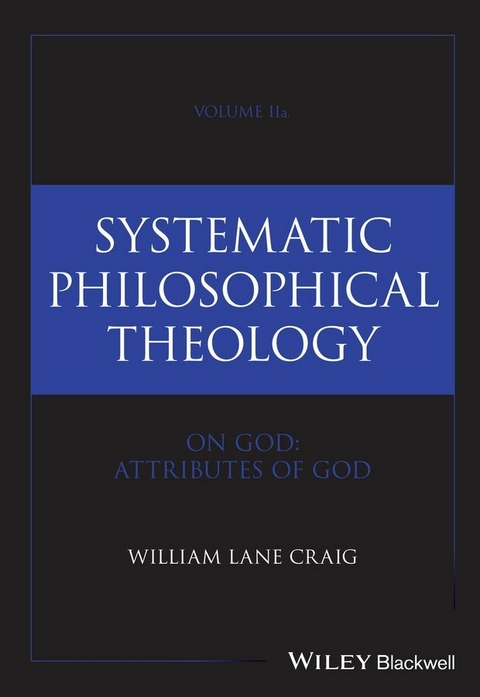
Systematic Philosophical Theology, Volume 2a (eBook)
1005 Seiten
Wiley-Blackwell (Verlag)
9781394278787 (ISBN)
'These volumes are chock full of arguments in a way that stands out in this field. . . . This is a remarkable, generational work that will become the resource in philosophical theology.'
-J.P. Moreland, Distinguished Professor of Philosophy, Biola University
'An enormous undertaking. However, Craig's past record indicates that he can and will carry it through to completion. Furthermore, his established reputation. . . guarantees that the work will attract wide interest and will have a ready readership.'
-William Hasker, Emeritus Professor of Philosophy, Huntington University
A transformative journey through Christian doctrine, Volume IIa. On God: Attributes of God
William Lane Craig's Systematic Philosophical Theology is a multi-volume explication of Christian doctrine in the classic Protestant tradition of the loci communes as seen through the lens of contemporary analytic philosophy. Uniquely blending the disciplines of biblical theology, historical theology, and analytic theology, these volumes aim to provide readers with a biblical and philosophically coherent articulation of a wide range of Christian doctrines.
Volume II treats the locus On God in two parts. The first part, Volume IIa. Attributes of God, explores the coherence of theism. Conceiving of God as an infinite and personal being of maximal greatness, Craig carefully defines and explicates the divine attributes of incorporeality, necessity, aseity, simplicity, eternality, omnipresence, omniscience, omnipotence, and goodness.
In the second part, Volume IIb. Excursus on Natural theology, The Trinity, Craig examines six arguments for God's existence, including the argument from contingency, the kal?m cosmological argument, the argument from the applicability of mathematics, the argument from cosmic fine-tuning, the moral argument, and the ontological argument, along with the problem of evil. Following the excursus, he transitions to an articulation and defence of Christian theism, formulating a biblical doctrine of the Trinity and offering a model of God as a tripersonal soul.
WILLIAM LANE CRAIG is Emeritus Research Professor of Philosophy at Talbot School of Theology in La Mirada, California. A distinguished theologian and philosopher, he has authored or edited more than 60 books, including The Blackwell Companion to Natural Theology, as well as over 300 articles in professional publications of philosophy and theology.
"e;These volumes are chock full of arguments in a way that stands out in this field. . . . This is a remarkable, generational work that will become the resource in philosophical theology."e; J.P. Moreland, Distinguished Professor of Philosophy, Biola University "e;An enormous undertaking. However, Craig's past record indicates that he can and will carry it through to completion. Furthermore, his established reputation. . . guarantees that the work will attract wide interest and will have a ready readership."e; William Hasker, Emeritus Professor of Philosophy, Huntington University A transformative journey through Christian doctrine, Volume IIa. On God: Attributes of God William Lane Craig s Systematic Philosophical Theology is a multi-volume explication of Christian doctrine in the classic Protestant tradition of the loci communes as seen through the lens of contemporary analytic philosophy. Uniquely blending the disciplines of biblical theology, historical theology, and analytic theology, these volumes aim to provide readers with a biblical and philosophically coherent articulation of a wide range of Christian doctrines. Volume II treats the locus On God in two parts. The first part, Volume IIa. Attributes of God, explores the coherence of theism. Conceiving of God as an infinite and personal being of maximal greatness, Craig carefully defines and explicates the divine attributes of incorporeality, necessity, aseity, simplicity, eternality, omnipresence, omniscience, omnipotence, and goodness. In the second part, Volume IIb. Excursus on Natural theology, The Trinity, Craig examines six arguments for God&'s existence, including the argument from contingency, the kal m cosmological argument, the argument from the applicability of mathematics, the argument from cosmic fine-tuning, the moral argument, and the ontological argument, along with the problem of evil. Following the excursus, he transitions to an articulation and defence of Christian theism, formulating a biblical doctrine of the Trinity and offering a model of God as a tripersonal soul.
1
Introduction
The existence and nature of God are central concerns of Christian theology. While the systematic theologian may not engage in natural theology but may simply assume on the basis of scriptural teaching that the God of the Bible exists, he cannot be indifferent to the question of the nature or attributes of the biblical God, since God’s nature is determinative for the entire Christian theological system. Unfortunately, in the words of Lutheran theologian Robert Preus, “The doctrine of God is the most difficult locus in Christian dogmatics.”1 Does God exist necessarily or contingently? Is he absolutely simple or complex? Is he timeless or omnitemporal? Does he transcend space or fill space? Does his almighty power imply the ability to do the logically impossible or are there limits to his power? Systematic theologians have often assumed uncritically traditional answers to these sorts of questions, answers that have been sharply challenged in modern times. During the late twentieth century the concept of God became fertile ground for anti‐theistic philosophical arguments. The difficulty with theism, it was often said, is not merely that there are no good arguments for the existence of God, but, more fundamentally, that the concept of God is incoherent.2
It is here that the contribution of contemporary Christian philosophers to systematic theology has been most pronounced and helpful. The anti‐theistic critique evoked a prodigious literature devoted to the philosophical analysis of the concept of God.3 As a result, one of the principal concerns of contemporary philosophy of religion has been the coherence of theism.
Two controls have tended to guide this inquiry into the divine nature: Scripture and so‐called perfect being theology. For thinkers in the Judeo‐Christian tradition, God’s self‐revelation in Scripture is obviously paramount in understanding what God is like. Still, while Scripture is our supreme authority in formulating a doctrine of God, so that doctrines contrary to biblical teaching are theologically unacceptable, contemporary thinkers have come to appreciate that the doctrine of God is underdetermined by the biblical data. The biblical authors were not philosophical theologians but in many cases storytellers whose accounts of man’s relationship with God bear all the marks of the storyteller’s art, being told from a human perspective without reflection upon philosophical considerations. The biblical theologian will therefore search in vain for clear answers to many philosophical questions concerning the divine attributes. Answers taken for granted by traditional dogmaticians need to be brought anew before the bar of Scripture and their biblical support and consonance re‐examined.
In addition, St. Anselm’s conception of God as a being than which a greater cannot be conceived (aliquid quo nihil maius cogitari possit)4 or most perfect being (ens perfectissimum) has guided philosophical speculation on the raw data of Scripture, so that God's biblical attributes are to be conceived in ways that would serve to exalt God's greatness.5 The biblical concept of God’s being almighty, for example, is thus to be construed as maximally as possible. John Hick aptly credits Anselm for bringing the Christian doctrine of God to full flower:
Perhaps the most valuable feature of Anselm’s argument is its formulation of the Christian concept of God. Augustine (De Libero Arbitrio II, 6, 14) had used the definition of God as one ‘than whom there is nothing superior.’ … Anselm, however, does not define God as the most perfect being that there is but as a being than whom no more perfect is even conceivable. This represents the final development of the monotheistic conception. God is the most adequate conceivable object of worship; there is no possibility of another reality beyond him to which he is inferior or subordinate and which would thus be an even more worthy recipient of man’s devotion. Thus metaphysical ultimacy and moral ultimacy coincide; one cannot ask of the most perfect conceivable being… whether men ought to worship him. Here the religious exigencies that move from polytheism through henotheism to ethical monotheism reach their logical terminus. And the credit belongs to Anselm for having first formulated this central core of the ultimate concept of deity.6
Unfortunately, the conception of God as a perfect being is not without its ambiguity. Nagasawa takes God to be “the greatest metaphysically possible being,” a view he calls the perfect being thesis.7 Nagasawa holds that the perfect being thesis need not be taken to entail that God is omnipotent, omniscient, and omnibenevolent, since those properties are a matter of philosophical dispute, but simply that God has “the maximal consistent set of knowledge, power, and benevolence.”8 He thinks that there are neither biblical grounds nor compelling philosophical arguments for the entailment of the omni‐attributes “in a philosophically strict sense.” That seems to me a dubious stratagem for perfect being theology, since the maximal, consistent set of attributes could describe a limited and finite God. Nagasawa’s construal seems to rule out the incoherence of theism by definition.
By contrast, Michael Almeida takes as “a defining feature of perfect being theology” the inference from the proposition that God is a perfect being to the conclusion that God has every property that it is better to exemplify than not.9 Unfortunately, it will not always be clear which properties it is absolutely better to have than to lack. My own understanding and utilization of perfect being theology is more informative, being what Almeida calls a posteriori Anselmianism, which extrapolates divine attributes from Scripture as greatly as possible.10
Since the concept of God is underdetermined by the biblical data and since what constitutes a “great‐making” property is to some degree debatable, philosophers working within the Judeo‐Christian tradition enjoy considerable latitude in formulating a philosophically coherent and biblically faithful doctrine of God. Philosophical theists have thus found that anti‐theistic critiques of certain conceptions of God can actually be quite helpful in framing a more adequate conception. Thus, far from undermining theism, the anti‐theistic critiques have served mainly to reveal how rich and interesting the concept of God is, thereby refining and strengthening theistic belief.
In what follows we shall explore some of the most important attributes traditionally ascribed to God.
Notes
- 1 Robert D. Preus, The Theology of Post‐Reformation Lutheranism, 2 vols. (St. Louis: Concordia Publishing House, 1970), 2:53.
- 2 Thus, an obviously unsympathetic critic like Kai Nielsen characterizes fellow atheists “who believe ‘There is a God' is simply false” as “Neanderthal atheists,” whereas atheists like himself “who reject the very concept of God as unintelligible” are “non‐Neanderthal atheists” (Kai Nielsen, “A Sceptic's Reply,” in Faith and the Philosophers, ed. John Hick [London: Macmillan, 1964], 232).
- 3 See William J. Wainwright, Philosophy of Religion: An Annotated Bibliography of Twentieth‐Century Writings in English (New York: Garland, 1978). Reference works in philosophy of religion thus almost always include a sizable section on the various attributes of God, for example, Chad Meister and Paul Copan, eds., The Routledge Companion to Philosophy of Religion, Routledge Philosophy Companions (London: Routledge, 2007), pt. 4; Paul Copan and Chad Meister, eds. Philosophy of Religion: Classic and Contemporary Issues (Oxford: Blackwell, 2008), pt. 3; Thomas P. Flint and Michael C. Rea, eds., The Oxford Handbook of Philosophical Theology (Oxford: Oxford University Press, 2009), pt. 2; Charles Taliaferro, Paul Draper, and Philip L. Quinn, eds., A Companion to Philosophy of Religion, 2nd ed., Blackwell Companions to Philosophy 8 (Oxford: Wiley‐Blackwell, 2010), pt. 4; Charles Taliaferro and Chad Meister, eds., The Cambridge Companion to Christian Philosophical Theology (Cambridge: Cambridge University Press, 2010), pt. 1; Stewart Goetz and Charles Taliaferro, eds., The Encyclopedia of Philosophy of Religion, 4 vols. (Oxford: Wiley‐Blackwell, 2021). The same is true of anthologies in philosophy of religion.
- 4 In his Proslogion 2 Anselm thus addresses God: “And, indeed, we believe that thou art a being than which nothing greater can be conceived.” Cf. Proslogion 3: “this being thou art, O Lord, our God.” Hoffman and Rosenkrantz explain, “Another way of putting the matter replaces the partly psychological term ‘can be conceived' with the wholly modal term ‘is possible,' resulting in a definition which states that God is a being than which nothing greater is possible. Such a revision is advantageous in that the resulting definition is less psychological, and therefore, more objective” (Joshua Hoffman and Gary S. Rosenkrantz, “Divine Attributes” in The Encyclopedia of Philosophy of Religion, ed. Stewart Goetz and Charles Taliaferro (Oxford: Wiley‐Blackwell, 2021),...
| Erscheint lt. Verlag | 25.3.2025 |
|---|---|
| Sprache | englisch |
| Themenwelt | Geisteswissenschaften ► Religion / Theologie |
| Schlagworte | analytic theology coherence of theism • Christian doctrine philosophical questions • systematic philosophical theology • Systematic Theology • systematic theology divine attributes • systematic theology doctrine of God • systematic theology nature of God • systematic theology synopsis |
| ISBN-13 | 9781394278787 / 9781394278787 |
| Informationen gemäß Produktsicherheitsverordnung (GPSR) | |
| Haben Sie eine Frage zum Produkt? |
 EPUB (Adobe DRM)
Kopierschutz: Adobe-DRM
Adobe-DRM ist ein Kopierschutz, der das eBook vor Mißbrauch schützen soll. Dabei wird das eBook bereits beim Download auf Ihre persönliche Adobe-ID autorisiert. Lesen können Sie das eBook dann nur auf den Geräten, welche ebenfalls auf Ihre Adobe-ID registriert sind.
Details zum Adobe-DRM
Dateiformat: EPUB (Electronic Publication)
EPUB ist ein offener Standard für eBooks und eignet sich besonders zur Darstellung von Belletristik und Sachbüchern. Der Fließtext wird dynamisch an die Display- und Schriftgröße angepasst. Auch für mobile Lesegeräte ist EPUB daher gut geeignet.
Systemvoraussetzungen:
PC/Mac: Mit einem PC oder Mac können Sie dieses eBook lesen. Sie benötigen eine
eReader: Dieses eBook kann mit (fast) allen eBook-Readern gelesen werden. Mit dem amazon-Kindle ist es aber nicht kompatibel.
Smartphone/Tablet: Egal ob Apple oder Android, dieses eBook können Sie lesen. Sie benötigen eine
Geräteliste und zusätzliche Hinweise
Buying eBooks from abroad
For tax law reasons we can sell eBooks just within Germany and Switzerland. Regrettably we cannot fulfill eBook-orders from other countries.
aus dem Bereich