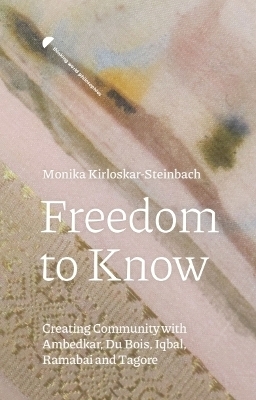
Freedom to Know
Edinburgh University Press (Verlag)
978-1-3995-5053-6 (ISBN)
In this book, Monika Kirloskar-Steinbach studies how Bhimrao Ambedkar (1891-1956), W.E.B. Du Bois (1868-1963), Mohammed Iqbal (1877-1938), Pandita Ramabai (1858-1922) and Rabindranath Tagore (1861-1941) diagnose the epistemic oppression they perceive and experience, their analysis of the coloniality of being as its cause, and their proposals to counter it. Kirloskar-Steinbach explores how these voices seek to co-create a space in which they can experience what it means to be free from the conceptual domination of academic frameworks, relish that freedom with their collaborators and, in the equal participation that that space affords, develop open-ended concepts that help them to resist the coloniality of being.
Monika Kirloskar-Steinbach is Professor of Philosophy and holds the chair for Diversifying Philosophy at the Vrije Universiteit, Amsterdam. She is editor of the Journal of World Philosophies and series editor of the Bloomsbury Studies in World Philosophies book series and co-series editor of Bloomsbury Introductions to World Philosophies. She is co-author of A Practical Guide to World Philosophies: Selves, Worlds and Ways of Knowing (Bloomsbury, 2021).
Acknowledgements
Introduction: Breaking Through Epistemic Silencing
1. Setting the Stage
2. Rigidified Concept Use and Epistemic Silencing: Deprivileging Dominant Ways of Knowing Then and Now
3. Chapter Overview
Conceptual Borrowing, Group Positioning and the Making of a New Human Being
1. Epistemic Domination and Resistance
2. Conceptual Borrowing at the Group Level and Its Risks
3. Stabilizing Alternate Conceptual Practices through Pedagogy
4. Creating an Alternate Conceptual Space
Pandita Ramabai, Epistemic Discrimination and Being Counted as a Knower
1. Becoming a Pandita and Epistemic Discrimination
2. Knowing as Doing, Epistemic Silencing and Freedom
3. Ramabai’s Knowledge as a Learned Woman from Colonial India
4. Contextualising Ramabai’s Account of Knowing
Knowing the Self and the World through an Iqbalian Īmān
1. Knowing Through Īmān.
2. Affirming the External World through Īmān
3. Affirming the Internal World through Īmān
4. Khudī and ‘Ishq
5. Working toward Khudī with the Ego
6. Working with Self-Possession after Khudī
7. Contextualizing Iqbal’s Imān
The Making of a Tagorean Samāj Through Rasa
1. Truth, Beauty and Experts
2. Yearning for Freedom and Appeasing It
3. Rasa and Subjectivity
4. Tagore’s Rasa Retrieval Under Conditions of Coloniality
5. Contextualizing Tagorean Rasa
Line-Smudging, Self-Consciousness and Freedom in Dark Princess
1. African American Selves in a Segregated World
2. Dark Princess: A Romance.
3. Love, Common Humanity, and Remaking Ideals through Negotiations
4. Love, Common Humanity, and Remaking Ideals through Kali
5. Love, Common Humanity, and Remaking Ideals through Krishna and Radha
6. Contextualizing Du Bois’s Dark Princess
Creating a Community Based on Ambedkarian Maitrī
1 Opportunity Equity and the Contingency of Birth
2 The Hindu Social Order in Comparison to a Free Social Order
3 Making a Community in India
4 Making a New Community in India
5 Contextualizing Ambedkar’s Meta-Plan
Conclusion: Resisting the Coloniality of Being, Then and Now
Bibliography
| Erscheinungsdatum | 17.10.2025 |
|---|---|
| Reihe/Serie | Thinking World Philosophies |
| Verlagsort | Edinburgh |
| Sprache | englisch |
| Maße | 138 x 216 mm |
| Themenwelt | Geschichte ► Teilgebiete der Geschichte ► Wirtschaftsgeschichte |
| Geisteswissenschaften ► Philosophie ► Östliche Philosophie | |
| ISBN-10 | 1-3995-5053-5 / 1399550535 |
| ISBN-13 | 978-1-3995-5053-6 / 9781399550536 |
| Zustand | Neuware |
| Informationen gemäß Produktsicherheitsverordnung (GPSR) | |
| Haben Sie eine Frage zum Produkt? |
aus dem Bereich