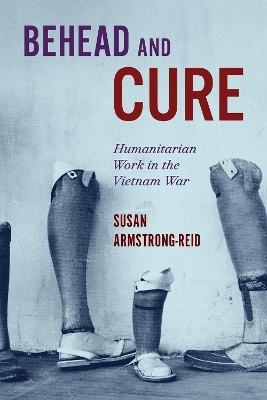
Behead and Cure
McGill-Queen's University Press (Verlag)
978-0-2280-2555-9 (ISBN)
The war in Vietnam was an ethical minefield for the medical humanitarians who volunteered to treat the injured and dying. The United States government used humanitarian aid as a counterinsurgency strategy and weapon of war. The Vietnamese people could not understand why the Americans and their allies sought at once to attack them and to save them by providing medical care. Civilian medical teams increasingly questioned their complicity in the war and whether neutrality was possible.
Behead and Cure explores the ethics of humanitarianism in Vietnam through the stories of seven medical teams from the United States, Britain, Canada, and Australia. Non-combatant women played key roles in all aspects of caring for civilians; this book repositions them from the sidelines of the Vietnam War to the centre. Drawing on interviews and first-hand accounts, Susan Armstrong-Reid considers how personality, life experience, place, and the culture of medical teams affected women's professional and personal lives in Vietnam and their lives afterwards. Confronted daily with the horrors of war, they were expected to fulfill their gendered roles as purveyors of Western medical care, humanitarian ambassadors, and models of femininity. Some proved resilient and pursued a lifelong commitment to peace movements and humanitarian causes. Others suffered burnout and sought to expunge the memory of their years in Vietnam.
Behead and Cure provides a new perspective on the ethical dilemmas facing humanitarian workers and the collateral human costs of war that remain timely today. It reveals how the experience of Vietnam changed humanitarians' views of their profession, their own countries' foreign policies, and the place of the United States in the world.
Susan Armstrong-Reid is adjunct professor of history at the University of Guelph.
Figures vii
Acknowledgments xi
Abbreviations xv
Introduction 3
Timeline 24
Part One – American Civilian Medical Teams
1 Different Perspectives of USAID Nurses in Vietnam 31
2 USAID and the MCC: The Humanitarian Experiences of Christian Women in Vietnam 65
Part Two – American Friends Service Committee: Bearing Witness to War
3 Launching the Quang Ngai Rehabilitation Centre, 1967–1968 99
4 Rebuilding Humanitarian Relationships in Quang Ngai, 1968–1972 118
5 Walking a Political and Ethical Tightrope, 1972–1975 133
Part Three – Private International Relief Agencies
6 Save the Children: A Global Vision of Childhood 161
7 Nursing with Dr Pat Smith: The Mother Teresa of Vietnam 190
Part Four – State-Sponsored Civilian Medical Teams: Australia and Canada
8 Australian Civilian Medical Teams: “Small Islands of Sanity,
Security and Care” 219
9 “Not Everyone Who Came Home from Vietnam Ever Left There”:
Leaving and New Directions Back Home 241
10 Claire Culhane: A Humanitarian Activist in Vietnam 259
Conclusion 293
Notes 317
Bibliography 375
Index 405
| Erscheinungsdatum | 30.10.2025 |
|---|---|
| Reihe/Serie | McGill-Queen's/AMS Healthcare Studies in the History of Medicine, Health, and Society |
| Zusatzinfo | 30 photos |
| Verlagsort | Montreal |
| Sprache | englisch |
| Maße | 152 x 229 mm |
| Themenwelt | Geschichte ► Allgemeine Geschichte ► Zeitgeschichte |
| Geschichte ► Teilgebiete der Geschichte ► Militärgeschichte | |
| Medizin / Pharmazie ► Pflege ► Ausbildung / Prüfung | |
| Studium ► Querschnittsbereiche ► Geschichte / Ethik der Medizin | |
| ISBN-10 | 0-2280-2555-9 / 0228025559 |
| ISBN-13 | 978-0-2280-2555-9 / 9780228025559 |
| Zustand | Neuware |
| Informationen gemäß Produktsicherheitsverordnung (GPSR) | |
| Haben Sie eine Frage zum Produkt? |
aus dem Bereich