


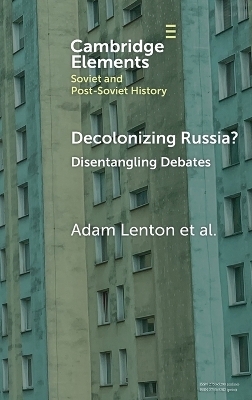
Decolonizing Russia?
Disentangling Debates
Seiten
2025
Cambridge University Press (Verlag)
978-1-009-66474-5 (ISBN)
Cambridge University Press (Verlag)
978-1-009-66474-5 (ISBN)
This Element examines the debates over decolonization in the Russian case. It begins by contextualizing these debates through an examination of Russia's historical development as an empire and identifies and disentangles key focal points. By doing so, this Element shows where decolonization has merit, but also where it is contested or limited.
Russia's full-scale invasion of Ukraine in February 2022 radically changed the way many viewed the nature of the Russian state. The centrality of resentment and imperial nostalgia in Russian narratives led many to argue that Russian imperialism was a key force behind the invasion. By extension, this led to the idea that decolonization – largely in scholarship, but also among some policy circles – offered a way to better understanding Russia in this new context. To this end, this Element examines the debates over decolonization in the Russian case. It begins by contextualizing these debates through an examination of Russia's historical development as an empire. It then identifies and disentangles three key focal points: decolonization as domestic Russian politics, the transnational politics of decolonization, and decolonization as a scholarly endeavor. By doing so, this Element shows where decolonization has merit, but also where it is contested or limited.
Russia's full-scale invasion of Ukraine in February 2022 radically changed the way many viewed the nature of the Russian state. The centrality of resentment and imperial nostalgia in Russian narratives led many to argue that Russian imperialism was a key force behind the invasion. By extension, this led to the idea that decolonization – largely in scholarship, but also among some policy circles – offered a way to better understanding Russia in this new context. To this end, this Element examines the debates over decolonization in the Russian case. It begins by contextualizing these debates through an examination of Russia's historical development as an empire. It then identifies and disentangles three key focal points: decolonization as domestic Russian politics, the transnational politics of decolonization, and decolonization as a scholarly endeavor. By doing so, this Element shows where decolonization has merit, but also where it is contested or limited.
1. Introduction; 2. Identity and Empire in Russian History; 3. The Soviet Rule: Decolonial in Form, Colonial in Content?; 4. Post-Socialist Transition: Decolonization and Recolonization; 5. Decolonization and Its International Dimension; 6. Decolonization as Scholarship; 7. Conclusion.
| Erscheinungsdatum | 13.05.2025 |
|---|---|
| Reihe/Serie | Elements in Soviet and Post-Soviet History |
| Zusatzinfo | Worked examples or Exercises |
| Verlagsort | Cambridge |
| Sprache | englisch |
| Themenwelt | Geisteswissenschaften ► Geschichte ► Regional- / Ländergeschichte |
| Geschichte ► Teilgebiete der Geschichte ► Wirtschaftsgeschichte | |
| ISBN-10 | 1-009-66474-3 / 1009664743 |
| ISBN-13 | 978-1-009-66474-5 / 9781009664745 |
| Zustand | Neuware |
| Informationen gemäß Produktsicherheitsverordnung (GPSR) | |
| Haben Sie eine Frage zum Produkt? |
Mehr entdecken
aus dem Bereich

aus dem Bereich
wie Tech-Konzerne und Großmächte die Welt unter sich aufteilen
Buch | Hardcover (2025)
C.H.Beck (Verlag)
CHF 39,20


