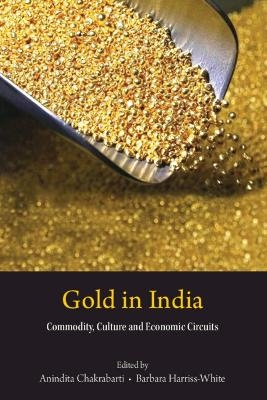
Gold in India
Cambridge University Press (Verlag)
978-1-009-52171-0 (ISBN)
India is developing as a global gold powerhouse. Yet its intricate web of trade and transformations remains largely overlooked in scholarly research. This book delves into the economic significance and cultural currency of gold in India. Drawing on insights from economic sociology, political economy and history, it combines comprehensive fieldwork with archival research to explore the circuits of gold – looking at legal and illegal imports, refining, trade, craft and mechanised production, retail and re-export. Through multidisciplinary research, it relates the roles of gold in the building and sharing of familial and gendered wealth, in the diversity of rural economic life and in women's sexuality, subordination and agency to a range of issues in state policy. It shows how exploring the quiddity of gold offers a perfect plot to deepen our understanding of the socially regulated Indian economy.
Anindita Chakrabarti is Associate Professor of Sociology, Department of Humanities and Social Sciences, Indian Institute of Technology, Kanpur. Her research areas lies in sociology of law, sociology of religion, economic sociology with a focus on sociology of work, wealth accumulation, inheritance and entrepreneurship. She is the co-editor of Religion and Secularity: Reconfiguring Islam in Contemporary India (2020) and has authored Faith and Social Movements: Religious Reform in Contemporary India (2018). She was the Visiting Fellow at the Max Planck Institute for Social Anthropology in 2022. Barbara Harriss-White is Senior Research Fellow, School of Interdisciplinary Area Studies, Professor Emeritus of Development Studies, and Emeritus Fellow of Wolfson College at the University of Oxford. Her research interests have developed from the economics of agricultural markets to India's socially regulated capitalist economy and corporate capital; and from the malnutrition caused by markets to many other aspects of deprivation: notably poverty, gender bias and gender relations, health and disability, destitution and caste discrimination. She has a long-term interest in agrarian change in southern India and has also tracked the economy of a market town there since 1972. She has directed an ESRC-DFID research project entitled Resources, Greenhouse Gas Emissions, Technology And Work In Production And Distribution Systems: Rice In India.
Introduction; Acknowledgements; 1. A Political Economy of Gold In India Barbara Harriss-White; 2. A New Sheen to the Barbarous Relic? A Long View of Monetary Gold in India Bazil Shaikh; 3. Gold and Money Laundering in India Sreekumar Gopalakrishnan; 4. Goldsmithery and Goldsmiths: How India's Informal Gold Jewellery Manufacturing Sector Works Sruti Kanungo; 5. Gold Trade and Gold Traders: The Subarnabaniks of Bengal Anindita Chakrabarti and Madhuparna Nayak; 6. 'Silk Reelers Know the Pawnbroker Well': Gold and Capital in a South Indian Town Nithya Joseph; 7. The Political and Moral Economies of Gold as Money in Rural Tamil Nadu Isabelle Guérin, G. Venkatasubramanian and Elena Reboul; 8. Malabar Gold: Relational, Reproductive Saving, Gendered Property, and Wealth Accumulation among Kerala Muslims K. C. Mujeebu Rahman and Anindita Chakrabarti.
| Erscheinungsdatum | 26.08.2025 |
|---|---|
| Zusatzinfo | Worked examples or Exercises |
| Verlagsort | Cambridge |
| Sprache | englisch |
| Gewicht | 500 g |
| Themenwelt | Geschichte ► Teilgebiete der Geschichte ► Wirtschaftsgeschichte |
| Wirtschaft ► Volkswirtschaftslehre ► Wirtschaftspolitik | |
| ISBN-10 | 1-009-52171-3 / 1009521713 |
| ISBN-13 | 978-1-009-52171-0 / 9781009521710 |
| Zustand | Neuware |
| Informationen gemäß Produktsicherheitsverordnung (GPSR) | |
| Haben Sie eine Frage zum Produkt? |
aus dem Bereich