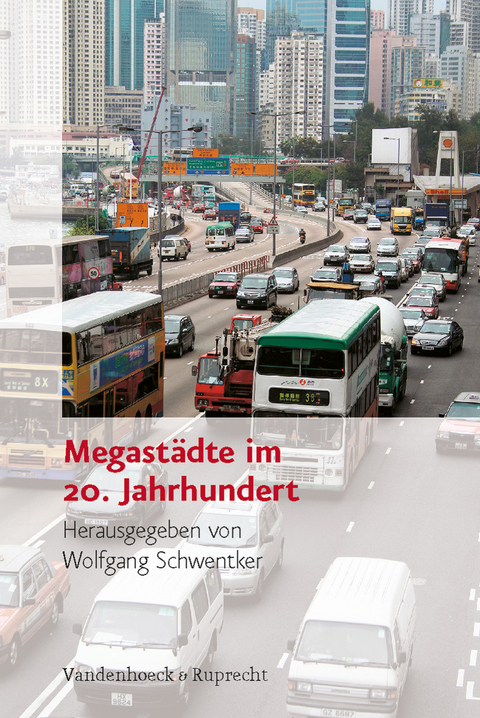
Megastädte im 20. Jahrhundert
Vandenhoeck & Ruprecht (Verlag)
978-3-525-36296-9 (ISBN)
Die Urbanisierung zählt heute unbestritten zu den charakteristischen Entwicklungsmerkmalen der modernen Welt. Eine Sonderform dieses Prozesses ist die Entstehung der Megastädte – Metropolen mit mehr als fünf Millionen Einwohnern. Die Beiträge dieses Bandes behandeln exemplarisch die alten und neuen Megastädte Chicago, Moskau, London, Shanghai, Tokio, Mexico City, Delhi, Seoul, Lagos, São Paulo und Los Angeles. Sie befassen sich mit den Strukturbedingungen megapolitaner Entwicklungen wie ihren politischen und sozialen Folgen. Der historisch-vergleichende Blick veranschaulicht dabei zahlreiche Probleme, die für die aktuelle Globalisierungsdiskussion von großem Interesse sind: gesellschaftliche und politische Umbrüche im Land, soziale und ökonomische Folgen des Wachstums, Administration und Planung sowie die Bekämpfung von Armut. Urbanization indisputably ranks among the characteristic features of development in the modern world. A special form of this process is the appearance of mega-cities: metropoles with more than five million inhabitants. The contributions to this volume provide exemplary discussions of the old and new mega-cities of Chicago, Moscow, London, Shanghai, Tokyo, Mexico City, Delhi, Seoul, Lagos, São Paolo and Los Angeles. They deal with the structural conditions of megapolitan developments as well as with their political and social consequences. The comparative historical viewpoint illustrates numerous problems that are of great interest for the current discussion about globalisation: social and political changes, the societal and economic consequences of growth, and the fight against delinquency and poverty.
Dr. Marcus Gräser ist Privatdozent am Historischen Seminar der Universität Frankfurt und Research Associate am Zentrum für Nordamerika-Forschung in Frankfurt.
Dr. Dietmar Neutatz ist Professor für Neuere und Osteuropäische Geschichte an der Albert-Ludwigs-Universität Freiburg.
Dr. Wolfgang Schwentker ist Associate Professor am Institute for the Comparative Study of Civilizations der Osaka University.
Wolfgang Schwentker
Einleitung: Die Megastadt als Problem der Geschichte
Marcus Gräser
Chicago 1880 - 1940: Urbanisierung ohne administrative Kompetenz
Dietmar Neutatz
Zwischen Planung und Chaos. Moskaus Aufstieg zur Megastadt des Sozialismus, 1900 - 1940
Rainer Liedtke
Vom Zentrum zur Peripherie. Stadtplanung in London, 1920 - 1950
Erich Pilz
Freihandel - Revolution - Atemlose Moderne: Drei Anläufe zur Metropolisierung Shanghais im 20. Jahrhundert
Wolfgang Schwentker
Die Doppelgeburt einer Megastadt: Tokyo 1923 - 1964
Christof Parnreiter
Mexico City: Die Produktion einer "Megastadt", 1930 - 1980
Michael Mann
Vision und Realität einer werdenden Mega-City: Delhi, 1947 - 1981
Eun-Jeung Lee "Das Wunder am Han-Fluss": die Expansion Seouls, 1960 - 1990
Andreas Eckert
Lagos im 20. Jahrhundert. Informalität als urbanes Prinzip
Matthias Harbeck/ Jochen Meissner
Sao Paulo: Eine Megastadt in Lateinamerika
Edward W. Soja/ Allen J. Scott
Los Angeles, 1870-1990. Historische Geographie einer amerikanischen Megastadt
This book deals with the emergence of megacities from a historical point of view. It provides a substantial analysis of urban development in some economic centers and at the periphery of the world economy.>
| Erscheint lt. Verlag | 15.12.2010 |
|---|---|
| Co-Autor | Andreas Eckert, Marcus Gräser, Matthias Harbeck, Eun-Jeung Lee, Rainer Liedtke, Michael Mann, Jochen Meissner, Dietmar Neutatz, Christof Parnreiter, Erich Pilz, Allen J. Scott, Edward W. Soja |
| Zusatzinfo | mit 24 Abb. und 13 Tab. |
| Verlagsort | Göttingen |
| Sprache | deutsch |
| Maße | 155 x 232 mm |
| Gewicht | 458 g |
| Themenwelt | Geschichte ► Allgemeine Geschichte ► Zeitgeschichte |
| Schlagworte | 20. Jahrhundert • Geschichte /Zeitgeschichte • Globalisierung • Großstadt • Metropole • Stadt • Stadtentwicklung |
| ISBN-10 | 3-525-36296-X / 352536296X |
| ISBN-13 | 978-3-525-36296-9 / 9783525362969 |
| Zustand | Neuware |
| Informationen gemäß Produktsicherheitsverordnung (GPSR) | |
| Haben Sie eine Frage zum Produkt? |
aus dem Bereich