


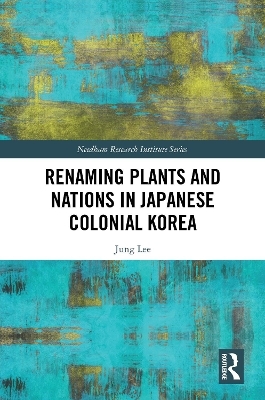
Renaming Plants and Nations in Japanese Colonial Korea
Seiten
2025
Routledge (Verlag)
978-1-032-83625-6 (ISBN)
Routledge (Verlag)
978-1-032-83625-6 (ISBN)
This book studies a striking example of intensely negotiated colonial scientific practice: the case of botanical practice in Korea during the Japanese colonisation from 1910 to 1945.
This book studies a striking example of intensely negotiated colonial scientific practice: the case of botanical practice in Korea during the Japanese colonization from 1910 to 1945.
The shared aim of botanists who encountered one another in colonial Korea to practice “modern Western botany” is successfully revealed through analysis of their fieldwork and subsequent publications. By exploring the variations in what that term should mean and the politically charged nature of the interactions between both imperial and colonial players, it reveals how botanists of the region created a form of scientific practice that was neither clearly Western nor particularly modern. It shows how the botany that evolved in this context was a product of colonially resourced, globally connected practice, immersed in intertwined traditions, rather than simply a copy of “modern Western botany.”
Utilizing extensive primary sources, this book will be of interest to students and scholars of the history of science, colonial Korean history, and environmental history.
This book studies a striking example of intensely negotiated colonial scientific practice: the case of botanical practice in Korea during the Japanese colonization from 1910 to 1945.
The shared aim of botanists who encountered one another in colonial Korea to practice “modern Western botany” is successfully revealed through analysis of their fieldwork and subsequent publications. By exploring the variations in what that term should mean and the politically charged nature of the interactions between both imperial and colonial players, it reveals how botanists of the region created a form of scientific practice that was neither clearly Western nor particularly modern. It shows how the botany that evolved in this context was a product of colonially resourced, globally connected practice, immersed in intertwined traditions, rather than simply a copy of “modern Western botany.”
Utilizing extensive primary sources, this book will be of interest to students and scholars of the history of science, colonial Korean history, and environmental history.
Jung Lee is an Assistant Professor in the Institute for the Humanities at Ewha Womans University in Seoul, South Korea.
Introduction 1. European Botany Made in Japan 2. Japanese Botany Made in Korea 3. Unsettling Imperial Universality 4. Civilizing Ourselves 5. Becoming Japanese through Collaboration 6. Imperial Transformation of Traditions 7. Confined to Imperial Privilege 8. Liberating through Provincial Botany Conclusion. Moving beyond Mistaken Names for Connected Provincial Tasks
| Erscheinungsdatum | 29.01.2025 |
|---|---|
| Reihe/Serie | Needham Research Institute Series |
| Zusatzinfo | 14 Halftones, black and white; 14 Illustrations, black and white |
| Verlagsort | London |
| Sprache | englisch |
| Maße | 156 x 234 mm |
| Gewicht | 580 g |
| Themenwelt | Geisteswissenschaften ► Geschichte ► Regional- / Ländergeschichte |
| Geschichte ► Teilgebiete der Geschichte ► Wirtschaftsgeschichte | |
| Naturwissenschaften ► Biologie ► Botanik | |
| ISBN-10 | 1-032-83625-3 / 1032836253 |
| ISBN-13 | 978-1-032-83625-6 / 9781032836256 |
| Zustand | Neuware |
| Informationen gemäß Produktsicherheitsverordnung (GPSR) | |
| Haben Sie eine Frage zum Produkt? |
Mehr entdecken
aus dem Bereich


aus dem Bereich
wie Tech-Konzerne und Großmächte die Welt unter sich aufteilen
Buch | Hardcover (2025)
C.H.Beck (Verlag)
CHF 39,20
Aufstieg und Fall der Deutschland AG
Buch | Hardcover (2025)
Suhrkamp (Verlag)
CHF 41,95


