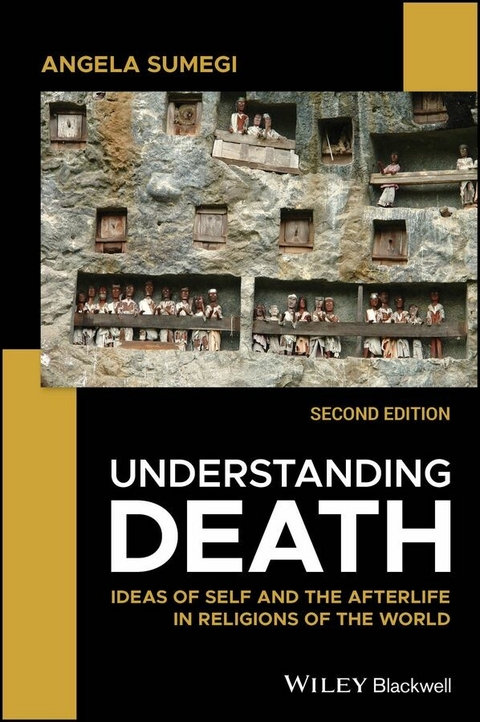
Understanding Death (eBook)
409 Seiten
Wiley-Blackwell (Verlag)
9781394185146 (ISBN)
What is death?
How can we respond to death?
Why must we die?
Where do we go from here?
Do we go anywhere?
Understanding Death offers a thorough introduction to the views and practices of various religions regarding death and life after death. Drawing on examples from Christian, Jewish, Hindu, Buddhist, and Shamanic traditions, this student-oriented textbook explores how different conceptions of the 'self' or soul inform the way humans interpret life and assign meaning to the phenomenon of death.
Incorporating contributions from members of each faith, Understanding Death provides readers with a comparative overview of how death is expressed and constructed in religious texts and canonical interpretations. Accessible chapters discuss how major religions address the nature of death itself while illustrating how history, philosophy, and ritual reflect what is important in understanding the meaning of death in that religion.
Now in its second edition, Understanding Death is revised and updated throughout, featuring three entirely new chapters on Sikhism, Jainism, as well as changing attitudes and new technologies related to death and dying in the twenty-first century.
Understanding Death: Ideas of Self and the Afterlife in Religions of the World, Second Edition, is an ideal textbook for undergraduate students and lecturers in Religious Studies programs, and an excellent resource for non-specialist readers interested in the subject.
ANGELA SUMEGI is Associate Professor (ret.) in Religion at Carleton University, Ottawa, Canada. She is the author of Dreamworlds of Shamanism and Tibetan Buddhism: The Third Place and a Senior Editor with the International Network for Training, Education, and Research on Culture, a non-profit organization dedicated to the support of Indigenous communities around the world.
1
Understanding Death
Life surrounds us. Wherever we find ourselves, we are conscious that countless other living things exist alongside us—animals, plants, insects, microbes, as well as strange combinations of not‐quite‐animal, not‐quite‐plant life, like sea anemones. Similarly, death surrounds us—from the mosquito unconsciously slapped on an arm to the daily news stories that may be of passing notice, to a loved one whose loss brings prolonged grief and mourning. In general, however, we tend to think deeply of death only when it becomes part of our emotional experience, and even then, the business and busyness of life is like a river that carries us along past the numerous moments of other deaths until our own moment arrives. One feels helpless in the face of inevitable death—what can one do about it, really? It is easy, therefore, even in the midst of death to avoid contemplating it, to turn to life where we can have some kind of control, where we can do something about it. I invite you to consider this book as a space in which you can take the time to consider questions like: What is death? Why death? Where do we go from here? Do we go anywhere? And, as you will discover, these questions are much the same as asking: What is life? Are we going anywhere now? In the complex symbol system that is language, words like “life” or “love” or “death” are bound up with feelings, emotions, and ideas that are very complicated; those that surround death have a long and complex history—you might think of it as the history of becoming who and what we are.
There are many stories (and many versions of those stories) of how death came into the world, some, like the Indonesian story of the stone and the banana hint that mortality is a result of our own foolishness and greediness.
In the central Celebes of Indonesia the people of Poso tell how the Creator used to send things down to the first people by a rope from his nearby sky home. Once he sent down a stone, and the people rejected it as useless. The creator pulled up the stone and lowered a banana instead, and the people rushed to take it. Then the voice of the creator called down and scolded the people for their foolishness. Had they accepted the stone, he said, they would have achieved its solidity and immortality, but having chosen the banana, they had chosen its mortality and had introduced death into the world
(Leeming, 2001, p. 165).
Some insert an element of sheer chance, like the Zulu story from southern Africa in which the high God sends two messengers to the ancestors: the chameleon carries the message that humans will be immortal, and the lizard carries the message that they will be mortal. The chameleon, however, stopped for a snack of berries on the way and the quick lizard arrived first with her message of death (Cotterell, 1997).
Other myths associate the presence of death with sin and disobedience. One of the more famous examples of this type is the biblical story of Adam and Eve, the first man and woman. Their life in an earthly paradise is one of innocence and ease. They enjoy the fruit of all the trees, but encouraged by the serpent, they eat the forbidden fruit of the tree of knowledge of good and evil.
The woman said to the serpent, “We may eat of the fruit of the trees in the garden; but God said, ‘You shall not eat of the fruit of the tree that is in the middle of the garden, nor shall you touch it, or you shall die.’” But the serpent said to the woman, “You will not die; for God knows that when you eat of it your eyes will be opened, and you will be like God, knowing good and evil.” So … she took of its fruit and ate; and she also gave some to her husband who was with her, and he ate. Then the eyes of both were opened and they knew that they were naked; and they sewed fig leaves together and made loincloths for themselves
(Gen. 3:1–7).
Due to this transgression, God banishes them from paradise. They must make their way in the wilderness beyond, working hard for their food, the woman experiencing pain in childbirth, and eventually they must die and return to the earth from which God made them. Ultimately, the story points to an understanding of humankind as partaking of divinity in that knowledge.
Then the Lord God said, “See, the man has become like one of us, knowing good and evil; and now, he might reach out his hand and take also from the tree of life, and eat, and live forever”—therefore the Lord God sent him forth from the garden of Eden, to till the ground from which he was taken. He drove out the man; and at the east of the garden of Eden he placed the cherubim, and a sword flaming and turning to guard the way to the tree of life
(Gen. 3:22–24).
The immortality that was denied to humans in the Garden of Eden, eternal life in the presence of God, becomes a primary goal of biblical traditions.
Stories such as these from various cultures and religions relate the mythic events of our past, they show us what it means to be human and tell us why we must die; they also look to the future and tell us where we go when this life is finished. And as to that, there are many who claim to have seen what awaits us after death. We will look more closely at the subject of near‐death experiences (NDEs) as well as various interpretations of them in the last chapter of this book. However, whether we read contemporary reports of NDEs or medieval Christian accounts of visitations to hell or the reports of those the Tibetans call delok (“returned from the dead”), a crucial aspect of the narrative is that the person who returns serves as a living witness to the experience of dying and the encounter with what lies beyond death. However, from another perspective, if death is defined as a state of no return, then perhaps such people have not died at all.
Debates and Definitions
Death from which there is no return would appear to be a different matter altogether. How do we know when that death takes place? The neurologist James Bernat outlines four questions that constitute the preconditions for defining death: (1) Is death a fundamentally biological phenomenon or a fundamentally social phenomenon? (2) Regarding higher organisms, is there any state other than dead or alive? Can there be fuzzy intervening states that have features of both? (3) Is death a process or an event? And (4) Is death reversible or irreversible? (Bernat, 2018, pp. 401–402). Bear these questions in mind as we go through this chapter.
In the past, the clues that indicated a state of death were related to the condition of the physical body. Does it move, breathe, or have a heartbeat? Does it emit heat? Is it in a state of decay? At a certain level of physical destruction, the condition of death is not ambiguous—whether it is a goldfish floating belly up in a fish tank or a body laid out in a morgue, there is no confusion as to who is living and who is dead. However, before decay or destruction is apparent, there are living states that can be mistaken for death. In Victorian times, the fear of being buried alive was so widespread that safety coffins were developed in which a bell was attached by a cord to the hand of the person who could ring it as an alarm upon awakening.
Although the final condition of death is not ambiguous, the moment when that which is alive becomes that which is dead is a lot vaguer, a lot more confusing and subject to error because death can be understood as both process and event. As an event, it marks the beginning of preparations to dispose of the body, the final physical separation from the living. The weightiness and mystery of death lies in that physical absence. Prior to the development of technology that allows us to keep the body “alive,” dying was understood, as it still is by many today, to be a passage, a process, the ending of life, which both culminates in the event of death and transforms into the processes of burial, grieving, and remembrance. Mistakes were certainly made in the past based on the traditional determination of death as the cessation of breath and heartbeat, but when developments in technology and expertise opened up a new frontier of possibilities, such as transplanting the organs of the dead to give life to others,1 then the magnitude of the error of mistaking that which is alive for that which is dead became even greater, the interconnection between life and death more difficult to disentangle, more crucial to separate. The organ to be transplanted must be living but the person from whom it is taken must be dead. You can see, then, how urgent the need would be for the medical establishment to accurately identify when death had taken place, both for the one who waits for a life‐giving transplant and for the one whose death allows for it.
Other technologies developed in the mid‐twentieth century required not only a definition of death but a definition of life. Mechanical respirators and electronic pacemakers meant that the physical body could be kept functioning like a machine without any brain activity or apparent conscious activity—a boon for those who pray that a loved one will eventually awaken from a death‐like coma, or for those who seek for an organ transplant to provide a chance at continued life, but an ethical dilemma of profound proportions for those who must consider the question of whether or not the costly machinery is merely animating a corpse. The decision to remove someone from life...
| Erscheint lt. Verlag | 21.8.2024 |
|---|---|
| Sprache | englisch |
| Themenwelt | Geisteswissenschaften ► Religion / Theologie |
| Schlagworte | Ancient Egypt • Ancient Mesopotamia • Christianity • Guru Nanak • Heaven and Hell • Hinduism • indigenous religion • Islam • Jainism • Judaism • Osiris • rituals of departure • sheol • Sikhism • soul theories • South American Warao • Zoroastrianism |
| ISBN-13 | 9781394185146 / 9781394185146 |
| Informationen gemäß Produktsicherheitsverordnung (GPSR) | |
| Haben Sie eine Frage zum Produkt? |
 EPUB (Adobe DRM)
Kopierschutz: Adobe-DRM
Adobe-DRM ist ein Kopierschutz, der das eBook vor Mißbrauch schützen soll. Dabei wird das eBook bereits beim Download auf Ihre persönliche Adobe-ID autorisiert. Lesen können Sie das eBook dann nur auf den Geräten, welche ebenfalls auf Ihre Adobe-ID registriert sind.
Details zum Adobe-DRM
Dateiformat: EPUB (Electronic Publication)
EPUB ist ein offener Standard für eBooks und eignet sich besonders zur Darstellung von Belletristik und Sachbüchern. Der Fließtext wird dynamisch an die Display- und Schriftgröße angepasst. Auch für mobile Lesegeräte ist EPUB daher gut geeignet.
Systemvoraussetzungen:
PC/Mac: Mit einem PC oder Mac können Sie dieses eBook lesen. Sie benötigen eine
eReader: Dieses eBook kann mit (fast) allen eBook-Readern gelesen werden. Mit dem amazon-Kindle ist es aber nicht kompatibel.
Smartphone/Tablet: Egal ob Apple oder Android, dieses eBook können Sie lesen. Sie benötigen eine
Geräteliste und zusätzliche Hinweise
Buying eBooks from abroad
For tax law reasons we can sell eBooks just within Germany and Switzerland. Regrettably we cannot fulfill eBook-orders from other countries.
aus dem Bereich