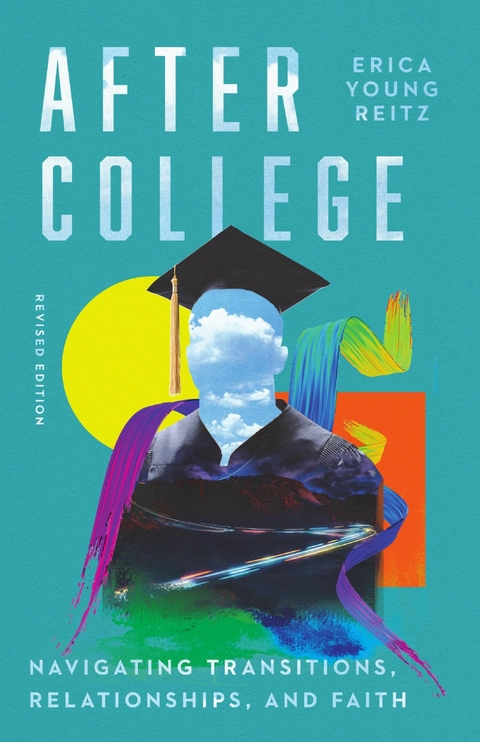
After College (eBook)
256 Seiten
IVP (Verlag)
978-1-5140-1119-5 (ISBN)
Erica Young Reitz is the founder of After College Transition, an organization that helps practitioners (higher education professionals, church leaders, and college ministers) equip students to thrive after college. Her experience working with college students includes teaching advanced writing at The Pennsylvania State University and campus ministry with the CCO (Coalition for Christian Outreach), directing Senior EXIT. She holds an MA in higher education from Geneva College with a research focus on the senior year transition, and her writing has appeared in publications including Christianity Today and Relevant. Erica serves as a leadership development specialist for Bartell and Bartell, helping individuals and teams uplevel their leadership and unleash their organizational potential. Erica lives in central Pennsylvania with her husband, Craig, and their two children.
Erica Young Reitz is the founder of After College Transition, an organization that helps practitioners (higher education professionals, church leaders, and college ministers) equip students to thrive after college. Her experience working with college students includes teaching advanced writing at The Pennsylvania State University and campus ministry with the CCO (Coalition for Christian Outreach), directing Senior EXIT. She holds an MA in higher education from Geneva College with a research focus on the senior year transition, and her writing has appeared in publications including Christianity Today and Relevant. Erica serves as a leadership development specialist for Bartell and Bartell, helping individuals and teams uplevel their leadership and unleash their organizational potential. Erica lives in central Pennsylvania with her husband, Craig, and their two children.
“Go to an Unknown Land”
TRUSTING A FAMILIAR GOD FOR UNFAMILIAR TIMES
I dwell in possibility.
In the cold November of her first year out of college, Natalia sat by the fireplace in her parents’ home, weeping. Bone-tired, overworked, and lonely, she thought, This is not what life is supposed to be like. Working over seventy hours a week just to stay afloat in a demanding marketing job, she had no time to make new friends. She also longed to be in a dating relationship—something she assumed would have happened in college. Her stomach hurt every Sunday evening at the thought of facing another week with her impossible boss, catty coworkers, and overflowing inbox.
Natalia felt desperate for just one of the luxuries she had enjoyed while she was a student: an hour to sit in a coffee shop with a friend or to play the piano alone. Leaving college felt like the “world had been ripped out” from under her. Nothing felt settled. Natalia confessed, “I felt inadequate and incapable of making life work.” Desperate for something familiar, Natalia made frequent trips to her parents’ home on the weekends. She longed for something known amid so much upheaval and uncertainty.
As we step into the great unknown of life after college, it’s important to know we are not alone. We journey forward in the footsteps of a long line of leavers—an ancient history of God’s people who have abandoned the familiar to follow a call into uncharted territory.
ABRAHAM’S JOURNEY
Consider Abraham (known as Abram before God changed his name in Genesis 17:5). God called him to leave his country, his people, and his father’s household in Harran for a new dream. When Abraham reached the ripe age of seventy-five, God said, “Go.” Give up everything:
Go from your country, your people and your father’s household to the land I will show you.
I will make you into a great nation,
and I will bless you;
I will make your name great,
and you will be a blessing.
I will bless those who bless you,
and whoever curses you I will curse;
and all peoples on earth
will be blessed through you. (Genesis 12:1-3)
When we understand the cultural context, this ask is huge. God calls Abraham to let go of all he has ever known and everyone who knows him. He must say goodbye forever to his kinship group—his entire network of relationships and social support. There’s no technology that will connect him to his people or hometown ever again. If he says yes to God, he says yes to a five-hundred-mile separation from all he’s ever known—a one-month journey by caravan.1 He will never again walk the dusty paths his feet have traveled, smell the salty air after a hard rain, see his aging father’s smile, or hear the roar of laughter as he and his friends throw their heads back in the glow of a night fire. It is goodbye for good.
As the male heir, Abraham is slated to inherit everything from his father, securing his place in society and in the family line.2 This too he must give up to follow God. Will he choose to forsake everything to heed God’s call? Will he cut ties with the land, his family, his inheritance, and his people—a bond built over seven and a half decades? Leave his entire life behind to embrace God’s promise?
Scripture says that Abraham goes (Genesis 12:4). He chooses to trust God—to take him at his word. Abraham has faith that God will provide anew everything he asked Abraham to give up.3
As we step into life after college, we too are called to forsake the familiar to embrace something new. As exciting as this time may be, it’s also marked by great uncertainty.4 We trade a familiar place and our familiar purpose within it for a new reality. Leaving college may mean we have to redefine relationships, embrace new roles, and let go of certain ways of doing things. As we enter the unknown, we can look to Abraham and be encouraged by his faith in an uncertain time, and by God’s faithfulness to him.
We can also take comfort from Abraham’s example when our expectations don’t match our reality. Abraham steps out in faith only to find his path littered with trials. He encounters plague, persecution, detour, and doubt long before reaching the fulfillment of God’s plan. At one point, he must reroute to Egypt because the land God has told him he’ll possess is brittle with drought. Not to mention that the wife with whom he is supposed to build a family is still barren at age sixty-five. The fruition of God’s plan is not looking so good.
The oppression and struggles cause Abraham to disbelieve God and question his character. Can God really be trusted? Abraham wonders, “O Sovereign LORD, how can I be sure that I will actually possess [the land you promised]?” (Genesis 15:8 NLT). Perhaps you also question whether the God you followed during college can be trusted in this time of transition. Maybe you find yourself throwing your hands up, wondering, How can I be sure you really have a plan, God?
In Abraham’s fear and frustration, God is gracious. He patiently reminds Abraham of his character and promise:
Do not be afraid, Abram.
I am your shield,
your very great reward. . . .
I am the LORD, who brought you out of Ur of the Chaldeans to give you this land to take possession of it.
(Genesis 15:1, 7, emphasis added)
The same God who led him in Ur is also the God of Abraham’s transition. Likewise, the God of your college years—the God of Abraham—is the same God who leads you in the joy and challenge of the transition.
God doesn’t change his tune when our circumstances change. His character and promises endure, even in dynamic times. Everything may be shifting around us, but God, our rock, remains the sure and solid place where we find our footing. He is the God who pursues, promises, and provides—even after college.
PREPARING TO ENTER THE UNKNOWN
Looking to God and his character is a crucial part of preparing for any transitional time. So are the perspectives and practices we choose. Though there are many things we cannot predict as we enter the unknown, we can manage our expectations, choose intentional actions, and adopt healthy heart attitudes.
Before we address these, it’s important to realize that our everyday expectations, actions, and attitudes are always connected to a bigger picture: our worldview. Like putting on a pair of glasses, our worldview forms the lens through which we view our experiences and make sense of the world in which we live. Our worldview is the “sum total of our beliefs about the world.”5 It’s our understanding of reality, shaped by our answers to fundamental life questions.6
-
Does God exist?
-
Who am I?
-
Why am I here?
-
What’s wrong with the world?
-
What’s the solution?
Though we may wrestle with life’s big questions until the day we die and some of us may articulate our worldview better than others, all of us have a “set of presuppositions . . . about the basic makeup of our world.”7 From how we view money, work, relationships, food, media, sex, and so on, our presuppositions inform everything we do and experience—every decision we make.
The more we root ourselves in the truest truths of the Bible—and grapple with what it means to live them out in our everyday lives—the more prepared we will be to pursue faithfulness after college. What else allows us to keep on keeping on? Dr. Steven Garber, author of The Fabric of Faithfulness, dedicated himself to exploring this question.
This wasn’t just a cerebral exercise for Garber. Having journeyed with many students over many years, his curiosity was personal. He needed to know why some of his young friends stayed the course while others struggled. Those who had “deepened and not discarded their beliefs” over the decades had the following qualities in common.
-
1. They developed a worldview that made sense of truth in a pluralizing, secularizing world.
-
2. They found a mentor who incarnated the worldview, showing that ideas do have legs.
-
3. They chose a community over that time that was a flesh-and-blood embodiment of this worldview.8
Forming a cohesive worldview—and finding like-minded individuals with whom we can live it out—is foundational for faithfulness. According to Garber, living a congruent life means that we seek to align our beliefs with our behaviors.9 This is no small thing. But it is possible.
Life’s trials often tempt and test us, even to the core of our beliefs. If we don’t know what we believe or if our claims don’t carry into the lives that we really live, we may end up adopting the worldview of those around us, borrowing bits and pieces from other worldviews, or filling in the gaps with something insufficient. On the positive side, times of upheaval can also bring clarity, causing us to refine our worldview. Dr. George Barna found “times of personal crisis and pain as periods of vulnerability to [worldview] change.”10
Not sure what you believe or what it means to...
| Erscheint lt. Verlag | 18.2.2025 |
|---|---|
| Verlagsort | Lisle |
| Sprache | englisch |
| Themenwelt | Geisteswissenschaften ► Religion / Theologie |
| Schlagworte | calling • christian college graduate • college graduate • college senior • college student • Community • Discernment • finding community post college • Generation Z • gen z • post college life • recent graduate • Vocation • Young Adult • Young Adulthood |
| ISBN-10 | 1-5140-1119-0 / 1514011190 |
| ISBN-13 | 978-1-5140-1119-5 / 9781514011195 |
| Informationen gemäß Produktsicherheitsverordnung (GPSR) | |
| Haben Sie eine Frage zum Produkt? |
 EPUB (Wasserzeichen)
DRM: Digitales Wasserzeichen
Dieses eBook enthält ein digitales Wasserzeichen und ist damit für Sie personalisiert. Bei einer missbräuchlichen Weitergabe des eBooks an Dritte ist eine Rückverfolgung an die Quelle möglich.
Dateiformat: EPUB (Electronic Publication)
EPUB ist ein offener Standard für eBooks und eignet sich besonders zur Darstellung von Belletristik und Sachbüchern. Der Fließtext wird dynamisch an die Display- und Schriftgröße angepasst. Auch für mobile Lesegeräte ist EPUB daher gut geeignet.
Systemvoraussetzungen:
PC/Mac: Mit einem PC oder Mac können Sie dieses eBook lesen. Sie benötigen dafür die kostenlose Software Adobe Digital Editions.
eReader: Dieses eBook kann mit (fast) allen eBook-Readern gelesen werden. Mit dem amazon-Kindle ist es aber nicht kompatibel.
Smartphone/Tablet: Egal ob Apple oder Android, dieses eBook können Sie lesen. Sie benötigen dafür eine kostenlose App.
Geräteliste und zusätzliche Hinweise
Buying eBooks from abroad
For tax law reasons we can sell eBooks just within Germany and Switzerland. Regrettably we cannot fulfill eBook-orders from other countries.
aus dem Bereich