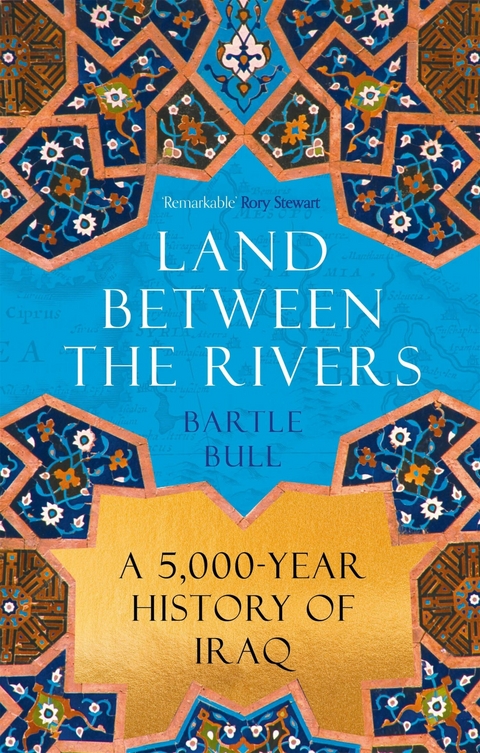
Land Between the Rivers (eBook)
576 Seiten
Atlantic Books (Verlag)
978-1-83895-786-5 (ISBN)
Bartle Bull is a former editor of the Middle East Monitor and foreign editor of Prospect magazine. He has written from the Middle East for the New York Times, Washington Post, Wall Street Journal, Financial Times, Daily Telegraph, Foreign Policy, Die Welt and other publications. His work, widely syndicated in Europe and the United States, has been featured in Corriere della Sera, International Herald Tribune, Los Angeles Times and elsewhere. He has appeared many times on radio and television and is most frequently a guest on Fox Business News; he has also appeared on the BBC, NPR, Fox News and Al Jazeera.
'Elegant, erudite, ambitious, inventive - a remarkable blend of research, imagination and first-hand experience.' Rory Stewart'A sweeping and superbly written epic' Wall Street Journal'A work of great ambition... an account that is informed, filled with insights and a cracking read too.' Peter FrankopanIraq is where civilisation was born, where East and West have mixed and clashed since long before Alexander, and it was here by the waters of Babylon where Judaism was born and the Sunni-Shia schism took its bloody shape. Inspired by extensive reporting from the region and a decade delving deep into its history, Land Between the Rivers chronicles Iraq's uniquely central role on the global stage throughout the past five millennia. We begin the story with ancient Sumer and Gilgamesh building the walls of Uruk ('Iraq') to make a great name for himself at the edge of historical time. We end it in 1958, as the last royal family of Iraq is slaughtered on the steps of a small palace in Baghdad, the most effervescent, free and promising capital in the Middle East. Bartle Bull's remarkable, sweeping achievement reminds us that the region defined by the land between the rivershas, throughout history, played host to the contest pitting humanism against the machinations of power and fate. 'Conceptual originality and laudable ambition... Inspired by firsthand experience of the region.'New York Times'A sweeping and superbly written epic... He is a more compassionate, and much better informed, heir to Gertrude Bell... Throughout his account, Mr. Bull highlights the human, and humanist, threads in the political tapestry.' Wall Street Journal'Dazzling erudition and narrative flair come together in this superb history of Iraq... essential reading' Justin Marozzi, author of Islamic Empires'Panoptic, fearless and beautifully written' Christopher de Bellaigue, author of The Lion House and The Islamic Enlightenment
Bartle Bull is a former editor of the Middle East Monitor and foreign editor of Prospect magazine. He has written from the Middle East for the New York Times, Washington Post, Wall Street Journal, Financial Times, Daily Telegraph, Foreign Policy, Die Welt and other publications. His work, widely syndicated in Europe and the United States, has been featured in Corriere della Sera, International Herald Tribune, Los Angeles Times and elsewhere. He has appeared many times on radio and television and is most frequently a guest on Fox Business News; he has also appeared on the BBC, NPR, Fox News and Al Jazeera.
Preface
Land Between the Rivers is the result of over a decade’s research and writing. The topic is large: five millennia, beginning somewhat before Gilgamesh, king of the Sumerian city-state of Uruk in about 2700 BC, at the edge of historical time. More than anywhere else, Mesopotamia, the famous land between the rivers, where civilization was born, where East and West have mixed, clashed, and fed each other since long before Alexander the Great died at Babylon in 323 BC, has led an existence that could be called, from a Eurasian perspective at any rate, one version of a history of the world.
A theme emerges. It is the theme of all politics, and perhaps ultimately of all culture: humanity’s innate freedom, the expression of this in humanism, and the struggle of this with tyranny. By humanism we mean not secularism but rather those qualities that inhere definitively in mankind: reason, natural law, autonomy. There are no grounds, depending on the faith, to find these at odds with religion.
Iraq has uniquely formed and manifested the phenomenon. The thesis revealed itself gradually over the years of working on this history, an insight picked up, piece by piece, from the soil like the discoveries of an archaeologist. Looking back, maybe the idea should be no surprise. What else would we expect from the axial land?
The earliest antecedent posited for Iraq’s name is the ancient Sumerian city of Uruk, birthplace of writing, the place where Gilgamesh was king, and greatest of the early cities in the small region in southern Iraq where civilization was born. The term “Iraq” has been used by Arabs to describe much of the present-day country of that name since at least the sixth century AD. Other terms have included “Mesopotamia,” “Turkish Arabia,” and more. Generally these expressions reflect their users, with their own times and contexts. While the latter inevitably change, there is no question that the place referred to has for millennia been a distinct, if internally variegated, part of the world. Through much of ancient history the components were “Babylonia” in the south and center and “Assyria” in the north. Under the five centuries of the Ottoman Turks, it was the three provinces, north to south, of Mosul, Baghdad, and Basra.
“Mesopotamia” is a Greek name that has meant differing things over the centuries. Literally meaning “between rivers,” it has always referred to land associated with the Tigris and Euphrates. Its widest definition includes country as far north as parts of southeast Turkey and as far south as Kuwait. Parts of western Syria can also be included. In Hellenistic times, “Mesopotamia” referred to the northern third of this area. In this book, as many have done before, we use the term to describe the area more or less embordered by the modern frontiers of Iraq. It can broadly be said that while “Mesopotamia” is the ancient Greek and European name, the name “Iraq,” in its various forms, has been more local. Similarly, with the usual caveats about the dangers of generalization, “Persia” is the ancient Greek and hence European name for the land more locally known as “Iran.” In the latter case, as with “Iraq” and “Mesopotamia,” we use the terms for the most part interchangeably.
The last word on the question of whether Iraq really is a distinct place, historically, can be given to the following fact. If one divides the five thousand years of human civilization into ten periods of five centuries each, during the first nine of these the world’s leading city was in one of the three regions of current-day Iraq, while none was in a neighboring land, much less—with the relatively brief (by Iraq’s standards) exception of ancient Rome—anywhere else.
First came the great cities of the Sumerian civilization of southern Iraq, including Uruk and Ur. Then Babylon rose, north of Sumer. Nineveh—at Mosul which long gave its name to the northernmost of Iraq’s three traditional regions—rose in the seventh century BC, to be followed by Babylon again through the time of Alexander. Babylon was followed by Seleucia-on-Tigris, city of Alexander’s Hellenistic successors, in the center of the country. After the interlude of Rome in the centuries around the time of Christ, Seleucia rose again as Ctesiphon, principal city of the Sasanian Persian Empire in the first half millennium after Christ. The last of the major Mesopotamian cities was Baghdad during the Abbasid dynasty, with its heyday in the ninth and tenth centuries AD.
Other cities in other lands rose and fell: Thebes and Alexandria in Egypt, for example, or Patna in India and Tang Dynasty Xi’an in China. But none of these defined historical epochs for a broader world like the urban centers of the land that invented civilization and that continued through all these periods to be the essential crossroads.
I first came to know Iraq during the four years I spent reporting and writing for newspapers and magazines during the 2004–2008 war there that erupted after a year or so of lesser violence following the 2003 US-led invasion. I was a freelancer, with no resources for security but also none of the restrictions that come with working for corporate media in a war zone. I worked and survived by the generosity and courage of the Iraqi people amongst whom I lived and moved. I placed myself at their mercy, as a guest in their houses and in their land. It paid off. I came to owe the place a great debt. Wanting to understand Iraq better, and to share what I learned about its longer and more fundamental story, as I had previously shared some of its more recent stories during my years in journalism, I embarked on this book.
Apart from the main theme of humanism versus the various outlooks of power, other principal threads emerge. One is that Iraq—the Mesopotamian floodplain with its southern wetlands and northern foothills—is very much a place, and one whose modern borders reflect this well. Another is Iraq’s extraordinary centrality to broader cultural and political history over the millennia. A third is how this, thanks partly to Iraq’s location and its mostly flat and open landscape, also means that the story, from the beginning, is so often driven by outsiders.
Another is the extraordinary length of what might be called an East-West conflict in Iraq. The Roman-Persian wars lasted from 54 BC until 628 AD.* Nine centuries later a version of the conflict resumed, when the Ottoman Turks made Constantinople again the capital of a strong empire, taking on much of the organization of the Second Rome; and when Iran’s Safavid Empire saw Persia at last whole and imperial once more for the first time since the Muslim invasions of the seventh century AD. The Ottoman-Persian wars, adding an additional layer of Sunni versus Shia, lasted from 1507 until 1823. More than anywhere else, these conflicts took place in Iraq. An expansive view would have them beginning on Iraq’s soil with Alexander the Great in 331 BC and continuing well into the twenty-first century.
Iraq’s historical status as the locus for these many conflicts is indisputable, and it has been interesting to discover how long that has been the case. That said, a parallel and probably more important narrative also emerges. This is the extraordinarily fruitful cross-pollination of cultures in the region, without which our existence today would be incalculably poorer. There is also the profound depth of liberal humanism—to put it in Western terms—in the region, embodied in the teachings of Zoroaster and in the many strands of Sufism, in Persian mystical poetry and in the dazzling cosmopolitanism of Ottoman government and society, and in other ways that readers will encounter here. All of this stands as an essential antidote to the influential narratives that have predominated since the “War on Terror” period when I first worked in the region.
If we limit ourselves to truisms and received wisdom, there is as little point in reading history as in writing it. Thus, at a more specific level than the broad themes outlined above, we are led to some surprising historical conclusions when we take an unusually long perspective that brings its own look at the facts.
To take an example from the realm of religion, naturally a central topic in Land Between the Rivers, from this longer perspective Shiism emerges as, in essence, a faith of its own, rather than as a sect or heresy within some greater “Islam.” (Alternatively, one could use a definition of Islam as a constellation of traditions that, while dramatically distinct in their roots and usually opposed to each other in message, happen to share a broad regional origin while making reference back to the Prophet. The view here is that this definition is so broad as to be of doubtful value.) The Sunni-Shia split is often described as a family feud over a disputed succession; in fact, it represents something far deeper, which Iraq itself reflects, namely a profound fault line between the Semitic and Perso-Hellenistic traditions. To take another example of an interesting, unexpected conclusion that was revealed by the unusual perspective taken here: the ideas that killed the project of Iraqi rebirth, freedom, and moderation in the twentieth century were indeed foreign, but the culprit ideologies were those of Berlin circa 1880–1945, not those of London—ethnic nationalism and collectivism, not constitutional liberalism. A third example: the Versailles conference of...
| Erscheint lt. Verlag | 22.8.2024 |
|---|---|
| Verlagsort | London |
| Sprache | englisch |
| Themenwelt | Geisteswissenschaften ► Geschichte ► Regional- / Ländergeschichte |
| Schlagworte | abbsid • Age of Empires • Assyria • Babylon • Baghdad • Bettany Hughes • birth of civilisation • Civilisation • History • Homeland • Iraq • Istanbul • Jews • King Faisal • Mesopotamia • Middle East • Mongol • Peter Frankopan • Saddam Hussein • Simon Sebag Montefiore • The Hurt Locker • The Silk Road • Tigris • West Asia |
| ISBN-10 | 1-83895-786-3 / 1838957863 |
| ISBN-13 | 978-1-83895-786-5 / 9781838957865 |
| Informationen gemäß Produktsicherheitsverordnung (GPSR) | |
| Haben Sie eine Frage zum Produkt? |
 EPUB (Wasserzeichen)
DRM: Digitales Wasserzeichen
Dieses eBook enthält ein digitales Wasserzeichen und ist damit für Sie personalisiert. Bei einer missbräuchlichen Weitergabe des eBooks an Dritte ist eine Rückverfolgung an die Quelle möglich.
Dateiformat: EPUB (Electronic Publication)
EPUB ist ein offener Standard für eBooks und eignet sich besonders zur Darstellung von Belletristik und Sachbüchern. Der Fließtext wird dynamisch an die Display- und Schriftgröße angepasst. Auch für mobile Lesegeräte ist EPUB daher gut geeignet.
Systemvoraussetzungen:
PC/Mac: Mit einem PC oder Mac können Sie dieses eBook lesen. Sie benötigen dafür die kostenlose Software Adobe Digital Editions.
eReader: Dieses eBook kann mit (fast) allen eBook-Readern gelesen werden. Mit dem amazon-Kindle ist es aber nicht kompatibel.
Smartphone/Tablet: Egal ob Apple oder Android, dieses eBook können Sie lesen. Sie benötigen dafür eine kostenlose App.
Geräteliste und zusätzliche Hinweise
Buying eBooks from abroad
For tax law reasons we can sell eBooks just within Germany and Switzerland. Regrettably we cannot fulfill eBook-orders from other countries.
aus dem Bereich