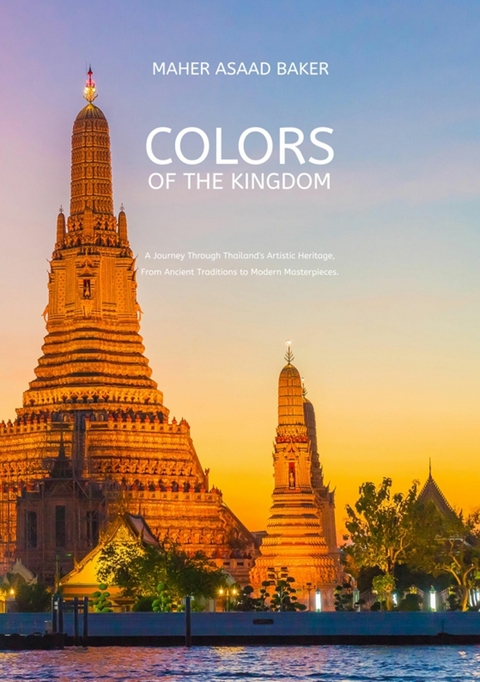
Colors of the Kingdom (eBook)
98 Seiten
tredition (Verlag)
978-3-384-27119-8 (ISBN)
Maher Asaad Baker (In Arabic: ???? ???? ???) is a Syrian Musician, Author, Journalist, VFX & Graphic artist, and Director, he was born in Damascus in 1977. Since his teens, he has been building up his career, starting by developing applications and websites while exploring various types of media-creating paths. He started his career in 1997 with a dream of being one of the most well-known artists in the world. Reading was always a part of his life as he was always surrounded by his father's books, but his writing ability didn't develop until a later age as his most time was occupied with other things such as developing, writing songs and music, or in media projects production, he is most known for his book "How I wrote a million Wikipedia articles" and a novel entitled "Becoming the man".
Maher Asaad Baker (In Arabic: ماهر أسعد بكر) is a Syrian Musician, Author, Journalist, VFX & Graphic artist, and Director, he was born in Damascus in 1977. Since his teens, he has been building up his career, starting by developing applications and websites while exploring various types of media-creating paths. He started his career in 1997 with a dream of being one of the most well-known artists in the world. Reading was always a part of his life as he was always surrounded by his father's books, but his writing ability didn't develop until a later age as his most time was occupied with other things such as developing, writing songs and music, or in media projects production, he is most known for his book "How I wrote a million Wikipedia articles" and a novel entitled "Becoming the man".
Historical Foundations
The origins of Thai art can be traced back to prehistoric times, as archaeological findings offer valuable insights into the artistic expressions of ancient Thai civilizations. The earliest forms of art in Thailand included cave paintings, pottery, and sculptures, which were used by people to convey their beliefs, experiences, and cultural identities.
Cave paintings found in different parts of Thailand, like Pha Taem National Park and Tham Pha Nang Khoi, demonstrate the artistic skills of prehistoric inhabitants. These paintings, mostly made using red and white pigments, depict a variety of themes, including human figures, animals, and geometric patterns. The human figures are often shown in different activities such as dancing, hunting, and fishing, reflecting the daily lives of ancient Thai people. The animal motifs mostly feature wild animals like elephants, deer, and tigers, which may have held symbolic significance in the cultural and religious practices of prehistoric Thai societies.
Pottery also played a significant role as an artistic expression during this time. The earliest pottery found in Thailand dates back to the Neolithic era and is characterized by simple forms and rough textures. However, as pottery-making techniques evolved, the pottery became more sophisticated, featuring intricate designs and motifs. The pottery discovered in Ban Chiang recognized as a UNESCO World Heritage site, is a prime example of the advanced pottery-making techniques of prehistoric Thai people. It is characterized by its distinctive red-on-buff ware, adorned with elaborate geometric patterns and human and animal motifs.
During the prehistoric period in Thailand, sculptures became a prominent form of artistic expression. The earliest sculptures found in Thailand are mainly made of stone and depict human figures and animals. The sculptures of human figures are characterized by stylized forms and exaggerated features, possibly serving a symbolic or ritualistic purpose. On the other hand, animal sculptures are often depicted in a more naturalistic manner, likely influenced by the surrounding environment and the fauna of that time.
The neighboring civilizations, such as Dvaravati, Srivijaya, and Khmer, had a significant impact on the development of Thai art, influencing artistic techniques, styles, and iconography.
The Dvaravati civilization, which thrived in central Thailand from the 6th to the 11th century, played a crucial role in shaping Thai art. As a predominantly Buddhist civilization, the religious beliefs and practices of the people heavily influenced the art forms of that era. Dvaravati art is characterized by a distinctive style, combining Indian and local artistic traditions. Examples of Dvaravati art include Buddha images, known for their serene expressions, elongated earlobes, and stylized drapery. Additionally, Dvaravati art features various motifs, such as mythical creatures, floral patterns, and geometric designs, often integrated into the architectural elements of Buddhist temples and shrines.
The Srivijaya civilization, which thrived in present-day southern Thailand and Sumatra from the 7th to the 13th century, was a maritime trading power that had extensive contacts with India, China, and other Southeast Asian civilizations. The Srivijaya civilization played a significant role in spreading Buddhism in Southeast Asia, and the religious beliefs and practices of the people had a profound impact on the art forms of that era. Srivijaya art is characterized by a unique style that fuses Indian, Chinese, and local artistic traditions. The most notable examples of Srivijaya art are the Buddha images, known for their serene expressions, elongated earlobes, and stylized drapery. Srivijaya art also includes various motifs such as mythical creatures, floral patterns, and geometric designs, which were often integrated into the architectural elements of Buddhist temples and shrines.
The Khmer civilization, which thrived in present-day Cambodia from the 9th to the 15th century, had a substantial influence on Thai art development. The Khmer civilization was predominantly Hindu, but Buddhism also played a significant role in the religious beliefs and practices of the people. Khmer art is known for its unique style, combining Indian and local artistic traditions. The most notable examples of Khmer art are the grand architectural structures, such as temples and palaces, distinguished by their massive scale, detailed carvings, and intricate ornamentation. Khmer art also includes various motifs like mythical creatures, floral patterns, and geometric designs, often integrated into the architectural elements of temples and palaces.
Religion, particularly Buddhism and Hinduism, had a profound impact on the early forms, symbols, and rituals of Thai art. The religious beliefs and practices significantly influenced the iconography and aesthetics of Thai art, as well as the function and purpose of artistic expressions.
Buddhism, which originated in India in the 6th century BCE, had a profound impact on the development of Thai art. The religious beliefs and practices of Buddhism, such as the Four Noble Truths and the Eightfold Path, provided a framework for the artistic expressions of the Thai people. The Buddha images are the most prominent examples of Thai art and serve as a visual representation of the Buddha's teachings and the path to enlightenment. These images are characterized by their serene expressions, elongated earlobes, and stylized drapery, which allude to the Buddha's renunciation of worldly pleasures and his attainment of enlightenment. The Buddhist temples and shrines were adorned with intricate carvings and elaborate ornamentation to enhance the spiritual experience of the worshippers.
Hinduism, which originated in India in the 2nd millennium BCE, also had a significant impact on the development of Thai art. The religious beliefs and practices of Hinduism, such as the concept of dharma and the worship of deities, provided a framework for the artistic expressions of the Thai people. The Hindu deities, such as Vishnu, Shiva, and Brahma, were often depicted in Thai art, either as individual figures or as part of a larger narrative scene. The Hindu temples and shrines, which were centers of religious worship and artistic expression, were adorned with intricate carvings and elaborate ornamentation to enhance the spiritual experience of the worshippers.
Temples, shrines, and religious structures played a significant role in the development of Thai art. These structures served as the centers of religious worship and artistic expression. They provided a platform for the artistic expression of the Thai people, such as the creation of Buddha images, murals, and sculptures. The temples and shrines were adorned with intricate carvings and elaborate ornamentation, which enhanced the spiritual experience of the worshippers. These artistic expressions also served to reinforce the religious beliefs and practices of the people, as well as the cultural and social dynamics of the ancient Thai civilizations.
The origins of Thai art can be traced back to the prehistoric epoch, where archaeological remnants provide insight into the artistic expressions of the ancient Thai civilizations. The development of Thai art was significantly influenced by neighboring civilizations, such as Dvaravati, Srivijaya, and Khmer, shaping the early Thai art forms, symbols, and rituals. Religion, particularly Buddhism and Hinduism, played a significant role in shaping the iconography and aesthetics of Thai art, as well as the function and purpose of the artistic expressions. These beliefs and practices had a profound impact on the development of Thai art.
Traditional Music
The melodious sounds of Thailand's traditional music have been captivating listeners for centuries. This rich musical heritage has evolved, influenced by various cultural and historical factors. To truly appreciate the beauty and complexity of traditional Thai music, it is essential to understand its origins and development.
The history of Thai music can be traced back to ancient times, with evidence of musical instruments and performances found in archaeological sites dating back to the Bronze Age. The earliest forms of Thai music were likely used for religious ceremonies and rituals, as well as for entertainment during communal gatherings.
As Thailand's cultural and political landscape evolved, so too did its music. The Mon and Khmer civilizations, which flourished in present-day Thailand before the arrival of the Thai people, had a significant impact on the development of Thai music. The Mon, in particular, is credited with introducing Buddhism to Thailand, which brought with it new forms of religious music.
The establishment of the Sukhothai Kingdom in the 13th century marked the beginning of the Thai cultural identity, and with it, the development of a distinctly Thai musical tradition. During this period, the royal court played a crucial role in the patronage and development of music. Court musicians were highly respected and skilled in performing a variety of musical genres, from classical court music to folk music.
The Ayutthaya Kingdom, which succeeded the Sukhothai Kingdom in the 14th century, saw the continued development of Thai music. The Ayutthaya period was marked by increased contact with foreign cultures, including those of India, China, and Persia. These cultural exchanges had a profound impact on Thai music, with new instruments, techniques, and styles being...
| Erscheint lt. Verlag | 25.6.2024 |
|---|---|
| Verlagsort | Ahrensburg |
| Sprache | englisch |
| Themenwelt | Kunst / Musik / Theater ► Malerei / Plastik |
| Kunst / Musik / Theater ► Musik | |
| Geisteswissenschaften ► Geschichte ► Regional- / Ländergeschichte | |
| Schlagworte | ART • Calligraphy • Contemporary • contemporary Art • cultural heritage • History • Pottery • sculpture • thai art • Thailand • Thai Painting • Traditional Music |
| ISBN-10 | 3-384-27119-X / 338427119X |
| ISBN-13 | 978-3-384-27119-8 / 9783384271198 |
| Informationen gemäß Produktsicherheitsverordnung (GPSR) | |
| Haben Sie eine Frage zum Produkt? |
 EPUB (Wasserzeichen)
DRM: Digitales Wasserzeichen
Dieses eBook enthält ein digitales Wasserzeichen und ist damit für Sie personalisiert. Bei einer missbräuchlichen Weitergabe des eBooks an Dritte ist eine Rückverfolgung an die Quelle möglich.
Dateiformat: EPUB (Electronic Publication)
EPUB ist ein offener Standard für eBooks und eignet sich besonders zur Darstellung von Belletristik und Sachbüchern. Der Fließtext wird dynamisch an die Display- und Schriftgröße angepasst. Auch für mobile Lesegeräte ist EPUB daher gut geeignet.
Systemvoraussetzungen:
PC/Mac: Mit einem PC oder Mac können Sie dieses eBook lesen. Sie benötigen dafür die kostenlose Software Adobe Digital Editions.
eReader: Dieses eBook kann mit (fast) allen eBook-Readern gelesen werden. Mit dem amazon-Kindle ist es aber nicht kompatibel.
Smartphone/Tablet: Egal ob Apple oder Android, dieses eBook können Sie lesen. Sie benötigen dafür eine kostenlose App.
Geräteliste und zusätzliche Hinweise
Buying eBooks from abroad
For tax law reasons we can sell eBooks just within Germany and Switzerland. Regrettably we cannot fulfill eBook-orders from other countries.
aus dem Bereich