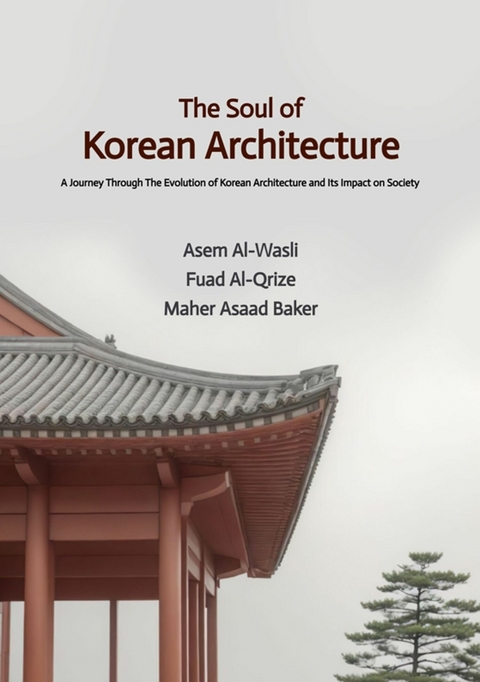
The Soul of Korean Architecture (eBook)
55 Seiten
tredition (Verlag)
978-3-384-18768-0 (ISBN)
Asem Al-Wasli (Arabic:???? ???????) is a Yemeni Musician, Author, and Writer. With extensive research and field experience, Al-Wasli has authored numerous publications. With a keen eye for detail and a unique storytelling style, Al-Wasli's writing has captivated readers from around the world.
Asem Al-Wasli (Arabic:عاصم الواصلي) is a Yemeni Musician, Author, and Writer. With extensive research and field experience, Al-Wasli has authored numerous publications. With a keen eye for detail and a unique storytelling style, Al-Wasli's writing has captivated readers from around the world.Fuad Al-Qrize (Arabic:فؤاد الكريزي) is a Yemeni musician, Producer, Author And Writer, The chief executive officer (CEO) of Al-Qrize Productions since October 2018 and has been its chief operating officer (Yemeni Artists Syndicate in Ibb, Yemen) since 2019. Fuad Al-Qrize, is one of the known names with regards to arising musicians in Yemen. Other than being the youngest successful effective TV and music producer, he is also a well-known author. His music makes him a known face. His fame taking off in the new recent months over the scene.Maher Asaad Baker (In Arabic: ماهر أسعد بكر) is a Syrian Musician, Author, Journalist, VFX & Graphic artist, and Director, he was born in Damascus in 1977. Since his teens, he has been building up his career, starting by developing applications and websites while exploring various types of media-creating paths. He started his career in 1997 with a dream of being one of the most well-known artists in the world. Reading was always a part of his life as he was always surrounded by his father's books, but his writing ability didn't develop until a later age as his most time was occupied with other things such as developing, writing songs and music, or in media projects production, he is most known for his book "How I wrote a million Wikipedia articles" and a novel entitled "Becoming the man".
Introduction
The architectural accomplishments of ancient Korea are a testament to the innovative spirit, technical sophistication, and aesthetic sensibilities of its people. Through careful study, we can develop a profound respect for those who came before us, and gain insight into how their built environments both shaped, and were shaped by the social, political, and spiritual dimensions of Korean civilization.
The earliest surviving examples of constructed shelters in the Korean peninsula date back to Neolithic settlements of around 8000 BC, during the Jeulmun Pottery Period. These comprised simple pit dwellings dug into the ground, sometimes lined with stone, with thatched sod or woven reed roofs. By 1500 BC in the Bronze Age, raised architecture had emerged involving post-and-beam wooden structures placed directly on the earth, as evidenced by archaeological sites. Climate and topographical conditions on the Korean peninsula incentivized the development of efficient load-bearing wood joinery that could withstand harsh winters and summer monsoon rains.
From the 3rd century BC Gojoseon period to the 1st century AD, palace complexes, and tomb structures reflected increasing social hierarchy, and ritual importance of burial rites. Earthen walls circled cities, and flagstone-paved roads connected settlements, pointing to early urban planning. Goguryeo period architecture from the 1st century BC to the 7th century AD demonstrated geometric symmetry, woodwork mastery, and advanced tiled roofing. Stately mud-wall fortress-cities were raised, some featuring inner and outer citadels with protective moats, and sentry towers - manifestations of a sophisticated militaristic culture.
Goguryeo's architectural zenith was seen in Anak Tomb No. 3, a pyramidal five-chamber burial structure faced with neatly cut stone blocks. Interior painted frescoes hint at the refinement of concurrent wooden buildings, though none survive intact today. Raised wood, and thatch domestic housing became standardized during Silla (57 BC-935 AD), and Balhae (691-926 AD) periods, with distinct gabled, and hipped saddleback roof styles developing. Socioeconomic specialization and populations supported urbanization, establishing a durable foundation for future Korean architectural forms.
The unified Goryeo Dynasty built extensively upon earlier traditions while establishing several formative conventions that would persist into the Joseon era. Buddhism gained widespread patronage, reflected in grand sanctuaries like the 11th-century Five-Story Stone Pagoda, and Seokguram Grotto, technical masterworks showcasing refined masonry, tiled roofs, and woodwork sculptural detail. Stone became important for pagoda substructures, allowing taller multistory designs, though buildings themselves remained principally of wood joints, tiles, and plaster.
Distinctive architectural elements emerged such as jeonji bul, curved gable extensions supported by decorated brackets above secondary eaves. Multi-room, one-story geomun (servant quarters) flanked larger two-story oge (main residences) in yangban aristocrat homes. Palace complexes expanded with raised wooden halls, bridges, and pavilions set among landscaped gardens connected by walkways - early examples of elegant scholastic compounds integrated with nature that would later characterize Korean nobility residences.
Urban planning principles coalesced around walled cities containing jangseong fortress towers, administrative buildings, and residential quarters centered on main boulevards. Standardized hanok wooden domestic architecture evolved, optimized for cold winters yet ventilation in summer, featuring raised wooden floorboards, heated ondol underfloor systems, warm roofs with extended eaves, sliding screens, and walls allowing flexible indoor-outdoor living. These designs maximized livable space within modest footprints, becoming iconic of traditional Korean residential culture.
During its 500-year reign, the Joseon Dynasty saw immense cultural, and technological progress alongside socio-political stability, allowing Korean architecture, and planning to fully mature. Confucian philosophy guided the harmonious siting of palaces, shrines, and yangban elites' villages concerning natural landscapes. Consolidated design standards appeared, such as the regulated architectural mapping (gyecheop) system for public works including palace complexes, and government offices in cities.
Palaces expanded under a standard gyeongcheong plan - symmetrical axes, ceremonial archways, paved main boulevards, and two-story halls faced with a polished stone or wooden walls enclosing inner walled courtyards. The apogee, Gyeongbokgung Palace, was meticulously erected in the 15th century with tall blue-tiled hip-and-gable roofs atop gray stone walls, and platforms. Finer outdoor, and indoor architectural elements of carved, and painted wooden embellishments reached stunning sophistication.
Donglimmun and Donuimun ceremonial gates emerged as defining images of palace entrances crowned by triple-gabled hip-and-gable roofs supported by large decorative brackets, exemplifying Korean mastery over complex curved architectural wooden members. Elsewhere, fortress towns like Hwaseong proclaimed progressive late 18th-century military architecture and landscaping principles.
The yangban scholar-official class constructed elegant yet understated scholar's retreats (seowon) blending study halls, and landscaped surroundings that fostered intellectual, and spiritual pursuits. Commoner residential areas in walled cities contained densely packed yet meticulously ordered hanoks adapted to small lots. Rural farm villages featured thatch-roofed homes encircled by raised earthen mounds, and ridges serving defensive-practical functions.
Despite periods of fragmentation and foreign oppression, traditional Korean architectural forms proved remarkably persistent, and adaptive. Though battered by modernization campaigns of the 20th century, important elements survive today in reconstructed heritage sites, continuing cultural functions, and modified living architectural styles. Perhaps above all, hanok homes remain iconic globally recognized symbols of the refined yet pragmatic adaptations evolved over millennia by the resilient Korean people and their building traditions.
By studying traditional Korean architecture's evolutionary origins, and innovations across dynasties, we can appreciate the ingenuity, technical sophistication, and aesthetic sensibilities embedded within its indigenous cultural vocabulary of forms. These evolved solutions reflected intimate relationships Koreans cultivated with place, climate, available materials, societal structures, and spiritual dimensions of lived experience. A heritage of adaptive innovation for maximizing livable space, mitigating harsh weather, defending settlements, and crafting refined interior-exterior living integration merits renewed respect, and understanding across borders in our increasingly interconnected world.
Traditional Korean architecture manifested a deeply respectful relationship with the natural landscape. For centuries, it has blended structures seamlessly into their environments through the use of indigenous materials, awareness of topography, and climate considerations, and emphasis on hierarchical positioning reflecting Confucian cosmic order. Palaces, shrines, scholar's retreats, and villages were carefully sited, and oriented according to feng shui principles aligning with mountain, and water flows. Buildings' scaled incorporation of outer ridges, terraces, and inner landscaped courtyards fostered a centered mindset attuned to seasonal changes and celestial rhythms.
This organic integration went hand in hand with pragmatic measures, from raised foundations preventing flooding to warm roofs with extended eaves shielding harsh winds, and rain. Window placement and hewn ventilation gaps maximized natural lighting, and airflow according to thermal dynamics. The resulting architectural works nestled snugly into scenery in relationship rather than rivalry with nature, whose balanced energies, and aesthetic scenes they respectfully complemented rather than dominated. This Confucian-inspired view of humans as stewards living in partnership rather than mastery over landscapes has profoundly shaped Korea's cultural identity, and connection to place.
Traditional residential hanok housing demonstrated architectural intelligence finely calibrated to topography while cultivating close-knit communities supported by adjacent agricultural, and administrative quarters. Their meticulous arrangement and division of living spaces fused interior-exterior realms, fluidly dissolving barriers between families, and neighbors through shared walkways, courtyards, and village compounds oriented along mountain spines. This community living facilitated cooperation, neighborhood bonds, and mutual assistance essential for coping with climatic adversity, upholding societal cohesion, and order through all strata of society from palaces to farming hamlets.
Throughout Korean history, spiritual ideas have powerfully motivated architectural innovations and the proliferation of related artistic works. Buddhism in particular stimulated technical developments like stone pagoda construction, and the refinement of delicate sculptural woodwork embellishing prayer halls, and shrines from the Goryeo era onward. Religious sites blended with nature along rivers, and mountains formed focal nodes anchoring surrounding village life. Grand palace Buddhist sanctuaries like Beopjusa served as loci where...
| Erscheint lt. Verlag | 28.3.2024 |
|---|---|
| Verlagsort | Ahrensburg |
| Sprache | englisch |
| Themenwelt | Geisteswissenschaften ► Geschichte ► Regional- / Ländergeschichte |
| Technik ► Architektur | |
| Schlagworte | Cultural symbolism in Korean architecture • Hanok houses • Korea • Korean Architecture • Modern Korean architecture • Preservation of Korean architecture |
| ISBN-10 | 3-384-18768-7 / 3384187687 |
| ISBN-13 | 978-3-384-18768-0 / 9783384187680 |
| Informationen gemäß Produktsicherheitsverordnung (GPSR) | |
| Haben Sie eine Frage zum Produkt? |
 EPUB (Wasserzeichen)
DRM: Digitales Wasserzeichen
Dieses eBook enthält ein digitales Wasserzeichen und ist damit für Sie personalisiert. Bei einer missbräuchlichen Weitergabe des eBooks an Dritte ist eine Rückverfolgung an die Quelle möglich.
Dateiformat: EPUB (Electronic Publication)
EPUB ist ein offener Standard für eBooks und eignet sich besonders zur Darstellung von Belletristik und Sachbüchern. Der Fließtext wird dynamisch an die Display- und Schriftgröße angepasst. Auch für mobile Lesegeräte ist EPUB daher gut geeignet.
Systemvoraussetzungen:
PC/Mac: Mit einem PC oder Mac können Sie dieses eBook lesen. Sie benötigen dafür die kostenlose Software Adobe Digital Editions.
eReader: Dieses eBook kann mit (fast) allen eBook-Readern gelesen werden. Mit dem amazon-Kindle ist es aber nicht kompatibel.
Smartphone/Tablet: Egal ob Apple oder Android, dieses eBook können Sie lesen. Sie benötigen dafür eine kostenlose App.
Geräteliste und zusätzliche Hinweise
Buying eBooks from abroad
For tax law reasons we can sell eBooks just within Germany and Switzerland. Regrettably we cannot fulfill eBook-orders from other countries.
aus dem Bereich