


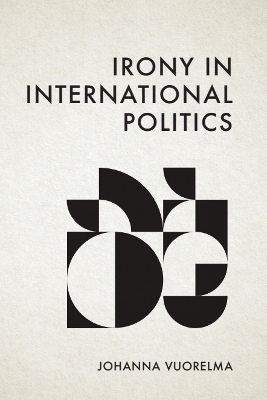
Irony in International Politics
Seiten
2024
Edinburgh University Press (Verlag)
978-1-3995-3177-1 (ISBN)
Edinburgh University Press (Verlag)
978-1-3995-3177-1 (ISBN)
Examines the use of ironic language among political leaders in international politics.
Irony in International Politics investigates ironic language in international politics, focusing on how political leaders use irony to articulate failures of the liberal international order. Underlining the political, performative, and affective nature of irony in international politics, the book introduces a novel typology of four forms of irony: justice-seeking irony, hegemony-seeking irony, recognition-seeking irony, and disruption-seeking irony. Irony is typically understood as a tool of the underdog who seeks to reveal the hypocritical nature of the powerful, but Irony in International Politics shows that irony is increasingly used by the powerful who expose that there is a wide gap between the ideal and the actual in international politics. Studying cases from Turkey, the United Kingdom, Hungary, the United States, Sweden, Germany, Greece, and Russia, the book illustrates how the post-Cold War era represents a distinct scene of irony with its particular identity struggles and power asymmetries that have prompted ironic reactions.
Irony in International Politics investigates ironic language in international politics, focusing on how political leaders use irony to articulate failures of the liberal international order. Underlining the political, performative, and affective nature of irony in international politics, the book introduces a novel typology of four forms of irony: justice-seeking irony, hegemony-seeking irony, recognition-seeking irony, and disruption-seeking irony. Irony is typically understood as a tool of the underdog who seeks to reveal the hypocritical nature of the powerful, but Irony in International Politics shows that irony is increasingly used by the powerful who expose that there is a wide gap between the ideal and the actual in international politics. Studying cases from Turkey, the United Kingdom, Hungary, the United States, Sweden, Germany, Greece, and Russia, the book illustrates how the post-Cold War era represents a distinct scene of irony with its particular identity struggles and power asymmetries that have prompted ironic reactions.
Johanna Vuorelma is University Researcher at the Centre for European Studies, University of Helsinki.
Acknowledgements
Introduction: A Gap Between the Ideal and the Actual
1. Understanding Irony in International Politics
2. Justice-seeking Irony
3. Hegemony-seeking Irony
4. Recognition-seeking Irony
5. Disruption-seeking Irony
Conclusion: The Limits of Irony in International Politics
Bibliography
| Erscheinungsdatum | 27.12.2024 |
|---|---|
| Zusatzinfo | 1 Table |
| Verlagsort | Edinburgh |
| Sprache | englisch |
| Maße | 156 x 234 mm |
| Themenwelt | Geschichte ► Allgemeine Geschichte ► Zeitgeschichte |
| Geisteswissenschaften ► Sprach- / Literaturwissenschaft ► Sprachwissenschaft | |
| Sozialwissenschaften ► Politik / Verwaltung ► Europäische / Internationale Politik | |
| Sozialwissenschaften ► Politik / Verwaltung ► Politische Systeme | |
| Sozialwissenschaften ► Politik / Verwaltung ► Staat / Verwaltung | |
| Sozialwissenschaften ► Politik / Verwaltung ► Vergleichende Politikwissenschaften | |
| ISBN-10 | 1-3995-3177-8 / 1399531778 |
| ISBN-13 | 978-1-3995-3177-1 / 9781399531771 |
| Zustand | Neuware |
| Informationen gemäß Produktsicherheitsverordnung (GPSR) | |
| Haben Sie eine Frage zum Produkt? |
Mehr entdecken
aus dem Bereich
aus dem Bereich
die großen Jahre der Soziologie 1949-1969
Buch | Hardcover (2025)
Klett-Cotta (Verlag)
CHF 39,20
eine Deutschlandreise im Jahr 1958
Buch | Hardcover (2024)
C.H.Beck (Verlag)
CHF 29,90


