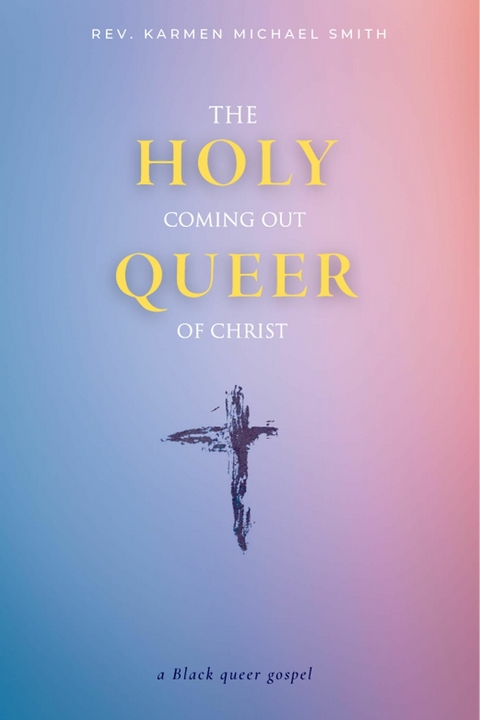
Holy Queer (eBook)
165 Seiten
Poor Culture Press (Verlag)
979-8-9876366-1-9 (ISBN)
INTRODUCTION
I was born in Greenville, Texas, in the fall of 1978. Although I was born in Greenville’s hospital, I often tell people, jokingly, that I was born on the church pew. This means that although I may have been birthed in a small town steeped in institutional racism, I was born into a community, a belief system, and a dynamic faith experience known as the Black church. Back then, everybody went to church on Sundays, at a minimum. People did not refer to their church simply by name. If someone asked me what church I attended, I’d answer strategically.
“My church home is Bethlehem Baptist Church.” We responded this way because, in the Black community, the Black church was a second home, an auxiliary school, a social hall, and its members were a part of the family—my church family. At “church,” we had services, Sunday school, vacation Bible school, choir rehearsals, group outings, movie nights, sleepovers for the “young people,” and many meals. I can still smell the aroma of fried chicken that would float into the sanctuary from the kitchen. It was the only thing powerful enough to quickly make a Baptist preacher end his sermon. The church is where we not only participated in rituals like communion but also learned the challenges and joys of the living practice of community. Yet, despite all of its efforts, the Black church remained a heterotopia—worlds within worlds, mirroring and yet upsetting what is outside—amid a racist town.
“Welcome to Greenville, The Blackest Land, The Whitest People.”
That sign was lifted high above the main street in Greenville, Texas, around 1921. Greenville is a small town in East Texas, but the sign has a larger-than-life history. Depending on whom you ask, its meaning also has a diverse and storied history. It was taken down for inappropriate language in the 60s or early 70s, again, depending on whom you ask. Still, the harmful effects of the words linger. Those were more than just words. It was much more than “just a sign.” It was a message, a warning, and a spectacle.
Whenever someone talks about hanging anything, my brain starts looking for the spectacle. Maybe it is the minister in me, and perhaps it is just lived experience. Maybe it is the many times that I have revisited the passion narrative, looking for missed meanings. The image of Christ, the innocent, hanging on the cross between thieves on a hill called Golgatha. Golgatha is an Aramaic word that means “place of the skull.” Think skull and crossbones. It symbolizes danger, and Jesus Christ didn’t just happen to be crucified on a hill representing danger. It didn’t just happen to be on a hill for all to see, even at a distance. No, this was intentional. Hanging Jesus Christ on a cross in this way created a spectacle. Spectacles grab our attention, and this one has continued to grab our attention for centuries because it was designed to send a message. It, too, was more. It was a warning to all that would follow in his footsteps. And just like the crucifixion, the sign that hung in downtown Greenville is still discussed many decades later.
You will likely see a “welcome” sign when traveling from one tiny town to the next. When you venture across Denver’s state lines and into the historic town of Golden, you will likely encounter a large sign beckoning: “WELCOME TO GOLDEN.” The slogan underneath the welcome reads: “Where the West Lives” Now, you may not know anything about Golden, as most do not. However, the slogan speaks to the social contract under which the community operates. In small-town terms, it’s “the way things are done ‘round these parts.” I must say that I have never been to Golden. Yet, as a Black man, I would have reservations about traveling to a place where the “west”—a period consisting of cowboys, outlaws, gunslinging, and the unfavorable treatment of Native Americans and Black people was looked upon favorably—still lives on. Just as the sign-in Golden was prescriptive, so was the sign in Greenville. It truly spoke to “the way” things were, and some would argue still are done.
In all matters, White and White-passing—individuals with skin light enough to pass for White—had the upper hand on the Blacks. For the Black community, our place was in the fields in service to the “Whitest people.” It was an audacious slogan that spoke volumes about the tenor of the town and provided clear direction for anyone who would find themselves out of step in the community.
The Black church mirrored the Black home as a subversive space that allowed Black people to operate with dignity amidst the reign of white supremacy. It gave us the freedom to be Blackish in our distinct ways. It gave us opportunities to exercise and honor being Black beyond skin color. It cultivated, fostered, and nurtured being Black as a people, a culture, and a religion. On any Sunday morning at Bethlehem Baptist Church, the parking lot was littered with freshly washed cars with white wall ties, gleaming hub caps, and leather seats. Yet, you would also see families stepping out of the “church van” that picked up members who couldn’t afford a car or were elderly. I rode the church van, and it was awesome. This was long before the days of Uber or Lyft. Back then, you’d offer a neighbor “gas money” to “ride” you to the store or church. Yet, the church van or bus was an innovation that leveled the Black community’s playing field.
You may not have had the means to go many places, but you could always get a ride to church. You could always get access to the community. Back then, congregations listened to and acted upon their members’ present and physical needs. Even in the parking lot, there was common ground and solidarity in being members of this community, but it didn’t stop there. At Bethlehem, like most black churches, we carried on a tradition from slavery and dressed up on Sundays—our Sunday’s best. The men dressed, without stylists, in a manner that would rival any high-end fashion editorial. There were three-piece, double-breasted, and pinstriped suits adorned with fine ties anchored by elegant tie pins, decorative pocket squares, and expensive-looking watches and rings. But, the show stoppers were always the shoes. They were made from various animal skins and shined to perfection. And the women... The women exiting automobiles radiated the full spectrum of colors in couture dresses and suits (some home-made) that looked like they had been styled by Andre Leon Talley or for an Ebony Fashion Show. From dresses to hats to shoes and the essential coordinated handbag, this was a level of fashion only rivaled by the men and women on the streets of west Africa.
Yes, we were financially poor. Yes, we lived in a racially divided town, but we dressed because we were seen in the Black church. We were seen as human beings. In the Black church, we were men and women. We were some-bodies in a world that saw us as nobodies. In the Black church, we were Mr. and Mrs. so and so, and Brother and Sister so and so, instead of “boy” and “gal.” We were the distinguished familial community at which the Apostle Paul would have marveled. And we gladly brought our dignified selves to church on Sundays.
Walking through the doors into Bethlehem’s pristine vestibule with its meticulously cleaned floors, gilded mirror, and portraits of former ministers who had served the congregation, you felt like you had arrived somewhere important. The Black church was likely the only public building in town where multiple images of Black men and Black families hung on the walls with such regalia. It was a mini-museum honoring the church’s history and the people who had served it. And, right beyond the vestibule was the sanctuary. It was a sacred space. It was the place where the community came together to worship.
“Aunt” Bettye Jo Mondy (who had earned aunt’s title as a sign of respect, not by birth relation) would strike up a song on the piano. The other musicians would join her. The doors to the sanctuary would open, and there was the choir. They looked militantly majestic in their matching choir robes that also matched the color of the red pews. The congregation would stand to receive the choir in anticipatory excitement as they “marched” into the service. Choir robes swaying, hands clapping, strutting down the center aisle in lockstep with all the pomp and circumstance of a coronation ceremony, and eventually arriving in the choir stand and facing sideways until the last choir member joined them. Then, like in a scene from a movie, the choir director raised their hand, flicked their wrist, and the entire choir turned forward like soldiers. Rocking in unison, the energized sound of the choir let loose and bathed the congregation in a glorious sound.
When we all get to heaven
What a day of rejoicing that will be.
When we all see Jesus
We’ll sing and shout the victory.
And just like that, the congregation was lifted up and away from the racist and oppressive reality of this small town in...
| Erscheint lt. Verlag | 23.2.2023 |
|---|---|
| Sprache | englisch |
| Themenwelt | Geisteswissenschaften ► Religion / Theologie |
| ISBN-13 | 979-8-9876366-1-9 / 9798987636619 |
| Informationen gemäß Produktsicherheitsverordnung (GPSR) | |
| Haben Sie eine Frage zum Produkt? |
 EPUB (Ohne DRM)
Größe: 1,0 MB
Digital Rights Management: ohne DRM
Dieses eBook enthält kein DRM oder Kopierschutz. Eine Weitergabe an Dritte ist jedoch rechtlich nicht zulässig, weil Sie beim Kauf nur die Rechte an der persönlichen Nutzung erwerben.
Dateiformat: EPUB (Electronic Publication)
EPUB ist ein offener Standard für eBooks und eignet sich besonders zur Darstellung von Belletristik und Sachbüchern. Der Fließtext wird dynamisch an die Display- und Schriftgröße angepasst. Auch für mobile Lesegeräte ist EPUB daher gut geeignet.
Systemvoraussetzungen:
PC/Mac: Mit einem PC oder Mac können Sie dieses eBook lesen. Sie benötigen dafür die kostenlose Software Adobe Digital Editions.
eReader: Dieses eBook kann mit (fast) allen eBook-Readern gelesen werden. Mit dem amazon-Kindle ist es aber nicht kompatibel.
Smartphone/Tablet: Egal ob Apple oder Android, dieses eBook können Sie lesen. Sie benötigen dafür eine kostenlose App.
Geräteliste und zusätzliche Hinweise
Buying eBooks from abroad
For tax law reasons we can sell eBooks just within Germany and Switzerland. Regrettably we cannot fulfill eBook-orders from other countries.
aus dem Bereich