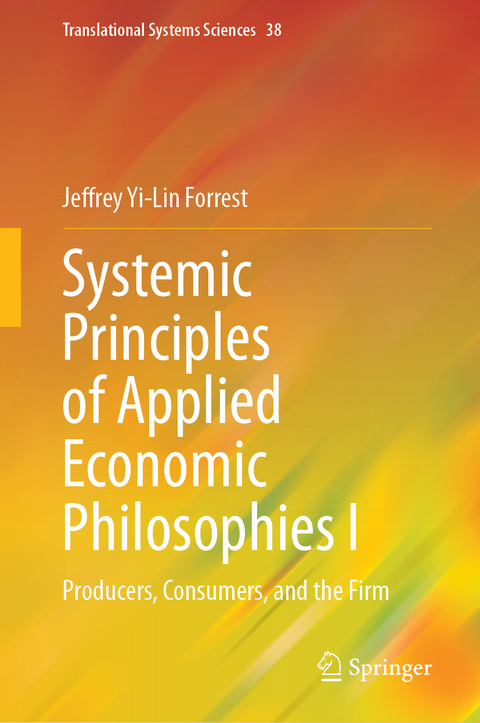
Systemic Principles of Applied Economic Philosophies I
Springer Verlag, Singapore
978-981-99-7272-2 (ISBN)
The target audience of the book includes graduate students and scholarly researchers, particularly those who look for opportunities to develop new territories in the world of economic and business knowledge. The book also aims at front-line decision-making managers and entrepreneurs who seek sounder theories than the commonly available ones on which to base their critical decisions. By competently employing the systemic intuition–yoyo model, graduate students, scholarly researchers, decision-making managers, and entrepreneurs can attain new conclusions. In addition, they will gain insightful understanding of market signals without unnecessarily expending other resources of limited availability.
Jeffrey Yi-Lin Forrest (aka Yi Lin) earned his PhD degree in mathematics from Auburn University, Alabama; and served as a visiting professor of economics, finance, mathematics, and systems science at several major universities from various countries. Currently, he is a professor of mathematics and the research coach for the School of Business at Slippery Rock University of Pennsylvania. Other than heading the International Institute for General Systems Studies, he served or serves on the editorial boards of thirteen scholarly journals, as a co-editor-in-chief of the international journal “Advances in Systems Science and Application,” the editor- or co-editor-in-chief of four book series, “Grey System (Springer),” “Systems Evaluation, Prediction, and Decision-Making (CRC Press, New York),” “Communications in Cybernetics, Systems Science and Engineering,” and “Communications in Cybernetics, Systems Science and Engineering – Proceedings (CRC Press, Balkema).” As of today, he publishedover 500 research works, including over 50 authored or edited volumes.
Chapter 1. Revisits to Some Fundamental Issues Facing Economic & Business Studies.- Chapter 2. Systems Science and the Logic of Systemic Reasoning.- Chapter 3. Closed and Open Systems.- Chapter 4. The Evolution of Freely Competitive Markets.- Chapter 5. Consumer’s Natural Endowments.- Chapter 6. Scenarios not Adequately Investigated. Chapter 7. Each Customer Defines What is Optimal and How to Optimize.- Chapter 8. Rationality: Optimal Fit to the Underlying Value-Belief System.- Chapter 9. Economy’s Properties Emerging out of Micro Agents of Inconsistent Interests.- Chapter 10. Overcoming the Challenge of the Fallacy of Composition.- Chapter 11. Production, Costs and Profits of a Producer Firm.- Chapter 12. Production Possibilities, Correspondence and Factor Demand.- Chapter 13. Optimal Production Correspondence and Aggregated Supply/Demand.- Chapter 14 Consumption Preferences and Utilities.- Chapter 15. Convexities of Consumption Preferences.- Chapter 16. Budget and Demand Correspondence.- Chapter 17. Management Efficiency and Organizational Inefficiency.
| Erscheinungsdatum | 07.02.2024 |
|---|---|
| Reihe/Serie | Translational Systems Sciences |
| Zusatzinfo | 1 Illustrations, black and white; XXII, 417 p. 1 illus. |
| Verlagsort | Singapore |
| Sprache | englisch |
| Maße | 155 x 235 mm |
| Themenwelt | Geschichte ► Teilgebiete der Geschichte ► Wirtschaftsgeschichte |
| Wirtschaft ► Allgemeines / Lexika | |
| Wirtschaft ► Volkswirtschaftslehre ► Makroökonomie | |
| Wirtschaft ► Volkswirtschaftslehre ► Mikroökonomie | |
| Schlagworte | Consumption Preference • invisible Hand • Method of Optimization • Rationality • Utility Representation |
| ISBN-10 | 981-99-7272-8 / 9819972728 |
| ISBN-13 | 978-981-99-7272-2 / 9789819972722 |
| Zustand | Neuware |
| Informationen gemäß Produktsicherheitsverordnung (GPSR) | |
| Haben Sie eine Frage zum Produkt? |
aus dem Bereich