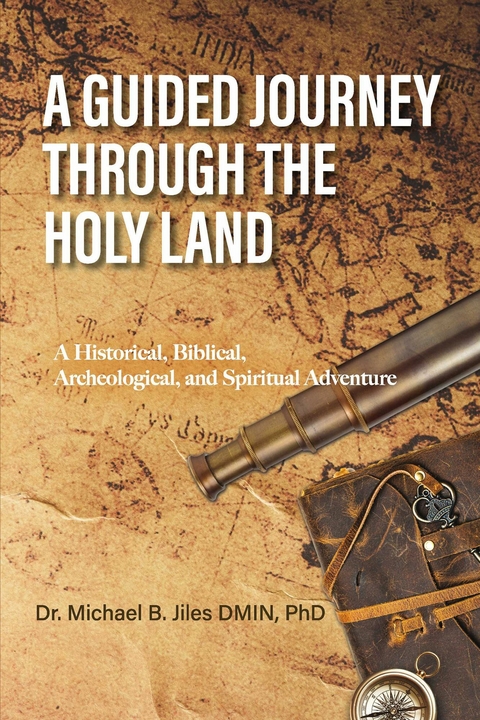
Guided Journey Through the Holy Land (eBook)
350 Seiten
Bookbaby (Verlag)
979-8-3509-0396-6 (ISBN)
With expert guidance, readers will delve into the Bible and other sacred texts to gain a deeper understanding of the spiritual significance of the Holy Land, while also exploring the many archaeological sites that dot the landscape, including ancient cities, tombs, and religious monuments. Along the way, readers will encounter a diverse array of cultures and religions, from the ancient Israelites to the early Christians and beyond. Filled with stunning photographs, maps, and illustrations, "e;A Guided Journey Through the Holy Land"e; is an immersive and unforgettable adventure that will leave readers with a newfound appreciation for this remarkable region and its enduring impact on the world. Whether you are a history buff, a spiritual seeker, or simply an armchair traveler looking for a thrilling journey, this book is sure to captivate and inspire.
Introduction
Where To Begin!
The Holy Land is one of the most fascinating places on earth, with a rich and complex history that spans thousands of years. From the ancient civilizations of the Canaanites, Philistines, and Israelites to the birthplace of three major world religions, the Holy Land is a treasure trove of archaeological wonders and historical landmarks.
At the heart of this land lies the city of Jerusalem, which has been a center of religious and political importance for millennia. But the Holy Land encompasses much more than just this one city. From the coastal plains to the Jordan Valley, from Galilee to the Negev, the Holy Land is a diverse and complex region with many archaeological sites waiting to be explored.
To help visitors navigate this fascinating region, the Israel Museum in Jerusalem has created a model map that provides an overview of the important archaeological sites throughout Jerusalem. In addition, this model map serves as a guide to the many historical landmarks found throughout this city.
In this book, we will take you on a journey through the Holy Land, beginning with the model map from the Israel Museum and exploring the many archaeological sites and historical landmarks in the old city of Jerusalem.
From the early days of human civilization to the modern day, we will explore the rich history of this fascinating land and the many cultures and societies that have called it home. Join us on this guided journey through the Holy Land and discover the wonders of this ancient and complex region.
We begin our expedition with the Israel Museum (Hebrew: מוזיאון ישראל, Muze’on Yisrael). This museum was established in 1965 as Israel’s national museum. The location of the museum is situated on a hill in the Givat Ram neighborhood of Jerusalem.
If time permits, you might visit the Bible Lands Museum next door at the end of your tour.
The Beginning
Once you have purchased your ticket, you will turn right into the courtyard. As you continue your walk, you will embark upon the Holy City. The Holy land Model of Jerusalem is a 1:50 scale model of Jerusalem in the late Second Temple Period.
As you look down on the Temple Mount, you are standing on the Mount of Olives. You will first be mesmerized at the sheer magnitude of the model city but refocus for a minute and imagine you are looking from the same vantage point as Jesus did around 30 A.D. or earlier when he sought solitude in this grove of olive trees.
Now that the shock starts to wear off, you will gaze down into the Kidron valley, and your eyes will rise to see Herod’s Temple, constructed from around 20 BCE.
The Temple Model viewed from the south, showing the Pool of Siloam at the bottom, and the stepped walkway leading up to the Temple Mount.
You will now allow your eyes to drift to the south of the Temple until you find a large pool of water. The Bible refers to the collection as the Pool of Siloam, which Jesus sent the man after he healed him of his blindness.
John 9:7 – “So the man went and washed, and came home seeing.” New Living Translation He told him, “Go wash yourself in the pool of Siloam” (Siloam means “Sent” or “Sent One”).
The next significant part of your orientation is locating all the gates surrounding the Temple Mount.
The Old City of Jerusalem is full of history and archaeology that can transport you back in time. To navigate properly, it is crucial to familiarize yourself with the different gates surrounding the city. Each gate has its own unique story to tell and is worth exploring.
The East Gate, mentioned in Ezekiel 44:1-3, is located on the eastern side of the Old City. It was through this gate that Jesus made his triumphal entry into Jerusalem, as described in Matthew 21:1-11.
Ezekiel 44
Then the man brought me back to the sanctuary’s outer gate facing east, and it was shut. 2 The LORD said, “This gate is to remain shut. It must not be opened; no one may enter through it. It is to remain shut because the LORD, the God of Israel, has entered through it. 3 The prince himself is the only one who may sit inside the gateway to eat in the presence of the LORD. He is to enter by way of the portico of the gateway and go out the same way.”
As I read this incredible story of prophecy and fulfillment, my heart swells with awe and wonder at the mysterious ways of the divine. In 1517, the Turks unknowingly sealed the eastern gate to prevent the fulfillment of the prophecy that the Messiah would enter through it. Little did they know that they were fulfilling the very prophecy in chapter 44, which decreed that the gate would remain shut until the coming of the Prince of Peace.
The East Gate as seen from the Kidron Valley.
As I contemplate the centuries passed, my emotions are stirred, with Arab tanks pointed toward the eastern gate during the 1967 war, poised to attack. Yet, for unknown reasons, the order to fire was never given, and the Jews recaptured the city. The gate remains sealed to this day, a testament to the power and sovereignty of the divine plan.
Matthew 21: 1-11
21 As they approached Jerusalem and came to Bethphage on the Mount of Olives, Jesus sent two disciples, 2 saying to them, “Go to the village ahead of you, and at once you will find a donkey tied there, with her colt by her. Untie them and bring them to me. 3 If anyone says anything to you, say that the Lord needs them, and he will send them right away.”
4 This took place to fulfill what was spoken through the prophet: 5 “Say to Daughter Zion, ‘See, your king comes to you, gentle and riding on a donkey, and on a colt, the foal of a donkey.’”
6 The disciples went and did as Jesus had instructed them. 7 They brought the donkey and the colt and placed their cloaks on them for Jesus to sit on. 8 A very large crowd spread their cloaks on the road, while others cut branches from the trees and spread them on the road. 9 The crowds that went ahead of him and those that followed shouted,
“Hosanna to the Son of David!”
“Blessed is he who comes in the name of the Lord!”
“Hosanna in the highest heaven!”
10 When Jesus entered Jerusalem, the whole city was stirred and asked, “Who is this?”
11 The crowds answered, “This is Jesus, the prophet from Nazareth in Galilee.”
The passage in Matthew 21:1-11 is significant as it portrays a moment of great emotion and anticipation as Jesus enters Jerusalem, fulfilling the prophecy of the arrival of the King of Zion. The people are excited and joyful as they witness Jesus riding on a donkey, acknowledging him as their King and Savior. The atmosphere is energized as the crowd spreads their cloaks on the road and waves palm branches, shouting, “Hosanna to the Son of David!” and “Blessed is he who comes in the name of the Lord!”
The emotions of the people in this passage are overwhelmingly positive and hopeful as they welcome Jesus with open arms and celebrate his arrival. The passage evokes feelings of awe, reverence, and gratitude toward Jesus, and the significance of his appearance is not lost on the people. The anticipation and joy are palpable as the crowd recognizes Jesus as fulfilling the prophecy and the promised Messiah. However, the public didn’t realize they would call for his death by crucifixion only a few days later.
In summary, the passage in Matthew 21:1-11 is emotionally significant as it portrays a moment of great anticipation, joy, and celebration as Jesus enters Jerusalem as the King of Zion, fulfilling the prophecy and bringing hope and salvation to his people.
The Lions Gate (also known as Stephen’s Gate) is located near the Kidron Valley on the city’s eastern side. According to oral tradition, Stephen was stoned to death near this gate, as described in Acts 7:54-60. The gate features two leopards, not lions, guarding its entrance.
The passage in Acts 7:54-60 is a poignant and emotionally charged account of the martyrdom of Stephen. As Stephen boldly proclaims the truth of God’s Word to the Sanhedrin, they become furious and enraged, gnashing their teeth at him. Yet, despite their anger, Stephen remains steadfast in his faith and full of the Holy Spirit.
Acts 7: 54-60
54 When the members of the Sanhedrin heard this, they were furious and gnashed their teeth at him. 55 But Stephen, full of the Holy Spirit, looked up to heaven and saw the glory of God, and Jesus standing at the right hand of God. 56 “Look,” he said, “I see heaven open and the Son of Man standing at the right hand of God.”
57 At this, they covered their ears and, yelling at the top of their voices, they all rushed at him, 58 dragged him out of the city and began to stone him. Meanwhile, the witnesses laid their coats at the feet of a young man named Saul.
59 While they were stoning him, Stephen prayed, “Lord Jesus, receive my spirit.” 60 Then he fell on his knees and cried, “Lord, do not hold this sin against them.” When he said this, he fell asleep.
The importance of this passage lies in the bravery and unwavering faith of Stephen, who, in the face of violent persecution, remains focused on God and the promise of eternal life. His vision of...
| Erscheint lt. Verlag | 25.5.2023 |
|---|---|
| Sprache | englisch |
| Themenwelt | Geisteswissenschaften ► Religion / Theologie |
| ISBN-13 | 979-8-3509-0396-6 / 9798350903966 |
| Informationen gemäß Produktsicherheitsverordnung (GPSR) | |
| Haben Sie eine Frage zum Produkt? |
 EPUB (Ohne DRM)
Größe: 19,9 MB
Digital Rights Management: ohne DRM
Dieses eBook enthält kein DRM oder Kopierschutz. Eine Weitergabe an Dritte ist jedoch rechtlich nicht zulässig, weil Sie beim Kauf nur die Rechte an der persönlichen Nutzung erwerben.
Dateiformat: EPUB (Electronic Publication)
EPUB ist ein offener Standard für eBooks und eignet sich besonders zur Darstellung von Belletristik und Sachbüchern. Der Fließtext wird dynamisch an die Display- und Schriftgröße angepasst. Auch für mobile Lesegeräte ist EPUB daher gut geeignet.
Systemvoraussetzungen:
PC/Mac: Mit einem PC oder Mac können Sie dieses eBook lesen. Sie benötigen dafür die kostenlose Software Adobe Digital Editions.
eReader: Dieses eBook kann mit (fast) allen eBook-Readern gelesen werden. Mit dem amazon-Kindle ist es aber nicht kompatibel.
Smartphone/Tablet: Egal ob Apple oder Android, dieses eBook können Sie lesen. Sie benötigen dafür eine kostenlose App.
Geräteliste und zusätzliche Hinweise
Buying eBooks from abroad
For tax law reasons we can sell eBooks just within Germany and Switzerland. Regrettably we cannot fulfill eBook-orders from other countries.
aus dem Bereich