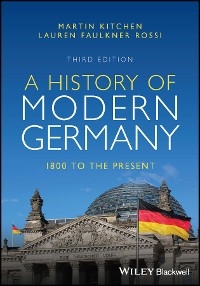
History of Modern Germany (eBook)
Wiley (Verlag)
978-1-119-74641-6 (ISBN)
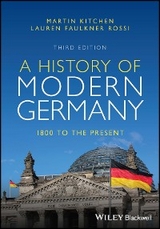
A History of Modern Germany provides a comprehensive account of the social, political, and economic history of Germany from 1800 to the present. Written in an engaging and accessible narrative style, this popular textbook offers an expansive view of the nation's complex and fragmented past, tracing the development of the German national consciousness through Napoleonic rule, the unification of Germany, the German Empire, the Weimar Republic, the Third Reich, post-war division, the collapse of Communism, reunification, and the first two decades of the 21st century. Throughout the text, the authors discuss the tensions prompted by structural changes within Germany, long-term shifts in demographics, social and economic reforms, and more.
Now in its third edition, A History of Modern Germany offers richer coverage of German cultural history, the German Democratic Republic, modernization, class, religion, and gender. Updated chapters explore continuity in imperial projects from Bismarck to Hitler, memory and commemoration since 1945, the distinct but intertwined histories of the two Germanys between 1949 and 1989, and the experience of diversity after the Second World into the post-unification era.
A History of Modern Germany: 1800 to the Present, Third Edition is an excellent textbook for undergraduate students taking courses in modern German history or modern European history as well as general readers with an interest in the subject.
Martin Kitchen is Professor Emeritus of History at Simon Fraser University, Canada. His books include Nazi Germany at War, The Cambridge Illustrated History of Germany, The German Offensives of 1918, The Third Reich: Charisma and Community, and Rommel's Desert War: Waging World War II in North Africa, 1941-1943. Internationally recognized as a key author in the study of contemporary history, Professor Kitchen has served on the editorial boards of International History Review, Canadian Journal of History, and International Affairs.
Lauren Faulkner Rossi is Assistant Professor of History at Simon Fraser University, where she teaches courses on World War II and modern German history. She is the author of Wehrmacht Priests and has published articles in journals such as Contemporary European History, Holocaust and Genocide Studies, and Journal of Modern History.
A HISTORY OF MODERN GERMANY A History of Modern Germany provides a comprehensive account of the social, political, and economic history of Germany from 1800 to the present. Written in an engaging and accessible narrative style, this popular textbook offers an expansive view of the nation s complex and fragmented past, tracing the development of the German national consciousness through Napoleonic rule, the unification of Germany, the German Empire, the Weimar Republic, the Third Reich, post-war division, the collapse of Communism, reunification, and the first two decades of the 21st century. Throughout the text, the authors discuss the tensions prompted by structural changes within Germany, long-term shifts in demographics, social and economic reforms, and more. Now in its third edition, A History of Modern Germany offers richer coverage of German cultural history, the German Democratic Republic, modernization, class, religion, and gender. Updated chapters explore continuity in imperial projects from Bismarck to Hitler, memory and commemoration since 1945, the distinct but intertwined histories of the two Germanys between 1949 and 1989, and the experience of diversity after the Second World into the post-unification era. A History of Modern Germany: 1800 to the Present, Third Edition is an excellent textbook for undergraduate students taking courses in modern German history or modern European history as well as general readers with an interest in the subject.
Martin Kitchen is Professor Emeritus of History at Simon Fraser University, Canada. His books include Nazi Germany at War, The Cambridge Illustrated History of Germany, The German Offensives of 1918, The Third Reich: Charisma and Community, and Rommel's Desert War: Waging World War II in North Africa, 1941--1943. Internationally recognized as a key author in the study of contemporary history, Professor Kitchen has served on the editorial boards of International History Review, Canadian Journal of History, and International Affairs. Lauren Faulkner Rossi is Assistant Professor of History at Simon Fraser University, where she teaches courses on World War II and modern German history. She is the author of Wehrmacht Priests and has published articles in journals such as Contemporary European History, Holocaust and Genocide Studies, and Journal of Modern History.
Illustrations
Introduction to the Second Edition
A Note on the Third Edition
1 Germany Under Napoleon
2 German Society in Transition
3 Restoration and Reform 1815-1840
4 The Revolutions of 1848
5 The Struggle for Mastery 1850-1866
6 The Unification of Germany 1866-1871
7 Bismarck's Germany
8 Germany and Europe 1871-1890
9 Wilhelmine Germany 1890-1914
10 The First World War
11 The Weimar Republic 1919-1933
12 The Nazi Dictatorship to 1939
13 Nazi Germany and the Jews 1933-1945
14 The Adenauer Era 1945-1963
15 The German Democratic Republic
16 The Federal Republic 1963-1982
17 The Reunification of Germany and Beyond
Bibliography
Introduction to the Second Edition
In 1800 Germany was a ramshackle empire, made up of hundreds of petty principalities, free cities, and ecclesiastical and aristocratic estates, which ever since 1512 had borne the impressive title of the Holy Roman Empire of the German Nation. Voltaire caustically remarked that it was neither holy nor Roman, and certainly not much of an empire. As for German – the word really did not mean much at that time.
Among the German states only Austria and Brandenburg‐Prussia counted for much, and Prussia was not even part of the empire. The empire nonetheless had many virtues, its federal structure providing a model for the founding fathers of the United States, but it was in a state of relentless decline and was impervious to reform. It was overrun by the armies of revolutionary France and reorganized under Napoleon. The historian Thomas Nipperdey begins his monumental history of nineteenth‐century Germany with the catchy phrase: “In the beginning was Napoleon.” Like most such aphorisms it is a half‐truth. This was no second creation, but it did mark the end of the empire and a significant transformation of Germany’s political geography. Napoleon forced sixteen of what the great reformer Baron vom Stein contemptuously called “petty sultanates” into the Confederation of the Rhine, thereby greatly enhancing Bavaria, Württemberg, and Baden in the hope of creating a third Germany to offset Austria and Prussia. The Confederation was reformed along French lines, adopting the progressive Napoleonic code of law, whereas in Prussia the reforms were designed to strengthen the state so as eventually to free those provinces that were under French occupation. These reforms and the struggle against France were to lay the foundations of Prussian strength in the new century, and to lead to the formation of a new Germany in 1871. In the process, the progressive liberalism of the early decades of the century was gradually transformed into an increasingly reactionary nationalism.
A somewhat vague notion of a German national identity was first articulated in the eighteenth century. It was centered on the linguistic and cultural peculiarities of the German‐speaking world. It was abstract, humanistic, cosmopolitan, philosophically rarefied and apolitical. The intense hatred of the French, caused by the revolutionary and Napoleonic wars, along with the unacceptable behavior of the French occupying troops soured this early nationalism. Cosmopolitanism turned into an arrogant feeling of cultural superiority. The apolitical became a reactionary obsession with a mythological German past. The rarefied was distilled into an impenetrable but intoxicating obscurity. The new nationalists hoped that when the wars were over a powerful and united Germany would emerge, but their hopes were dashed at the Congress of Vienna, where they were overridden by the imperatives of the great European powers.
Britain and France preferred to accept the changes made by Napoleon and completed his work by creating a German Confederation comprising the 39 remaining states. There was neither a head of state nor a government, but simply a federal assembly to which the member states sent their representatives, with Austria providing the chairman. The solution was acceptable to the Austrians, for they were the senior partners, and Metternich appeared to be firmly in charge as he imposed his reactionary and repressive policies on the Confederation.
Outward appearances were deceptive. Whereas Austria failed to set its house in order by tackling the serious problems of a multinational empire at a time when national sentiments were becoming inflamed, Prussia was laying the foundations of its future economic strength. The Rhineland, which Prussia had been awarded at the Congress of Vienna much against its will, since it was a backward and Catholic area, became the center of Germany’s industrial might. The Customs Union (Zollverein), founded in 1834 under Prussian leadership, made many of the German states economically dependent on Prussia, and created a market that was soon to challenge British supremacy. Capital moved northwards as Austria declined. All that was needed was some form of unification for Germany to be the most powerful nation on the Continent. But what form was this unification to take? Would it be a Greater Germany that included Austria, or a Little Germany under Prussian domination?
Metternich introduced a number of repressive measures, but he was unable to contain the various groups that clamored for constitutional reform, liberal nationalism, and radical change. Following the example of the French there was revolutionary upheaval in Germany in 1848. A national assembly met in Frankfurt that was immediately confronted with the fundamental and perplexing questions, “Who is a German?” and “Where is Germany?” There was at first general agreement that Germans were people who spoke German and, in the words of the patriotic poet and historian Ernst Moritz Arndt, who was born a serf and was thus a personification of the fundamental changes in the social fabric, Germany was “Wherever German is spoken.” On second thoughts, this raised more questions than it solved. Were the proudly independent German‐speaking Swiss really Germans? What about the Alsatians who spoke German but had French citizenship? Then there were the hundreds of thousands of Polish‐speaking Prussians. Were they honorary Germans simply because there was no Polish state? A similar question was raised about the Czechs in the Austrian provinces of Bohemia and Moravia. Then there was some discussion whether Jews should be treated as equal citizens, or whether the German people needed to be protected against these threatening outsiders.
Most of the delegates to the Prussian parliament wanted a greater German solution that would include Austria. Such a Germany would, they hoped, be strong enough to protect and later absorb the German minorities on its borders in Holland, Luxembourg, Schleswig, Switzerland, and Alsace‐Lorraine. Such ideas came up against the national aspirations of Poles and Czechs in the east, and were hastily dropped in the west for fear of confronting France. Whereas German liberals had traditionally championed the Polish struggle against Russian autocracy, they suddenly changed their tune, denouncing any suggestion that the German minority in Poland should be absorbed in a backward and uncultured nation. Similar accusations of treason were levied during the discussions over the Czech lands, northern Italy, and Schleswig. Healthy national egotism triumphed over any concern for other peoples’ rights to national self‐determination. Precious few liberals realized that the denial of the rights of others undermined their own claims, and that victory over insurgents in Italy, Hungary, Bohemia, and Poland greatly strengthened the forces of reaction. It was a fatal flaw of this new form of nationalism that it was based on ethnicity rather than the acceptance of a shared set of values and respect for a common legal system. One hundred and fifty years after the revolution of 1848 a Russian who could not speak a word of German, but who was born of parents who claimed to be of German descent, had an automatic right to German citizenship, whereas a German‐speaking child born of Turkish parents in Germany had no such claim. In spite of recent reforms of the immigration laws a residue of this heritage is still painfully apparent.
The men of 1848 were only free to deliberate and decide by majority vote as long as Austria and Prussia were busy dealing with their own immediate problems. Once the reaction had triumphed in both states the parliamentarians were ordered to pack their bags and returned to their respective states. In the years that followed, Austria and Prussia jockeyed for position within the Confederation, until Bismarck was appointed its chancellor in 1867. He immediately set about settling the German question with “blood and iron.”
Very few people realized the dangers of national unification by such violent means; prominent among them was Friedrich Nietzsche. After all, Greece, Serbia, and Italy were all founded in violence, while most nations were forged in civil wars. Later historians were to endorse Nietzsche’s reservations, claiming that German history traveled down a unique path (Sonderweg), but this was soon shown to be an exaggerated case of self‐immolation and an inadequate explanation for the phenomenon of National Socialism. The German empire of 1871 had a parliament elected by universal manhood suffrage, which was much more than the “fig‐leaf of absolutism” that the socialist leader, August Bebel, claimed. Bismarck, its founding father, pronounced Germany to be “saturated.” Once his great gambling streak was over, knowing full well that the other European powers were ever watchful of this prosperous and powerful newcomer, he was anxious to keep the peace.
The “Second Reich,” much like that which it had replaced, was a loose confederation of states, but it was dominated by Prussia. The military had always played a dominant role in Prussian society, and the Prussian army, having won three wars in quick succession virtually unaided, was admired, adulated, and emulated. It was virtually free from parliamentary control since the war minister was not answerable to parliament and the budget only came up for approval every seven years. The kaiser jealously guarded his power of command and protected the army from outside influences. Such was the social prestige of the army...
| Erscheint lt. Verlag | 15.8.2023 |
|---|---|
| Sprache | englisch |
| Themenwelt | Geisteswissenschaften ► Geschichte ► Regional- / Ländergeschichte |
| Schlagworte | Deutschland /Geschichte • Geschichte • Geschichte der europäischen Moderne • History • Modern European history • modern German economic history • Modern German history • modern German history introduction • modern German history overview • modern German history textbook • modern German narrative history • modern German political history • modern German social history |
| ISBN-10 | 1-119-74641-8 / 1119746418 |
| ISBN-13 | 978-1-119-74641-6 / 9781119746416 |
| Informationen gemäß Produktsicherheitsverordnung (GPSR) | |
| Haben Sie eine Frage zum Produkt? |
 EPUB (Adobe DRM)
Kopierschutz: Adobe-DRM
Adobe-DRM ist ein Kopierschutz, der das eBook vor Mißbrauch schützen soll. Dabei wird das eBook bereits beim Download auf Ihre persönliche Adobe-ID autorisiert. Lesen können Sie das eBook dann nur auf den Geräten, welche ebenfalls auf Ihre Adobe-ID registriert sind.
Details zum Adobe-DRM
Dateiformat: EPUB (Electronic Publication)
EPUB ist ein offener Standard für eBooks und eignet sich besonders zur Darstellung von Belletristik und Sachbüchern. Der Fließtext wird dynamisch an die Display- und Schriftgröße angepasst. Auch für mobile Lesegeräte ist EPUB daher gut geeignet.
Systemvoraussetzungen:
PC/Mac: Mit einem PC oder Mac können Sie dieses eBook lesen. Sie benötigen eine
eReader: Dieses eBook kann mit (fast) allen eBook-Readern gelesen werden. Mit dem amazon-Kindle ist es aber nicht kompatibel.
Smartphone/Tablet: Egal ob Apple oder Android, dieses eBook können Sie lesen. Sie benötigen eine
Geräteliste und zusätzliche Hinweise
Buying eBooks from abroad
For tax law reasons we can sell eBooks just within Germany and Switzerland. Regrettably we cannot fulfill eBook-orders from other countries.
aus dem Bereich