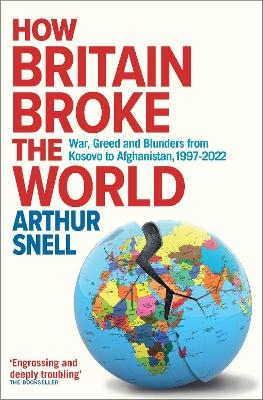
How Britain Broke the World
Canbury Press (Verlag)
978-1-912454-64-8 (ISBN)
How Britain Broke the World is a compelling, eye‑opening account of how British foreign policy helped shape the turbulent world we’re living in now. If you’ve wondered why the rules‑based international order feels weaker, why conflict keeps spreading, and why trust in Western leadership has eroded, this book connects the dots — from the Balkans to the Middle East, from London’s financial districts to Brexit’s aftershocks in Europe.
Snell isn’t a distant commentator. He served as a British diplomat through the era of “ethical foreign policy,” humanitarian intervention and the war on terror, including postings in places where the consequences were brutally real. He writes with an insider’s understanding of the Foreign Office, Downing Street decision‑making, intelligence culture, and the national obsession with “punching above our weight” — and he shows what happens when ambition outruns strategy, expertise and accountability.
Across a fast‑moving narrative of modern history and geopolitics, you’ll see how pivotal UK choices since the late 1990s contributed to a world of greater instability, rising authoritarianism and deepening great‑power rivalry. Snell explores how Britain repeatedly became the “marginal buyer” in international crises: not always the biggest actor, but the one that tipped the balance.
Inside you’ll explore:
Kosovo and the birth of liberal interventionism: NATO’s war in Europe, the humanitarian argument, and the long‑term cost of bypassing UN Security Council authority
Iraq, MI6, and the weapons of mass destruction fiasco: intelligence failures, the infamous dossier, and how a botched invasion helped fuel sectarian violence, regional chaos and the conditions that later fed ISIS/Islamic State
Afghanistan and the fantasy of “government in a box”: counter‑terrorism, nation‑building, Helmand, and why exit strategies collapse when local realities are ignored
Libya and Syria: regime change, power vacuums, proxy warfare, and the ripple effects of prolonged conflict and refugee flows
Russia and the London laundromat: oligarchs, offshore tax havens, money laundering, corruption and the security consequences of letting dirty money shape politics
China and Britain’s “golden era” error: trade, technology, strategic dependency, and tensions inside the Five Eyes intelligence alliance
Saudi Arabia, oil, arms sales and influence: the ethics-versus-interest dilemma, and what the Yemen war reveals about modern power politics
India and the politics of empire: colonial legacy, identity, and diplomacy in a multipolar world
The US–UK “special relationship” and Brexit: alliance management, multilateralism, the Northern Ireland problem, and what sovereignty slogans can cost in credibility and leverage
This is essential reading for fans of current affairs, political nonfiction, international relations and diplomatic history — especially readers interested in British politics, NATO, the UN, international law, security studies, intelligence agencies, Russia, China, the Middle East, Europe and the global fallout of intervention.
You’ll come away with a sharper grasp of the forces driving global insecurity: how intervention and regime change can backfire, how intelligence can be politicised, how sanctions and offshore finance intersect, and how populism at home (from the Brexit referendum to culture‑war politics) can distort national security abroad. Whether you’re tracking the Ukraine war, Putin’s grievances, the fragility of the UN system, or the future of Western alliances, Snell offers a readable, debate‑starting map of what happened — and why it matters now.
If you want a clearer, more honest picture of how today’s crises connect — and what Britain could do differently — How Britain Broke the World delivers. Add it to your library today and understand the hidden links behind the headlines.
An intelligent, cultured read for turbulent times.
After graduating from Oxford with a first class degree in history, Arthur Snell joined the Foreign and Commonwealth Office. A fluent Arabic speaker, he served in Afghanistan, Zimbabwe, Nigeria, Yemen, and Iraq. He headed the international strand of the UK Government’s Prevent counterterrorism programme. He is currently a geopolitical consultant and host of the podcasts Doomsday Watch and Behind the Lines.
INTRODUCTION. Former diplomat Arthur Snell starts with a car boom in Baghdad in 2005, amid the failure of the Allied operation after the Iraq War - which was a blow to the International rules-based order and shredded the credibility of Western governments, benefitting autocratic China and Russia
1. AN 'ETHICAL' FOREIGN POLICY. In 1997 the Labour Foreign Secretary Robin Cook set out the 'ethical' approach of Tony Blair's government to foreign policy. It spawned a doctrine of liberal intervention in foreign countries, starting with Kosovo, but extending to Iraq, Libya and Afghanistan
2. KOSOVO: WAR IN KOSOVO. Tony Blair's Labour government put together a global coalition to bomb Serbia to protect Kosovar Albanians, but, despite headlines to the contrary, the operation was not a success. Slobodan Milošević's forces increased their repression before NATO ground troops invaded
3. IRAQ, MI6 AND A BOTCHED INVASION. The Allied invasion of Iraq in 2003 was built on bogus intelligence that Saddam Hussein had weapons of mass destruction, largely supplied by Britain's Secret Intelligence Service, MI6. Mismanagement of Iraq post-Invasion fomented strife between Sunni and Shia
4. AFGHANISTAN: 'GOVERNMENT IN A BOX'. Britain failed to learn from the failures of its previous embarrassments in Afghanistan when it joined US forces in invading the country after the 9/11 attacks. The UK and US wrongly believed they could impose top-down rule on a massive, complex tribal country
5. LIBYA: CREATING A POWER VACUUM. Britain's role in unseating Libyan dictator Muammar Qadhafi in 2011 shows that Britain had not learnt the lessons from earlier failed liberal interventions. Its basis was false: no massacres were imminent. Post-invasion Libya has collapsed into chaos
6. SYRIA: A CONFLICT WITHOUT END. The ethnic composition of Syria is such that Bashar Al-Assad was always likely to cling to power. While there have been actual massacres involving actual weapons of mass destruction, Britain and other Western powers have allowed the Syrian civil war to rage for years
7. RUSSIA AND THE LONDON LAUNDROMAT. Britain has welcomed Russian billionaires to London, where they spend lavishly on financiers, lawyers, accountants. Ill-gotten riches have been ploughed into the heart of the UK financial system
8. CHINA: THE GOLDEN ERROR OF KOWTOW. Despite China respecting power and toughness, David Cameron's government prostrated itself before Beijing in an attempt to lure Chinese money, which has been pumped into UK telecommunications and the nuclear industry
9. SAUDI ARABIA, OIL AND INFLUENCE. Britain helps run the Saudi military in exchange for big defence deals and other riches, while turning a blind eye to Saudi human rights abuses, sponsorship of Islamic extremism and its destruction of Yemen
10. INDIA AND THE POLITICS OF EMPIRE. Britain has swithered over its response to India’s Prime Minister Narendra Modi, who has fostered Hindu extremism that threatens other religious groups in India such as Muslims and Christians. More recently the UK has misunderstood India's post-Brexit demands
11. THE US AND THE UK 'SPECIAL' RELATIONSHIP. Britain has consistently overestimated the strength of its strategic alignment with America, which is on a par with that of France or Germany. The US-UK relationship is primarily about security as part of the 'Five Eyes' intelligence network
12. BREXIT: ISOLATION IN EUROPE. While an important regional power, with considerable resources, the UK can overestimate its ability to shape events and in recent decades has tended to be chronically short-termist
CONCLUSION. Britain has considerable gusto for bold initiatives, such as the interventions in Kosovo, Libya, Afghanistan and Iraq. But it does not have the enthusiasm for considering their long-term implications. The system lacks expertise and is unwilling to listen to external experts.
ACKNOWLEDGEMENTS. 'Many of the people I owe the most to cannot be named. They know who they are and I am eternally grateful. These people collectively have centuries of experience in every corner of the world and it has been my privilege to work alongside them.'
REFERENCES. A full list of notes and sources for key facts about British foreign policy. The sources range from books about the UK's military interventions to think tank reports to newspaper coverage.
INDEX. From Abdullah, King of Saudi Arabis, to Zimbabwe, an extensive list of pages references
| Erscheinungsdatum | 08.12.2023 |
|---|---|
| Zusatzinfo | 1 Index; 1 Diagrams; 4 Inset maps |
| Sprache | englisch |
| Maße | 153 x 235 mm |
| Gewicht | 490 g |
| Themenwelt | Geschichte ► Allgemeine Geschichte ► Zeitgeschichte |
| Sozialwissenschaften ► Politik / Verwaltung ► Europäische / Internationale Politik | |
| Sozialwissenschaften ► Politik / Verwaltung ► Staat / Verwaltung | |
| ISBN-10 | 1-912454-64-5 / 1912454645 |
| ISBN-13 | 978-1-912454-64-8 / 9781912454648 |
| Zustand | Neuware |
| Informationen gemäß Produktsicherheitsverordnung (GPSR) | |
| Haben Sie eine Frage zum Produkt? |
aus dem Bereich