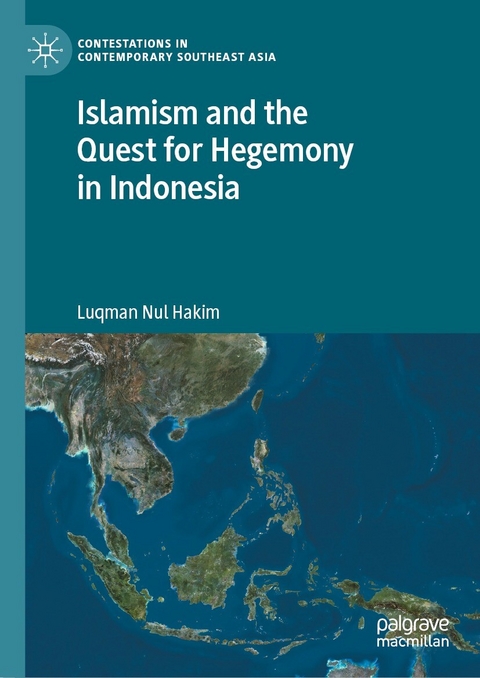
Islamism and the Quest for Hegemony in Indonesia (eBook)
XI, 290 Seiten
Springer Nature Singapore (Verlag)
978-981-19-9661-0 (ISBN)
This book examines the failure of Islamic politics in becoming a hegemonic force in Indonesia and the far-reaching consequences for current practices of democracy and of Islam itself. In contrast to the thesis of compatibility between Islam and democracy following the dominant discourse of the Global War on Terror (GWOT) and neoliberal democracy, this study situates Islamic politics in broader social settings by examining its nature and trajectories throughout Indonesia's modern political history. The book thus investigates how the practices of Islamic politics, or Islamism, have shaped and been transformed through political contestations and the formation of coalitions of multiple forces in constructing Indonesia's socio-political landscape.
Using the concept of hegemony from poststructuralist discourse theory, the analytical framework applied in this book goes beyond liberal epistemologies of Islamism that prescribe the separation of religion from politics and treat Islamism as an object of intervention. Instead, the book is premised on the contention that Indonesia is a political construction, in which Islam has become one of the major discourses that have defined and transformed Indonesia's nation-state throughout history. In this view, it is argued that the nature and dynamics of Islamism are not driven primarily by different interpretations of religious doctrines, cultural norms or by the imperative of institutions. Rather, the struggles of different Islamist projects in their quest for hegemony are contingent on the outcomes of socio-political changes and contestations that involve multiple political forces, both within and beyond the Islamists, in specific historical conjunctures.
Luqman Nul Hakim is a lecturer at the Department of International Relations and a director at the Institute of International Studies (IIS), Universitas Gadjah Mada, Indonesia.
This book examines the failure of Islamic politics in becoming a hegemonic force in Indonesia and the far-reaching consequences for current practices of democracy and of Islam itself. In contrast to the thesis of compatibility between Islam and democracy following the dominant discourse of the Global War on Terror (GWOT) and neoliberal democracy, this study situates Islamic politics in broader social settings by examining its nature and trajectories throughout Indonesia's modern political history. The book thus investigates how the practices of Islamic politics, or Islamism, have shaped and been transformed through political contestations and the formation of coalitions of multiple forces in constructing Indonesia's socio-political landscape.Using the concept of hegemony from poststructuralist discourse theory, the analytical framework applied in this book goes beyond liberal epistemologies of Islamism that prescribe the separation of religion from politics and treat Islamism as an object of intervention. Instead, the book is premised on the contention that Indonesia is a political construction, in which Islam has become one of the major discourses that have defined and transformed Indonesia's nation-state throughout history. In this view, it is argued that the nature and dynamics of Islamism are not driven primarily by different interpretations of religious doctrines, cultural norms or by the imperative of institutions. Rather, the struggles of different Islamist projects in their quest for hegemony are contingent on the outcomes of socio-political changes and contestations that involve multiple political forces, both within and beyond the Islamists, in specific historical conjunctures.
| Erscheint lt. Verlag | 25.2.2023 |
|---|---|
| Reihe/Serie | Contestations in Contemporary Southeast Asia | Contestations in Contemporary Southeast Asia |
| Zusatzinfo | XI, 290 p. 1 illus. |
| Sprache | englisch |
| Themenwelt | Geisteswissenschaften ► Religion / Theologie |
| Sozialwissenschaften ► Politik / Verwaltung | |
| Schlagworte | Islam and democracy in Indonesia • Islam and democratic consolidation • Islam and developmentalism in Indonesia • Islam and nationalism in Indonesia • Islam in post-New Order Indonesia • Islamism and discourse theory • Islamism and hegemony • Islamism and post-colonial state formation • Political Islam and democratic transition • Political Islam in Indonesia • Poststructuralist approach to Islamism • Religion and politics in Indonesia |
| ISBN-10 | 981-19-9661-X / 981199661X |
| ISBN-13 | 978-981-19-9661-0 / 9789811996610 |
| Informationen gemäß Produktsicherheitsverordnung (GPSR) | |
| Haben Sie eine Frage zum Produkt? |
 PDF (Wasserzeichen)
DRM: Digitales Wasserzeichen
Dieses eBook enthält ein digitales Wasserzeichen und ist damit für Sie personalisiert. Bei einer missbräuchlichen Weitergabe des eBooks an Dritte ist eine Rückverfolgung an die Quelle möglich.
Dateiformat: PDF (Portable Document Format)
Mit einem festen Seitenlayout eignet sich die PDF besonders für Fachbücher mit Spalten, Tabellen und Abbildungen. Eine PDF kann auf fast allen Geräten angezeigt werden, ist aber für kleine Displays (Smartphone, eReader) nur eingeschränkt geeignet.
Systemvoraussetzungen:
PC/Mac: Mit einem PC oder Mac können Sie dieses eBook lesen. Sie benötigen dafür einen PDF-Viewer - z.B. den Adobe Reader oder Adobe Digital Editions.
eReader: Dieses eBook kann mit (fast) allen eBook-Readern gelesen werden. Mit dem amazon-Kindle ist es aber nicht kompatibel.
Smartphone/Tablet: Egal ob Apple oder Android, dieses eBook können Sie lesen. Sie benötigen dafür einen PDF-Viewer - z.B. die kostenlose Adobe Digital Editions-App.
Buying eBooks from abroad
For tax law reasons we can sell eBooks just within Germany and Switzerland. Regrettably we cannot fulfill eBook-orders from other countries.
aus dem Bereich