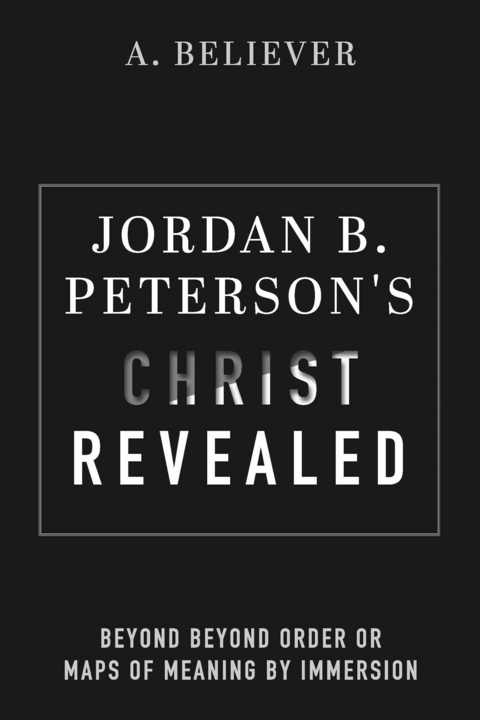
Jordan B. Peterson's Christ Revealed (eBook)
218 Seiten
Bookbaby (Verlag)
978-1-6678-7824-9 (ISBN)
Jordan B. Peterson's Christ Revealed by A. Believer is a thought-provoking book that explores Peterson's conception of Christ as a strange, even revolutionary idea with the potential to transform Christianity. The book explores the most significant characteristics of Christ described in Maps of Meaning: The Architecture of Belief, Jordan Peterson's magnum opus and the wellspring of his better-known books 12 Rules for Life and Beyond Order. These characteristics that constitute Peterson's conception of Christ are scattered throughout Maps of Meaning in a way reminiscent of how Osiris' body is dismembered and scattered in the underworld. Christ Revealed puts the pieces together to reveal the revolutionary idea that is Peterson's conception of Christ. Moreover, there is far more to the book. The author skillfully weaves Jordan Peterson's abstract ideas, which are drawn from various sources, into his own personal story. Using his own life as an example, the author brings to life all of Jordan Peterson's most fundamental ideas, allowing the reader to apprehend and appreciate the significance of Jordan Peterson's conception of Christ as well as its relevance to the current hour in the history of Western civilization. The book is a must-read for anyone interested in exploring the intersection or interplay of Christianity, modern science, and psychology.
INTRODUCTION
What’s he pointing at?
Imagine you’re dreaming and in your dream you see Jordan Peterson standing in a field on a moonless summer evening. You watch as he points to three particular stars and then uses his finger to trace the outline of a triangle whose vertices are defined by those three stars. After he has traced this outline a few times, he turns to you and says, “There, somewhere in that triangle. That’s where you’ll find it. It has to be there but I can’t see it.” Then, his eyes lock tightly on yours and he asks, “Can you see it?”
Instinctively, you look up and bring your gaze to the area defined by those three stars. At first, you see nothing either. You continue to stare into that space wondering what exactly Jordan Peterson expects to find there.
Get your story straight
Jordan Peterson (JP) first appeared on my radar at Thanksgiving1 in 2018. I was almost immediately captivated by what I perceived to be the strength of his character and the soundness of his thinking, especially his ideas relating to the Bible. His lectures on the Bible left me wondering how someone could possibly approach Scripture from the scientific perspective and get so close to what Christians call sound doctrine. But to understand my fascination with JP’s thinking you need to know a bit about my story.
Aim at something. Pick the best target you can currently conceptualize. Stumble toward it. Notice your errors and misconceptions along the way, face them, and correct them. Get your story straight. Past, present, future—they all matter... For better or worse, you are on a journey. You are having an adventure—and your map better be accurate.
– Beyond Order
I’m a bit less than two years younger than Jordan Peterson, which is to say I’m quickly approaching 60 and so my story had pretty much been played out already when I first encountered JP, four years ago. Despite my story having been mostly played out, and as strange as this might sound, JP’s ideas would completely alter my understanding of my story. In fact, before JP, I was convinced that my story simply could not be set straight.
I’d given up on making sense of the journey that I had already travelled. My story, prior to encountering JP’s ideas, consisted of three completely disjointed and, as far as I was concerned, unrelated pieces. The problem was that I’d started my story over from scratch, not once but twice, and that left my life split into three pieces that were, from my perspective, separate, stand-alone pieces, and most importantly, irreconcilable. These pieces bore more resemblance to a collection of slightly related short stories than anything even remotely resembling a single, cohesive, and coherent narrative. Attempting to make sense of the whole seemed impossible. Even now, in the light of hindsight, I can see that it actually would have been impossible to make sense of my story without Jordan Peterson’s ideas. Allow me to give you an idea of why this was the case and to introduce you to the ideas that allowed me to finally get my story straight, the ideas that this book will center around.
Three distinct chapters
My life can be broken down into three distinct epochs or chapters, with each chapter covering a period of roughly twenty years. The first chapter is all about what Peterson calls “enculturation” or “adoption of a shared map.” In my case, the culture in question was Catholic, Roman Catholic to be precise. As a result, the first chapter in my story was all about ritual, ceremony, customs, and traditions. That is, this chapter was about embodying my culture, absorbing its implicit beliefs through its various “symbols” and by acting out its particular rituals. I was entirely steeped in this culture. For example, not just one but both my parents attended mass religiously. What’s more, my education was also Catholic. I attended Catholic schools, including an all-boy, strictly academic high school, where many of the teachers were priests and mass was observed during such times as lent. I went along with all of this until I left home, at nineteen.
The first chapter in my life, then, comes to an end when I stepped out into the world on my own. The line that separates the first and second chapters isn’t crisp and clean. Instead, this line consists of a transition period that lasted somewhere between two and three years. During this period, I not only left home but got married, had a son, and witnessed my mother lose her battle to cancer (before my son’s first birthday.) I was completely and utterly overwhelmed by life during this transition period.
It didn’t take me long to realize that I had shipwrecked my life right from the very start. I had been poorly prepared for the reality that awaited me as I stepped out on my own and foolish enough to dive in head first. As a result, I found myself drowning, going under for the third time as it were. It was then that I “turned to Christ” for help. I abandoned my Catholic belief system to become a “Bible-believing” Christian. That is, I converted from Catholicism to the Protestant faith. I didn’t do this by half-measures either. I went all-in, as they say.
The core idea is this: subjugate yourself voluntarily to a set of socially determined rules—those with some tradition in their formulation—and a unity that transcends the rules will emerge. That unity constitutes what you could be, if you concentrate on a particular goal and see it through.
– Beyond Order
I had no real idea of what I was doing but, in JP’s terms what I did during the second chapter of my life corresponds to this idea of subjugating myself voluntarily to a set of socially determined rules. In my case, the rules consisted of the Bible itself. During this time, as a fundamentalist evangelical Christian, I read the Bible daily. What’s more I spent a lot of time also studying the Bible and meditating on it. In fact, I became so familiar with the Bible that, on hearing a Biblical reference, I could bring to mind what book of the Bible it was from as well as summarize the context from which the quote was taken. And while I subjugated myself voluntarily to the teachings of the Bible, I would never have used the word “subjugation” to describe what I was doing, because this subjugation was done out of a heart of gratitude and not servitude. Regardless, I remained in this state of voluntary subjugation to the set of rules expressed in Scripture for nearly twenty years.
That leads us to the third chapter of my story. This is where the story goes off the rails. You see, at the age of forty, after having essentially lived my entire life from the religious perspective, I abruptly closed my Bible and walked away from God. As I’d done at the end of the first chapter of my life, I once again jettisoned my entire belief system. From this point on, the story—my story—stopped making sense. And it wouldn’t make sense again until JP appeared on my radar fourteen years later and I’d become familiar enough with ideas to begin to see how the pieces fit together.
You can imagine my curiosity then, when I came across JP. The first thing that struck me was just how closely his ideas about the Bible mirrored my understanding of Scripture. The fact that here was a scientist who could expound on the Bible in such a way that it reminded me of some of the great preachers of my past was something incredibly strange for me. Here was an anomaly that didn’t make sense to me, and it’s precisely this that drew me to explore JP’s ideas, especially his most fundamental ideas, the ones he cared enough about to put down in writing.
It’s been four years since I first encountered JP’s ideas. In that time, I’ve become very familiar with his thinking, which has in turn enabled me to get my story straight. It’s been a slow and arduous process, however, because the more I became familiar with JP’s ideas, the more I could see just how strange they were. At first, I made the mistake of thinking that I understood what he meant because he used a vocabulary that I was extremely familiar with. The more I paid attention to the details, however, the more I realized that while he was using familiar words, the meaning behind the words was very different—so different, in fact, that it required prolonged repeated exposure before I could stop seeing my ideas in his words so that I could start to see what he really meant by those words. This process culminated in a clear understanding of JP’s conception of Christ which, as it turned out, was far stranger than I’d ever imagined when I first encountered his ideas.
And so, the primary objective of this book is to make what I’ve discovered visible to you. That is, the purpose of this book is to reveal what JP means by Christ and to do so in such a way that you can “see” it for yourself. I’m sure you’ll be as surprised by what you see as I was.
Christ: The strange idea
JP’s thinking is extremely complex and very abstract. As a result, I suspect that most people who listen to him have only a vague understanding of what he is saying. This is...
| Erscheint lt. Verlag | 23.12.2022 |
|---|---|
| Sprache | englisch |
| Themenwelt | Geisteswissenschaften ► Religion / Theologie |
| ISBN-10 | 1-6678-7824-7 / 1667878247 |
| ISBN-13 | 978-1-6678-7824-9 / 9781667878249 |
| Informationen gemäß Produktsicherheitsverordnung (GPSR) | |
| Haben Sie eine Frage zum Produkt? |
 EPUB (Ohne DRM)
Größe: 6,1 MB
Digital Rights Management: ohne DRM
Dieses eBook enthält kein DRM oder Kopierschutz. Eine Weitergabe an Dritte ist jedoch rechtlich nicht zulässig, weil Sie beim Kauf nur die Rechte an der persönlichen Nutzung erwerben.
Dateiformat: EPUB (Electronic Publication)
EPUB ist ein offener Standard für eBooks und eignet sich besonders zur Darstellung von Belletristik und Sachbüchern. Der Fließtext wird dynamisch an die Display- und Schriftgröße angepasst. Auch für mobile Lesegeräte ist EPUB daher gut geeignet.
Systemvoraussetzungen:
PC/Mac: Mit einem PC oder Mac können Sie dieses eBook lesen. Sie benötigen dafür die kostenlose Software Adobe Digital Editions.
eReader: Dieses eBook kann mit (fast) allen eBook-Readern gelesen werden. Mit dem amazon-Kindle ist es aber nicht kompatibel.
Smartphone/Tablet: Egal ob Apple oder Android, dieses eBook können Sie lesen. Sie benötigen dafür eine kostenlose App.
Geräteliste und zusätzliche Hinweise
Buying eBooks from abroad
For tax law reasons we can sell eBooks just within Germany and Switzerland. Regrettably we cannot fulfill eBook-orders from other countries.
aus dem Bereich