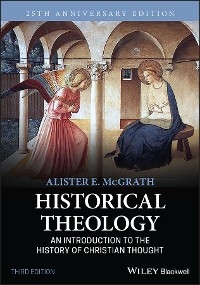
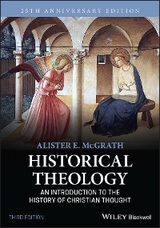
Historical Theology (eBook)
John Wiley & Sons (Verlag)
9781119870364 (ISBN)
The newly updated and expanded edition of the bestselling introduction to Historical Theology
Historical Theology: An Introduction to the History of Christian Thought traces the development of Christian theology from its earliest days to the present. Assuming no prior knowledge of the subject, this authoritative yet accessible textbook introduces the major theological movements, key ideas, and individual theologians of the Patristic Period, the Middle Ages and Renaissance, the Reformation and Post-Reformation, and the Modern Era up to the present day. Throughout the book, students explore central themes through numerous case studies, primary readings, and study questions at the end of each section.
Now in its third edition, Historical Theology including substantial new sections on theodicy, modern African Christologies, and postcolonial theology. The book retains the structure of the previous editions, covering the key development and people within all the main historical periods while introducing readers to the core themes of historical theology across the centuries. This fully updated new edition:
- Provides a general overview of each period covered, including historical background and main theological developments
- Features individual case studies and excerpts from primary texts to allow readers to examine specific themes in greater detail
- Defines the fundamental theological vocabulary necessary for engaging with other works
- Highlights the importance of the discipline of historical theology and its place in wider Christian theology
- Contains references to further readings in each chapter and full glossaries of important words, names, phrases, and theological developments
- Includes web material developed by the author to help users get the most out of using this textbook, along with sample lectures on some of its themes
Written by one of the most renowned theologians in the field, Historical Theology: An Introduction to the History of Christian Thought, Third Edition remains the perfect textbook for advanced undergraduate and graduate courses in Christian History, Christian Theology, and the Reformation.
ALISTER E. MCGRATH, formerly Professor of Historical Theology at the University of Oxford, UK, is an acclaimed scholar, theologian, intellectual historian, lecturer, and author. His bestselling books and textbooks on theology with Wiley Blackwell include Reformation Thought: An Introduction (5e, 2021), Science and Religion: A New Introduction (3e, 2020), Theology: The Basics (4e, 2017), The Christian Theology Reader (5e, 2016), and Christian Theology: An Introduction (6e, 2016).
How to Use This Book xii
Introduction 1
The Concept of "Theology": A Brief Introduction 1
The Architecture of Theology 5
Historical Theology: Its Purpose and Place 9
1 Early Christian Theology: The Patristic Period, c.100-451 17
A Clarification of Terms 18
Difficulties in Approaching Early Christian Theology 19
The Historical Background to Early Christian Theology 20
Centers of Early Christian Theological Reflection 24
Key Theologians 25
Key Theological Developments 28
Key Names, Words, and Phrases 37
Case Studies 38
2 The Middle Ages and the Renaissance, c.500-1500 83
On Defining the "Middle Ages" 84
Medieval Theological Landmarks in Western Europe 86
The Rise of Scholasticism 90
The Italian Renaissance 91
The Rise of Humanism 92
Medieval Theological Landmarks in Eastern Europe 93
Key Theologians 95
Key Theological Developments 100
Key Names, Words, and Phrases 105
Case Studies 106
3 The Reformation and Post-Reformation Periods, 1500-1750 133
Reformation - or Reformations? 134
A Clarification of Terms 135
Post-Reformation Movements 141
Key Theologians 145
Key Theological Developments 149
Developments in Theological Literature 151
Key Names, Words, and Phrases 155
Case Studies 156
4 The Modern Period, 1750 - The Present Day 196
A Cultural Watershed: The Enlightenment 198
The Enlightenment Critique of Traditional Theology 199
Romanticism and the Critique of the Enlightenment 203
The Crisis of Faith in Victorian England 204
The Crisis of the First World War 205
Postmodernism and a New Theological Agenda 207
Key Theologians 209
Some Recent Western Theological Movements and Trends 212
Key Names, Words, and Phrases 227
Case Studies 228
Where Next? 300
A Glossary of Theological Terms 302
Sources of Citations 314
Suggestions for Further Reading 319
Index 321
Introduction
Contents
The Concept of “Theology“: A Brief Introduction
Historical Theology: Its Purpose and Place
This volume is a basic introduction to the discipline of historical theology. So why is historical theology important? For a start, it helps us to understand that doing theology is about stepping into a conversation that has been going on for a very long time! We need to know how that conversation developed and what was discussed before we became part of it. Before looking at its themes in more detail, it is important to have a sense of the place and importance of this discipline within theology as a whole. To begin with, we shall consider the historical development of Christian theology as an academic subject and try to understand how the specific discipline of “historical theology” fits into this overall picture.
The Concept of “Theology”: A Brief Introduction
The word “theology” is easily broken down into two Greek words: theos (God) and logos (word or discourse). Theology is thus “discourse about God,” in much the same way as “biology” is discourse about life (Greek: bios). If there is only one God, and if that God happens to be the “God of the Christians” (to borrow a phrase from the third-century writer Tertullian), then the nature and scope of theology is relatively well defined: theology is a reflection upon the God whom Christians worship and adore.
The word “theology” is not itself biblical, but came to be used occasionally in the early patristic period to refer to at least some aspects of Christian beliefs. Thus Clement of Alexandria, writing in the late second century, contrasted Christian theologia with the mythologia of pagan writers, clearly understanding “theology” to refer to “Christian truth claims about God,” which could be compared with the fictional stories of pagan mythology. Other writers of the patristic period, such as Eusebius of Caesarea, also use the term to refer to something like “the Christian understanding of God.” However, it seems that the word was not used to refer to the entire body of Christian thought, but only to those aspects relating directly to God.
Yet Christianity came into existence in a polytheistic world, where belief in the existence of many gods was a commonplace. Part of the task of the earliest Christian writers appears to have been to distinguish the Christian god from other gods in the religious marketplace. At some point, it had to be asked which god Christians were talking about and how this god related to the “God of Abraham, Isaac, and Jacob,” who figures so prominently in the Old Testament. The doctrine of the Trinity appears to have been, in part, a response to the pressure to identify the god that Christian theologians were speaking about.
As time passed, polytheism began to be regarded as outdated and rather primitive, especially within the sophisticated intellectual culture of the cosmopolitan city of Alexandria. The assumption that there was only one god, and that this god was identical to the Christian god, became so widespread that, by the early Middle Ages in Europe, it seemed self-evident. Thus Thomas Aquinas, in developing arguments for the existence of God in the thirteenth century, did not think it worth demonstrating that the god whose existence he had proved was the “god of the Christians”: after all, what other god was there? To prove the existence of god was, by definition, to prove the existence of the Christian god.
Theology was thus understood as a systematic analysis of the nature, purposes, and activity of God. Although “theology” was initially understood in a restricted sense to mean “the doctrine of God,” the term developed a wider meaning in the twelfth and thirteenth centuries, as the University of Paris began to develop. A name had to be found for the systematic study of the Christian faith at university level. Under the influence of Parisian writers such as Peter Abelard and Gilbert of Poitiers, the Latin word theologia came to mean “the discipline of sacred learning,” embracing the totality of Christian doctrine, not merely one of its aspects – namely, the doctrine of God.
There is no doubt that the introduction of theology into university circles in the twelfth and thirteenth centuries gave a new stimulus to the systematization of the subject. Medieval universities – such as Paris, Bologna, and Oxford – generally had four faculties: arts, medicine, law, and theology. The faculty of arts was seen as entry level, qualifying students to go on to more advanced studies in the three “higher faculties.” This general pattern continued into the sixteenth century, as can be seen from the educational backgrounds of two leading theologians of this period. Martin Luther initially studied arts at the University of Erfurt, before going on to study within the higher faculty of theology at the same university. John Calvin began his university life by studying arts at the University of Paris, before going on to study civil law at the University of Orléans. The result of this development was that theology became established as a significant component of advanced study at European universities. As more and more universities were established in western Europe, so the academic study of theology became more widespread.
Initially, the study of Christianity in western Europe was focused on schools attached to cathedrals and monasteries. Theology was generally understood to be concerned with practical matters, such as issues of prayer and spirituality, rather than as a theoretical subject. However, with the founding of the universities, the academic study of the Christian faith gradually moved out of monasteries and cathedrals into the public arena. The word “theology” came to be used extensively at the University of Paris during the thirteenth century to refer to the systematic discussion of Christian beliefs in general, and not simply beliefs about God. The use of the word in this sense can be seen to a limited extent in earlier works, such as the writings of Peter Abelard. However, the work that is widely regarded as being of decisive importance in establishing the general use of the term appeared in the thirteenth century – Thomas Aquinas’ Summa Theologiae. Increasingly, theology came to be seen as a theoretical rather than a practical subject, despite reservations about this development.
Many early thirteenth-century theologians, such as Bonaventure and Alexander of Hales, were concerned about the implications of neglecting the practical side of theology. However, Thomas Aquinas’ argument that theology was a speculative and theoretical discipline gained increasing favor among theologians. This alarmed many medieval spiritual writers, such as the fourteenth-century monk Thomas à Kempis, who felt that this encouraged speculation about God rather than obedience to God. At the time of the Reformation, writers such as Martin Luther attempted to rediscover the practical aspects of theology. The Genevan Academy, founded by John Calvin in 1559, was initially concerned with the theological education of pastors, oriented toward the practical needs of ministry in the church. This tradition of treating theology as concerned with the practical concerns of Christian ministry would continue in many Protestant seminaries and colleges. However, later Protestant writers operating in a university context generally returned to the medieval understanding of theology as a theoretical subject, even though they usually made it clear that it had certain definite practical implications in the areas of spirituality and ethics.
The rise of the Enlightenment during the eighteenth century, particularly in Germany, called the place of theology in the university into question. Enlightenment writers argued that academic inquiry should be free from any kind of external authority. Theology was regarded with suspicion, in that it was seen to be based on “articles of faith,” such as those contained in the Christian creeds or in the Bible. Theology came increasingly to be seen as outmoded. The German philosopher Immanuel Kant argued that university faculties of philosophy were concerned with the pursuit of truth, while other faculties (such as theology, medicine, or law) were concerned with more practical matters, such as ethics and good health. Increasingly, philosophy came to be seen as the academic discipline that was concerned with issues of truth; the continuing existence of a university faculty of theology would have to be justified on other grounds.
One of the most robust justifications of the need for university faculties of theology was provided in the early nineteenth century by the Protestant theologian F. D. E. Schleiermacher, who argued that it was essential for the good of both the church and state to have a well-educated clergy. In his Brief Outline of the Study of Theology (1811), Schleiermacher argued that theology had three major components: philosophical theology (which identifies the “essence of Christianity”); historical theology (which deals with the history of the church, in order to understand its present situation and needs); and practical theology (which is concerned with “techniques” of church leadership and practice). This approach to theology had the result of linking its academic credentials with public agreement that it was important for society to have a...
| Erscheint lt. Verlag | 10.11.2022 |
|---|---|
| Sprache | englisch |
| Themenwelt | Geisteswissenschaften ► Religion / Theologie |
| Schlagworte | Christian theology history • Christian theology textbook • Christian thought introduction • Geschichte • Geschichte des Christentums • historical theology introduction • historical theology middle ages • historical theology Reformation • historical theology Renaissance • historical theology textbook • History • History of Christianity • Religion & Theology • Religion u. Theologie • Systematic Theology • Systematische Theologie • Theologie • Theologiegeschichte • Theology |
| ISBN-13 | 9781119870364 / 9781119870364 |
| Informationen gemäß Produktsicherheitsverordnung (GPSR) | |
| Haben Sie eine Frage zum Produkt? |
 EPUB (Adobe DRM)
Kopierschutz: Adobe-DRM
Adobe-DRM ist ein Kopierschutz, der das eBook vor Mißbrauch schützen soll. Dabei wird das eBook bereits beim Download auf Ihre persönliche Adobe-ID autorisiert. Lesen können Sie das eBook dann nur auf den Geräten, welche ebenfalls auf Ihre Adobe-ID registriert sind.
Details zum Adobe-DRM
Dateiformat: EPUB (Electronic Publication)
EPUB ist ein offener Standard für eBooks und eignet sich besonders zur Darstellung von Belletristik und Sachbüchern. Der Fließtext wird dynamisch an die Display- und Schriftgröße angepasst. Auch für mobile Lesegeräte ist EPUB daher gut geeignet.
Systemvoraussetzungen:
PC/Mac: Mit einem PC oder Mac können Sie dieses eBook lesen. Sie benötigen eine
eReader: Dieses eBook kann mit (fast) allen eBook-Readern gelesen werden. Mit dem amazon-Kindle ist es aber nicht kompatibel.
Smartphone/Tablet: Egal ob Apple oder Android, dieses eBook können Sie lesen. Sie benötigen eine
Geräteliste und zusätzliche Hinweise
Buying eBooks from abroad
For tax law reasons we can sell eBooks just within Germany and Switzerland. Regrettably we cannot fulfill eBook-orders from other countries.
aus dem Bereich