


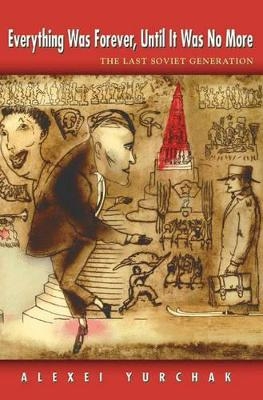
Everything Was Forever, Until It Was No More
The Last Soviet Generation
Seiten
2005
Princeton University Press (Verlag)
9780691121161 (ISBN)
Princeton University Press (Verlag)
9780691121161 (ISBN)
- Titel ist leider vergriffen;
keine Neuauflage - Artikel merken
Explores the paradoxes of Soviet life, during the period of "late socialism" (1960s-1980s) through the eyes of the last Soviet generation. Focusing on the major transformation of the 1950s at the level of discourse, ideology, language, and ritual, this book traces the emergence of multiple unanticipated meanings, communities, and ideals.
Soviet socialism was based on paradoxes that were revealed by the peculiar experience of its collapse. To the people who lived in that system the collapse seemed both completely unexpected and completely unsurprising. At the moment of collapse it suddenly became obvious that Soviet life had always seemed simultaneously eternal and stagnating, vigorous and ailing, bleak and full of promise. Although these characteristics may appear mutually exclusive, in fact they were mutually constitutive. This book explores the paradoxes of Soviet life, during the period of "late socialism" (1960s-1980s) through the eyes of the last Soviet generation. Focusing on the major transformation of the 1950s at the level of discourse, ideology, language, and ritual, Alexei Yurchak traces the emergence of multiple unanticipated meanings, communities, relations, ideals, and pursuits that this transformation subsequently enabled. His historical, anthropological, and linguistic analysis draws on rich ethnographic material from Late Socialism and the post-Soviet period.
The model of Soviet socialism that emerges provides an alternative to binary accounts that describe that system as a dichotomy of official culture and unofficial culture, the state and the people, public self and private self, truth and lie - and ignore the crucial fact that, for many Soviet citizens, the fundamental values, ideals, and realities of socialism were genuinely important, although they routinely transgressed and reinterpreted the norms and rules of the socialist state.
Soviet socialism was based on paradoxes that were revealed by the peculiar experience of its collapse. To the people who lived in that system the collapse seemed both completely unexpected and completely unsurprising. At the moment of collapse it suddenly became obvious that Soviet life had always seemed simultaneously eternal and stagnating, vigorous and ailing, bleak and full of promise. Although these characteristics may appear mutually exclusive, in fact they were mutually constitutive. This book explores the paradoxes of Soviet life, during the period of "late socialism" (1960s-1980s) through the eyes of the last Soviet generation. Focusing on the major transformation of the 1950s at the level of discourse, ideology, language, and ritual, Alexei Yurchak traces the emergence of multiple unanticipated meanings, communities, relations, ideals, and pursuits that this transformation subsequently enabled. His historical, anthropological, and linguistic analysis draws on rich ethnographic material from Late Socialism and the post-Soviet period.
The model of Soviet socialism that emerges provides an alternative to binary accounts that describe that system as a dichotomy of official culture and unofficial culture, the state and the people, public self and private self, truth and lie - and ignore the crucial fact that, for many Soviet citizens, the fundamental values, ideals, and realities of socialism were genuinely important, although they routinely transgressed and reinterpreted the norms and rules of the socialist state.
Alexei Yurchak is Assistant Professor of Anthropology at the University of California, Berkeley.
Acknowledgments ix Chapter 1: Late Socialism An Eternal State 1 Chapter 2: Hegemony of Form Stalin's Uncanny Paradigm Shift 36 Chapter 3: Ideology Inside Out Ethics and Poetics 77 Chapter 4: Living "Vnye" Deterritorialized Milieus 126 Chapter 5: Imaginary West The Elsewhere of Late Socialism 158 Chapter 6: Tr ue Colors of Communism King Crimson, Deep Purple, Pink Floyd 207 Chapter 7: Dead Irony Necroaesthetics, "Stiob," and the Anekdot 238 Conclusion 282 Bibliography 299 Index 319
| Erscheint lt. Verlag | 30.10.2005 |
|---|---|
| Reihe/Serie | In-Formation |
| Zusatzinfo | 15 halftones. 3 line illus. 4 tables. |
| Verlagsort | New Jersey |
| Sprache | englisch |
| Maße | 152 x 235 mm |
| Gewicht | 624 g |
| Themenwelt | Geschichte ► Allgemeine Geschichte ► Zeitgeschichte |
| Geisteswissenschaften ► Geschichte ► Regional- / Ländergeschichte | |
| ISBN-13 | 9780691121161 / 9780691121161 |
| Zustand | Neuware |
| Informationen gemäß Produktsicherheitsverordnung (GPSR) | |
| Haben Sie eine Frage zum Produkt? |
Mehr entdecken
aus dem Bereich

aus dem Bereich
eine Deutschlandreise im Jahr 1958
Buch | Hardcover (2024)
C.H.Beck (Verlag)
CHF 29,90
der Osten, der Westen, der Zorn und das Glück
Buch | Hardcover (2024)
S. Fischer (Verlag)
CHF 36,40


