



Translation and Epistemicide
Racialization of Languages in the Americas
Seiten
2023
University of Arizona Press (Verlag)
978-0-8165-4782-1 (ISBN)
University of Arizona Press (Verlag)
978-0-8165-4782-1 (ISBN)
- Titel erscheint in neuer Auflage
- Artikel merken
Zu diesem Artikel existiert eine Nachauflage
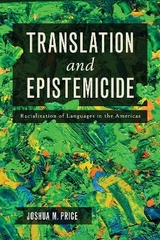
Provides an account of translation-as-epistemicide in the Americas, drawing on a range of examples from the early colonial period to the War on Terror. The book tracks how through the centuries translation practices have enabled colonialism and resulted in epistemicide, or the destruction of Indigenous and subaltern knowledge.
Translation has facilitated colonialism from the fifteenth century to the present day. Epistemicide, which involves destroying, marginalizing, or banishing Indigenous, subaltern, and counter-hegemonic knowledges, is one result. In the Americas, it is a racializing process. But in the hands of subaltern translators and interpreters, translation has also been used as a decolonial method.
The book gives an account of translation-as-epistemicide in the Americas, drawing on a range of examples from the early colonial period to the War on Terror. The first chapters demonstrate four distinct operations of epistemicide: the commensuration of worlds, the epistemic marginalization of subaltern translators and the knowledge they produce, the criminalization of translators and interpreters, and translation as piracy or extractivism. The second part of the book outlines decolonial translation strategies, including an epistemic posture the author calls “bewilderment.”
Translation and Epistemicide tracks how through the centuries translation practices have enabled colonialism and resulted in epistemicide, or the destruction of Indigenous and subaltern knowledge.
Translation has facilitated colonialism from the fifteenth century to the present day. Epistemicide, which involves destroying, marginalizing, or banishing Indigenous, subaltern, and counter-hegemonic knowledges, is one result. In the Americas, it is a racializing process. But in the hands of subaltern translators and interpreters, translation has also been used as a decolonial method.
The book gives an account of translation-as-epistemicide in the Americas, drawing on a range of examples from the early colonial period to the War on Terror. The first chapters demonstrate four distinct operations of epistemicide: the commensuration of worlds, the epistemic marginalization of subaltern translators and the knowledge they produce, the criminalization of translators and interpreters, and translation as piracy or extractivism. The second part of the book outlines decolonial translation strategies, including an epistemic posture the author calls “bewilderment.”
Translation and Epistemicide tracks how through the centuries translation practices have enabled colonialism and resulted in epistemicide, or the destruction of Indigenous and subaltern knowledge.
| Erscheinungsdatum | 31.01.2023 |
|---|---|
| Verlagsort | Tucson |
| Sprache | englisch |
| Maße | 152 x 231 mm |
| Gewicht | 363 g |
| Themenwelt | Sachbuch/Ratgeber ► Geschichte / Politik ► Allgemeines / Lexika |
| Geisteswissenschaften ► Geschichte ► Regional- / Ländergeschichte | |
| Geisteswissenschaften ► Sprach- / Literaturwissenschaft ► Sprachwissenschaft | |
| Sozialwissenschaften ► Ethnologie | |
| Sozialwissenschaften ► Soziologie | |
| ISBN-10 | 0-8165-4782-3 / 0816547823 |
| ISBN-13 | 978-0-8165-4782-1 / 9780816547821 |
| Zustand | Neuware |
| Informationen gemäß Produktsicherheitsverordnung (GPSR) | |
| Haben Sie eine Frage zum Produkt? |
Mehr entdecken
aus dem Bereich



aus dem Bereich
Handbuch zum Lesen des Himmels
Buch | Hardcover (2025)
Harpercollins (Verlag)
CHF 30,80
historische Porträts von George Washington bis Donald Trump
Buch | Softcover (2025)
C.H.Beck (Verlag)
CHF 33,55


