


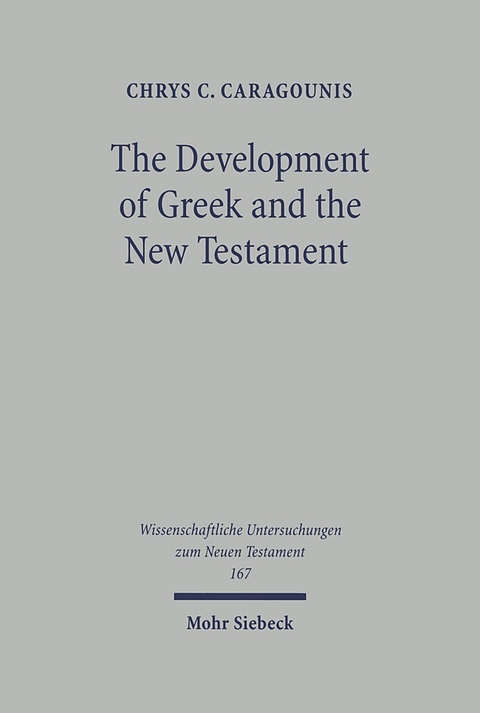
The Development of Greek and the New Testament
Morphology, Syntax, Phonology, and Textual Transmission
Seiten
2004
Mohr Siebeck (Verlag)
978-3-16-148290-8 (ISBN)
Mohr Siebeck (Verlag)
978-3-16-148290-8 (ISBN)
Die Einführung der erasmischen Aussprache des Griechischen 1528 hatte zwei Konsequenzen: zum einen wurde die griechische Sprache in Alt- und Neugriechisch getrennt, zum anderen führte die Änderung der Aussprache dazu, daß viele kommunikative Aspekte, wie etwa Wortspiele, nicht mehr erkannt wurden und die text-kritische Arbeit am Neuen Testament erschwert wurde. Chrys C. Caragounis argumentiert für die Einheit der griechischen Sprache und verweist auf die große Bedeutung des späteren Griechisch für die Auslegung des Neuen Testaments und für die Lösung von vielen text-kritischen Problemen.
The introduction of the Erasmian pronunciation in 1528 had two dire consequences: Greek was divided into ancient and modern - a division that led to the neglect of the later periods of the language, and the pronunciation applied made impossible the detection of many communicatory aspects and obscured many text-critical problems. Chrys C. Caragounis argues for the unity of the Greek language from Mycenaean times to the present. The New Testament appears during the time of transition (335 B.C. - A.D. 565) from ancient to modern Greek. Morphological and syntactical analysis shows that the New Testament often adumbrates morphological and syntactical changes that characterize later Greek, up to Neohellenic. This means that the evidence of Later Greek is often a sine qua non for a fuller understanding of the New Testament. The Historical Greek Pronunciation helps us detect rhetorical figures, wordplays, etc. that the Erasmian pronunciation has missed, and its application on MS readings solves many text-critical cruces.
The introduction of the Erasmian pronunciation in 1528 had two dire consequences: Greek was divided into ancient and modern - a division that led to the neglect of the later periods of the language, and the pronunciation applied made impossible the detection of many communicatory aspects and obscured many text-critical problems. Chrys C. Caragounis argues for the unity of the Greek language from Mycenaean times to the present. The New Testament appears during the time of transition (335 B.C. - A.D. 565) from ancient to modern Greek. Morphological and syntactical analysis shows that the New Testament often adumbrates morphological and syntactical changes that characterize later Greek, up to Neohellenic. This means that the evidence of Later Greek is often a sine qua non for a fuller understanding of the New Testament. The Historical Greek Pronunciation helps us detect rhetorical figures, wordplays, etc. that the Erasmian pronunciation has missed, and its application on MS readings solves many text-critical cruces.
Born 1940; Professor Emeritus in New Testament Exegesis at Lund University, Sweden.
| Erscheint lt. Verlag | 8.7.2004 |
|---|---|
| Reihe/Serie | Wissenschaftliche Untersuchungen zum Neuen Testament |
| Verlagsort | Tübingen |
| Sprache | englisch |
| Maße | 164 x 238 mm |
| Gewicht | 1100 g |
| Themenwelt | Religion / Theologie ► Christentum ► Bibelausgaben / Bibelkommentare |
| Schlagworte | Altgriechisch • Greek language • HC/Religion/Theologie/Christentum • Morphology • Neues Testament |
| ISBN-10 | 3-16-148290-5 / 3161482905 |
| ISBN-13 | 978-3-16-148290-8 / 9783161482908 |
| Zustand | Neuware |
| Informationen gemäß Produktsicherheitsverordnung (GPSR) | |
| Haben Sie eine Frage zum Produkt? |
Mehr entdecken
aus dem Bereich


aus dem Bereich
Buch | Softcover (2021)
De Gruyter (Verlag)
CHF 44,90
die Weihnachtsbotschaft – entstaubt, durchgelüftet, neuentdeckt
Buch | Hardcover (2024)
Verlag Herder
CHF 28,90


