


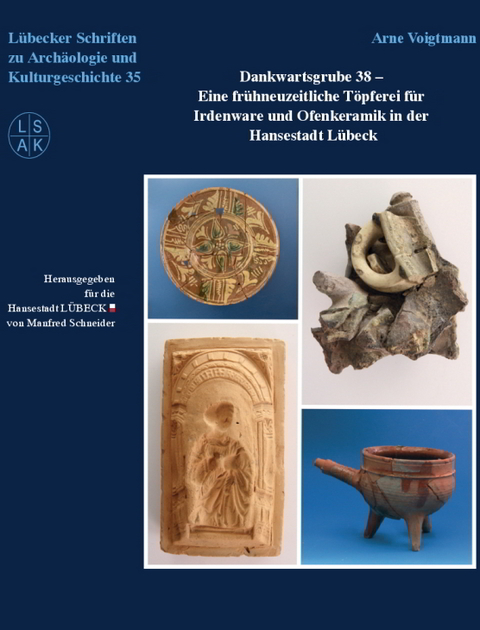
Dankwartsgrube 38 –
Eine frühneuzeitliche Töpferei für Irdenware und Ofenkeramik in der Hansestadt Lübeck
Seiten
2021
|
1., Aufl.
VML Vlg Marie Leidorf (Verlag)
978-3-86757-435-8 (ISBN)
VML Vlg Marie Leidorf (Verlag)
978-3-86757-435-8 (ISBN)
Die Bamberger Dissertation befaßt sich mit einer seit dem 13. Jh. genutzten Parzelle im Südwesten der Stadt, auf der ein im 17. Jh. genutzter Werkstattbereich mit zwei liegenden längsovalen Töpferöfen und 50.963 Keramikresten [ca. 90 % Fehlbrände aus 10 Schichten] herausragt. Holzbefunde und Steinbefunde des 13.-20. Jh. gaben Aufschluß zur Baugeschichte, darunter zahlreiche Dielenpflasterungen aus Backstein bzw. Fliesen sowie die Fundamente mehrerer benachbarter Wärmestuben, sog. Dornsen. Auf dem Nachbargrundstück Nr. 36 sind jahrhundertelang Böttcher nachgewiesen. Ziel war es, das Typenspektrum der Keramik, Typ und Parallelen der Öfen sowie den Wandel von Machart und Umfang der Produkte zu klären. 65 % aller Fehlbrände stammen von monochrom glasierter roter Irdenware. 64 % der Gefäßkeramik gehört zu Grapen, gefolgt von 30 % Tellern und Schüsseln. Ofenkacheln waren mit 1.465 Fragmenten vertreten. Diese archäologischen Reste werden durch Schriftquellen zum Lübecker Töpferamt aus dem Stadtarchiv ergänzt, z.B. für den 1648-1669 ansässigen Töpfermeister Heinrich Lüders mit Angaben zu seiner Biographie, sozialen Stellung und Bedeutung im Töpferamt.
This doctoral dissertation from Bamberg deals with a parcel in south-western Lübeck occupied since the 13th century A.D., which mainly revealed a 17th-century workshop with 2 horizontal elongated pottery kilns and 50,963 pottery sherds [ca. 90 % wasters in 10 layers]. Timber and masonry features of the 13th-20th century illustrated the architectural history, including many hallway pavements of brick or tiles respectively, as well as the foundations of several adjoining heatable rooms called Dornse. The neighbouring parcel no. 36 has been the home to families of coopers for centuries. The aim of the present study was to clarify the type spectrum of pottery, types and parallels of the kilns, and the change of quality and quantity of products in the course of time. 65 % of wasters belong to monochromely glazed red earthenware. 64 % of pottery vessels were pipkins, followed by 30 % of plates and bowls. Stove tiles account for 1,465 fragments. These archaeological remains were supported by textual sources on the Lübeck Pottery Office from the city archive, e.g. as to the master potter Heinrich Lüders [resident 1648-69] with information on biography, social standing, and significance for the Pottery Office. This doctoral dissertation from Bamberg deals with a parcel in south-western Lübeck occupied since the 13th century A.D., which mainly revealed a 17th-century workshop with 2 horizontal elongated pottery kilns and 50,963 pottery sherds [ca. 90 % wasters in 10 layers]. Timber and masonry features of the 13th-20th century illustrated the architectural history, including many hallway pavements of brick or tiles respectively, as well as the foundations of several adjoining heatable rooms called Dornse. The neighbouring parcel no. 36 has been the home to families of coopers for centuries. The aim of the present study was to clarify the type spectrum of pottery, types and parallels of the kilns, and the change of quality and quantity of products in the course of time. 65 % of wasters belong to monochromely glazed red earthenware. 64 % of pottery vessels were pipkins, followed by 30 % of plates and bowls. Stove tiles account for 1,465 fragments. These archaeological remains were supported by textual sources on the Lübeck Pottery Office from the city archive, e.g. as to the master potter Heinrich Lüders [resident 1648-69] with information on biography, social standing, and significance for the Pottery Office.
This doctoral dissertation from Bamberg deals with a parcel in south-western Lübeck occupied since the 13th century A.D., which mainly revealed a 17th-century workshop with 2 horizontal elongated pottery kilns and 50,963 pottery sherds [ca. 90 % wasters in 10 layers]. Timber and masonry features of the 13th-20th century illustrated the architectural history, including many hallway pavements of brick or tiles respectively, as well as the foundations of several adjoining heatable rooms called Dornse. The neighbouring parcel no. 36 has been the home to families of coopers for centuries. The aim of the present study was to clarify the type spectrum of pottery, types and parallels of the kilns, and the change of quality and quantity of products in the course of time. 65 % of wasters belong to monochromely glazed red earthenware. 64 % of pottery vessels were pipkins, followed by 30 % of plates and bowls. Stove tiles account for 1,465 fragments. These archaeological remains were supported by textual sources on the Lübeck Pottery Office from the city archive, e.g. as to the master potter Heinrich Lüders [resident 1648-69] with information on biography, social standing, and significance for the Pottery Office. This doctoral dissertation from Bamberg deals with a parcel in south-western Lübeck occupied since the 13th century A.D., which mainly revealed a 17th-century workshop with 2 horizontal elongated pottery kilns and 50,963 pottery sherds [ca. 90 % wasters in 10 layers]. Timber and masonry features of the 13th-20th century illustrated the architectural history, including many hallway pavements of brick or tiles respectively, as well as the foundations of several adjoining heatable rooms called Dornse. The neighbouring parcel no. 36 has been the home to families of coopers for centuries. The aim of the present study was to clarify the type spectrum of pottery, types and parallels of the kilns, and the change of quality and quantity of products in the course of time. 65 % of wasters belong to monochromely glazed red earthenware. 64 % of pottery vessels were pipkins, followed by 30 % of plates and bowls. Stove tiles account for 1,465 fragments. These archaeological remains were supported by textual sources on the Lübeck Pottery Office from the city archive, e.g. as to the master potter Heinrich Lüders [resident 1648-69] with information on biography, social standing, and significance for the Pottery Office.
| Erscheinungsdatum | 07.10.2021 |
|---|---|
| Reihe/Serie | Lübecker Schriften zur Archäologie und Kulturgeschichte ; 35 |
| Zusatzinfo | 54 Abbildungen, 19 Pläne |
| Verlagsort | Rahden/Westf. |
| Sprache | deutsch |
| Maße | 210 x 297 mm |
| Gewicht | 1750 g |
| Einbandart | gebunden |
| Themenwelt | Geschichte ► Allgemeine Geschichte ► Mittelalter |
| Schlagworte | Architektur • Handwerk • Stadtgeschichte • Wirtschaftsgeschichte |
| ISBN-10 | 3-86757-435-9 / 3867574359 |
| ISBN-13 | 978-3-86757-435-8 / 9783867574358 |
| Zustand | Neuware |
| Informationen gemäß Produktsicherheitsverordnung (GPSR) | |
| Haben Sie eine Frage zum Produkt? |
Mehr entdecken
aus dem Bereich
aus dem Bereich
Geschichte einer Augsburger Familie (1367-1650)
Buch | Softcover (2024)
Kohlhammer (Verlag)
CHF 47,60


