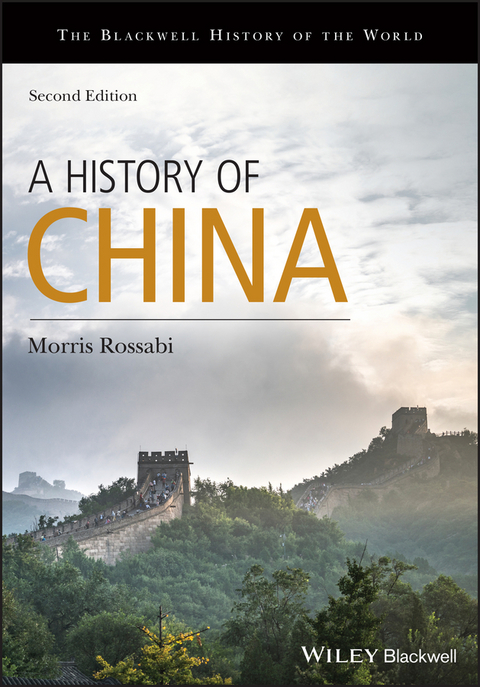
A History of China (eBook)
John Wiley & Sons (Verlag)
9781119604228 (ISBN)
Discover the complexity of China's past with this multi-faceted portrayal of the storied nation from a leading expert in the field
The newly revised Second Edition of A History of China delivers a comprehensive treatment of the political, economic, social, and cultural history of China that covers all major events and trends that have shaped the country over the centuries. The book is written in a clear and uncomplicated style, sure to be of assistance to undergraduate students with little prior background knowledge in the subject matter.
The text examines Chinese history through a global lens to better understand how foreign influences affected domestic policies and practices. It includes discussions of the roles played by non-Chinese ethnic groups in China, like the Tibetans and Uyghurs, and the Mongol and Manchu rulers who held power in China for several centuries.
The distinguished author takes pains to incorporate the perspectives and narratives of people traditionally left out of Chinese history, including women, peasants, merchants, and artisans. Readers will also enjoy the inclusion of:
- A thorough introduction to early and ancient Chinese history, including classical China, the first Chinese empires, and religious and political responses to the period between 220 and 581 CE
- An exploration of the restoration of Empire under Sui and Tang, as well as post-Tang society and Glorious Song
- A discussion of China and the Mongol world, including Mongol rule in China and the isolationism and involvement on the global stage of the Ming dynasty
- A treatment of China in global history, including the Qing era, the Republican period, and the Communist era
Perfect for undergraduate students of courses on Chinese history and Central Asian History, the Second Edition of A History of China will also earn a place in the libraries of students studying global history and related classes in history departments and departments of Asian studies.
The Blackwell History of the World Series
The goal of this ambitious series is to provide an accessible source of knowledge about the entire human past, for every curious person in every part of the world. It will comprise some two dozen volumes, of which some provide synoptic views of the history of particular regions while others consider the world as a whole during a particular period of time. The volumes are narrative in form, giving balanced attention to social and cultural history (in the broadest sense) as well as to institutional development and political change. Each provides a systematic account of a very large subject, but they are also both imaginative and interpretative. The Series is intended to be accessible to the widest possible readership, and the accessibility of its volumes is matched by the style of presentation and production.
MORRIS ROSSABI, PhD, is Distinguished Professor of History at City University of New York and Adjunct Professor at Columbia University. He is the author of several celebrated works on Asian history and has collaborated on exhibitions at the Metropolitan Museum of Art and the Cleveland Museum of Art.
Discover the complexity of China s past with this multi-faceted portrayal of the storied nation from a leading expert in the field The newly revised Second Edition of A History of China delivers a comprehensive treatment of the political, economic, social, and cultural history of China that covers all major events and trends that have shaped the country over the centuries. The book is written in a clear and uncomplicated style, sure to be of assistance to undergraduate students with little prior background knowledge in the subject matter. The text examines Chinese history through a global lens to better understand how foreign influences affected domestic policies and practices. It includes discussions of the roles played by non-Chinese ethnic groups in China, like the Tibetans and Uyghurs, and the Mongol and Manchu rulers who held power in China for several centuries. The distinguished author takes pains to incorporate the perspectives and narratives of people traditionally left out of Chinese history, including women, peasants, merchants, and artisans. Readers will also enjoy the inclusion of: A thorough introduction to early and ancient Chinese history, including classical China, the first Chinese empires, and religious and political responses to the period between 220 and 581 CE An exploration of the restoration of Empire under Sui and Tang, as well as post-Tang society and Glorious Song A discussion of China and the Mongol world, including Mongol rule in China and the isolationism and involvement on the global stage of the Ming dynasty A treatment of China in global history, including the Qing era, the Republican period, and the Communist era Perfect for undergraduate students of courses on Chinese history and Central Asian History, the Second Edition of A History of China will also earn a place in the libraries of students studying global history and related classes in history departments and departments of Asian studies.The Blackwell History of the World Series The goal of this ambitious series is to provide an accessible source of knowledge about the entire human past, for every curious person in every part of the world. It will comprise some two dozen volumes, of which some provide synoptic views of the history of particular regions while others consider the world as a whole during a particular period of time. The volumes are narrative in form, giving balanced attention to social and cultural history (in the broadest sense) as well as to institutional development and political change. Each provides a systematic account of a very large subject, but they are also both imaginative and interpretative. The Series is intended to be accessible to the widest possible readership, and the accessibility of its volumes is matched by the style of presentation and production.
MORRIS ROSSABI, PhD, is Distinguished Professor of History at City University of New York and Adjunct Professor at Columbia University. He is the author of several celebrated works on Asian history and has collaborated on exhibitions at the Metropolitan Museum of Art and the Cleveland Museum of Art.
PREFACE
I have deliberately titled this book A History of China. It is not The History of China. In fact, such an all-encompassing book has not been and probably will never be written. Chinese history is beyond the scope of a single volume. In this work, much in the history of China has been omitted, partly due to size restrictions. I have tried to replicate the course on Chinese history I have taught at a variety of universities. However, I have left out some anecdotes and have eschewed documentary overkill. I have had to select from a vast array of political, economic, social, and cultural developments.
Yet this work offers a survey of Chinese history, with one innovation. The basic events and trends are described, but I have emphasized China as part of a larger world, starting with its contacts with its neighbors in early times and stretching to west, south, and southeast Asia, Korea, and Japan in later eras. From the Mongol age in the thirteenth century onward, I portray China in the context of global developments and history. Specific Chinese policies and practices can be understood as, in part, responses to foreign influences. Indeed, non-Chinese peoples have ruled China for almost half of its history since 1279, the date the Mongols crushed the Southern Song dynasty. In the past, some histories depicted the Mongol and Manchu rulers who governed China during that time as typical Chinese potentates and their people as highly sinicized. This history and many recent scholarly studies have challenged that interpretation, and I devote more space than most texts to describing Mongol and Manchu societies and analyzing their impact on China. In addition, since 1279, China has had a significant non-Chinese population, mostly along strategic frontier areas. Again, I have emphasized these peoples’ histories in this book, often devoting more space to the subject than almost all other histories of China.
Such emphases on China in global history and on the non-Chinese population living in the country have not been my sole perspective. To be sure, many developments in China generally reflected internal events and were not responses to foreign pressures or stimuli. Chinese officials, military commanders, artists, scientists, and philosophers most often reacted to indigenous political or cultural challenges. Yet China and the Chinese were not isolated; they had contacts with foreigners adjacent to their lands, and the Mongol Empire linked them with Eurasia (a connection that was never truly severed). Events and trends in other parts of Eurasia – and indeed in other parts of the world – have influenced China. Similarly, developments in China occasionally reverberated in Europe, west Asia, the Americas, and, to an extent, Africa. Such external impacts did not necessarily determine the course of events or the development of discoveries or ideas. Yet a conception of China from a global perspective provides unique insights. Consideration of domestic causes of events in Chinese history will be of primary concern, but, unlike many other appraisals of Chinese society, a new global perspective, capitalizing on recent research, will also be presented and will, I trust, add to the understanding of Chinese history.
On another note, even within the country, there have been many different Chinas. China’s population has long been sizable and the territory under its control substantial. In traditional times, various regions faced numerous obstacles in transport and communications. Thus, different parts of the country and different peoples had differing values and differing histories. A peasant in Sichuan, an official in the city of Changan (modern Xian), a merchant in the city of Quanzhou, and a woman in a remote village in Gansu all had different histories.
Until the late nineteenth century, the elite produced nearly all the written sources, which described the lives, activities, concerns, and values of a single group of people who derived from the same social background. They hardly portrayed other groups of Chinese. Peasants, the vast majority of the population, barely appeared in these texts. Women also received short shrift, and only through painstaking perusals of numerous texts have scholars begun to piece together aspects of their roles in Chinese history. Confucian officials, who wrote most of the histories, relegated merchants and artisans to a lowly social status and scarcely mentioned them in historical accounts; thus, information about these two groups is limited. The available sources are not as multidimensional and diverse as historians would like. Scholars have used the briefest of mentions in texts and material remains to offer a glimpse of the lives and roles of merchants and artisans. Nonetheless, until changes in nineteenth-century Chinese history, most sources, both written and visual, center on the careers and roles of the imperial families and officials. The reader needs to bear this in mind in reading this book.
A historian would find that traditional Chinese historical texts portrayed Confucianism as the system of values governing personal relations and the philosophical view that shaped people’s lives. Yet he or she could wonder whether popular religions played as important or greater roles for the ordinary Chinese. However, little is known about popular religions in certain eras of Chinese history because of the nature of the sources. Such religions were generally the province of ordinary Chinese, nearly all of whom were illiterate. Written texts that described these religions have, by and large, not survived (if they existed in the first place). Because the elite embraced Confucianism, wrote extensively about it, and appear to have led lives shaped by it, historians may assume that it was pervasive because the surviving texts portray it as such. This may not have been the case for ordinary people.
I have chosen to organize this history based on the various dynasties of China. I realize, of course, that changes in dynasties do not necessarily coincide with or reflect transformations in society and economy, cultural and ideological patterns, technological and scientific knowledge, or other equally significant developments. I am aware that a Japanese scholar has divided Chinese history in two, arguing that dramatic changes in the eleventh and twelfth centuries ce changed the course of Chinese society. Other historians have adopted a variety of schemes for the periodization of Chinese history, including a disputed one centering on China’s response to the West. I have referred to some of these interpretations, describing them while also alluding to crucial assessments and critiques of these theories. However, in many years of teaching, I have found that students are better able to grasp the fundamentals of Chinese history through the lens of dynasties. Because this book is aimed at students and the nonspecialist reader, the dynastic approach appears to be less confusing and more optimal for a work of this kind.
Despite this choice, I do not subscribe to the concept of the dynastic cycle, a traditional and stereotypical paradigm of Chinese history. Advocates of this theory assert that a dynasty’s first rulers were honest, courageous, and powerful and cared for their people, creating conditions of prosperity and longevity, but that the later rulers were oppressive and corrupt and were unconcerned about their people, leading to decline and increasing chaos. This approach does not jibe with actual events and overemphasizes the roles of the emperors and the courts in shaping the history of China. Another misconception that arose from the dynastic-cycle paradigm was an idea of the insignificance of eras that lacked either strong dynasties or dynasties that ruled over all of China. Periods of decentralization were equated with chaos and no important cultural innovations. Yet Confucianism, Daoism, and other philosophies of a golden age of classical thought developed in precisely such an era – known as the Warring States period – and Buddhism flourished after the collapse of the great Han dynasty and before the Sui and Tang dynasties restored centralized government in China. Suffice it to say that I use “dynasties” as the organizational scheme for the reader’s convenience and ease.
FURTHER READING
- The Further Reading sections, which can be found at the end of each chapter, consist principally of works that are accessible both to undergraduate students and the general educated reader. The selections are weighted toward books that offer summaries of highly scholarly studies. The major exceptions to this principle are the general reference works cited below, which provide guidance on more specialized studies. Journal articles are excluded because they are less accessible to nonspecialists. Another reason for some of the selections is that I enjoyed reading them.
- An important general work is The Cambridge History of China, a multivolume and chronological political and economic history of China, with essays written by leading specialists in the various fields covered. Each volume provides an extensive bibliography, in a variety of languages, for those intending further serious study.
- Eugene Anderson, The Food of China (New Haven: Yale University Press, 1990).
- Kathryn Bernhardt, Women and Property in China, 960–1949 (Stanford: Stanford University Press, 1999).
- Caroline Blunden and Mark Elvin, Cultural Atlas of China (New York: Checkmark Books, 1998).
- HowardBoorman and RichardHoward, eds., A Biographical Dictionary of Republican China (New York: Columbia University Press, 4 vol.,...
| Erscheint lt. Verlag | 25.2.2021 |
|---|---|
| Reihe/Serie | Blackwell History of the World |
| Blackwell History of the World | Blackwell History of the World |
| Sprache | englisch |
| Themenwelt | Geisteswissenschaften ► Geschichte ► Regional- / Ländergeschichte |
| Schlagworte | Asian & Australasian History • Asian/Asian-American Studies • Asien-/Asioamerika-Forschung • China /Geschichte • Cultural Studies • Geschichte • Geschichte / Asien u. Australasien • History • Kulturwissenschaften |
| ISBN-13 | 9781119604228 / 9781119604228 |
| Informationen gemäß Produktsicherheitsverordnung (GPSR) | |
| Haben Sie eine Frage zum Produkt? |
 EPUB (Adobe DRM)
Kopierschutz: Adobe-DRM
Adobe-DRM ist ein Kopierschutz, der das eBook vor Mißbrauch schützen soll. Dabei wird das eBook bereits beim Download auf Ihre persönliche Adobe-ID autorisiert. Lesen können Sie das eBook dann nur auf den Geräten, welche ebenfalls auf Ihre Adobe-ID registriert sind.
Details zum Adobe-DRM
Dateiformat: EPUB (Electronic Publication)
EPUB ist ein offener Standard für eBooks und eignet sich besonders zur Darstellung von Belletristik und Sachbüchern. Der Fließtext wird dynamisch an die Display- und Schriftgröße angepasst. Auch für mobile Lesegeräte ist EPUB daher gut geeignet.
Systemvoraussetzungen:
PC/Mac: Mit einem PC oder Mac können Sie dieses eBook lesen. Sie benötigen eine
eReader: Dieses eBook kann mit (fast) allen eBook-Readern gelesen werden. Mit dem amazon-Kindle ist es aber nicht kompatibel.
Smartphone/Tablet: Egal ob Apple oder Android, dieses eBook können Sie lesen. Sie benötigen eine
Geräteliste und zusätzliche Hinweise
Buying eBooks from abroad
For tax law reasons we can sell eBooks just within Germany and Switzerland. Regrettably we cannot fulfill eBook-orders from other countries.
aus dem Bereich