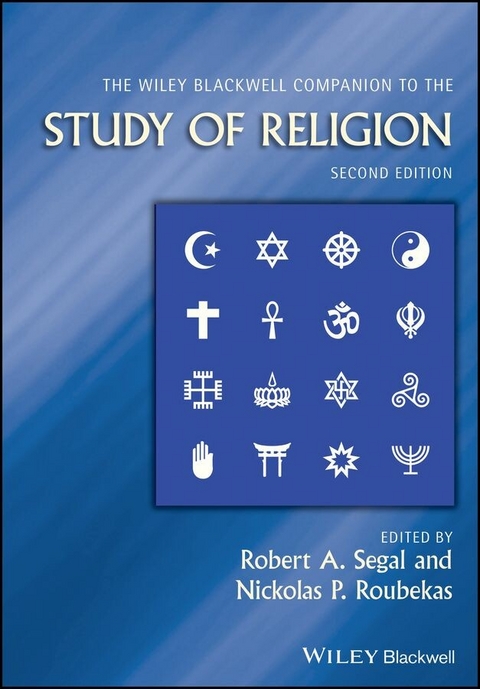
The Wiley Blackwell Companion to the Study of Religion (eBook)
John Wiley & Sons (Verlag)
978-1-119-09276-6 (ISBN)
Explore a rigorous but accessible guide to contemporary approaches to the study of religion from leading voices in the field
The Wiley Blackwell Companion to the Study of Religion delivers an expert and insightful analysis of modern perspectives on the study of religion across the humanities and the social sciences. Presupposing no knowledge of the approaches examined in the collection, the book is ideal for undergraduate students who have yet to undertake extensive study in the humanities or social sciences.
The book includes perspectives from those in fields as diverse as globalization, cognitive science, the study of emotion, law, esotericism, sex and gender, functionalism, terror, the comparative method, modernism, and postmodernism. Many of the topics covered in the book clearly hail from religious studies, while others are grounded in other areas of academia.
All of the chapters contained within are written by recognized authors who show how their chosen discipline contributes to the understanding of the phenomenon of religion. This book also includes topics like:
- A comprehensive exploration of multiple approaches to religious study, including anthropology, economics, literature, phenomenology, philosophy, psychology, sociology, and theology
- A review of various topics germane to the study of religion, including the study of the body, cognitive science, the comparative method, death and the afterlife, law, magic, music, and myth
- A selection of subjects touching on modern trends in extremism and violence, including chapters on terror and violence, fundamentalism, and nationalism
- A discussion of the influence of modernism and postmodernism in religion
Ideal for undergraduate, graduate, and postgraduate students in humanities and social science programs taking courses on religion and myth, The Wiley Blackwell Companion to the Study of Religion will also earn a place in the libraries of specialists working in the fields of Religious Studies, Theology, Sociology, Anthropology, Psychology, Political Science, History, and Philosophy.
Robert A. Segal is Sixth Century Chair in Religious Studies at the University of Aberdeen. He is also Honorary Professor at the University of Essex and Professorial Research Fellow at the University of Vienna.
Nickolas P. Roubekas is Assistant Professor of Religious Studies at the University of Vienna.
Explore a rigorous but accessible guide to contemporary approaches to the study of religion from leading voices in the field The Wiley Blackwell Companion to the Study of Religion delivers an expert and insightful analysis of modern perspectives on the study of religion across the humanities and the social sciences. Presupposing no knowledge of the approaches examined in the collection, the book is ideal for undergraduate students who have yet to undertake extensive study in the humanities or social sciences. The book includes perspectives from those in fields as diverse as globalization, cognitive science, the study of emotion, law, esotericism, sex and gender, functionalism, terror, the comparative method, modernism, and postmodernism. Many of the topics covered in the book clearly hail from religious studies, while others are grounded in other areas of academia. All of the chapters contained within are written by recognized authors who show how their chosen discipline contributes to the understanding of the phenomenon of religion. This book also includes topics like: A comprehensive exploration of multiple approaches to religious study, including anthropology, economics, literature, phenomenology, philosophy, psychology, sociology, and theology A review of various topics germane to the study of religion, including the study of the body, cognitive science, the comparative method, death and the afterlife, law, magic, music, and myth A selection of subjects touching on modern trends in extremism and violence, including chapters on terror and violence, fundamentalism, and nationalism A discussion of the influence of modernism and postmodernism in religion Ideal for undergraduate, graduate, and postgraduate students in humanities and social science programs taking courses on religion and myth, The Wiley Blackwell Companion to the Study of Religion will also earn a place in the libraries of specialists working in the fields of Religious Studies, Theology, Sociology, Anthropology, Psychology, Political Science, History, and Philosophy.
Robert A. Segal is Sixth Century Chair in Religious Studies at the University of Aberdeen. He is also Honorary Professor at the University of Essex and Professorial Research Fellow at the University of Vienna. Nickolas P. Roubekas is Assistant Professor of Religious Studies at the University of Vienna.
List of Contributors viii
About the Editors x
Introduction xi
Robert A. Segal
Part I Approaches 1
1 Anthropology of Religion 3
Fiona Bowie
2 Economics of Religion 25
Rodney Stark
3 Literature and Religion 44
Eric Ziolkowski
4 Phenomenology of Religion 65
Thomas Ryba
5 Philosophy of Religion 93
Charles Taliaferro
6 Psychology of Religion 113
Roderick Main
7 Sociology of Religion 135
Titus Hjelm
8 Theology 152
Ian S. Markham
Part II T opics 169
9 Body 171
Yudit Kornberg Greenberg
10 Cognitive Science 184
Jesper Sorensen
11 Comparative Method 197
Paul Roscoe
12 Death and Afterlife 209
Douglas J. Davies
13 Emotion 219
Tony Milligan
14 Esotericism 229
Karl Baier
15 Ethics 241
G. Scott Davis
16 Functionalism 253
Robert A. Segal
17 Fundamentalism 265
Henry Munson
18 Globalization 277
Michael Wilkinson
19 History 289
Robert A. Yelle
20 Law 302
Winnifred Fallers Sullivan
21 Magic 315
Kocku von Stuckrad
22 Modernism and Postmodernism 325
Paul-Francois Tremlett
23 Music 335
Guy L. Beck
24 Myth 348
Robert A. Segal
25 Nationalism 361
Mark Juergensmeyer
26 Pilgrimage 371
Simon Coleman
27 Ritual 382
Part I by Catherine Bell -- Part II by Jens Kreinath
28 Science 400
Ralph O'Connor
29 Secularization 414
Steve Bruce
30 Sex and Gender 429
Ivan Strenski
31 Terror and Violence 440
Lorne L. Dawson
Index 451
Introduction
Robert A. Segal
The first edition of the Blackwell Companion to the Study of Religion appeared all the way back in 2006. The second edition, now named the Wiley Blackwell Companion to the Study of Religion, is revamped. The first edition consisted of twenty‐four entries. The second consists of thirty‐one entries. The differences are major. There are new entries: on cognitive science, emotion, esotericism, functionalism, globalization, history, law, music, science, sex and gender, and terror and violence. Three entries from the first edition have been dropped: heaven and hell, holy men/holy women, and mysticism – all dropped for idiosyncratic reasons. The comparative method has been switched from an approach to a topic. Five of the entries have new authors. One entry, that on ritual, has been retained unaltered because of the author’s sad death in the interim, but it now has a supplementary updating of the subject. All but one of the existing entries have been substantially revised.
When the first edition appeared, I was a member of a department of theology and religious studies. Two years ago my department decided to drop almost all of religious studies and to rename itself sheer “divinity.” What the difference is between divinity and theology I have no idea. But the exclusion of religions other than Christianity from “divinity” – or even the past needed addition of “religious studies” to “theology” – is not quite a universal terminology. In the United States, not least at esteemed venues like the Harvard Divinity School, the Yale Divinity School, and the University of Chicago Divinity School, “divinity” covers all religions, not just one religion. Whatever the difference between an approach to, say, Islam in a divinity school and an approach to it in a department of religious studies, Islam is assumed to be a fit topic of study for both.
The Companion is a guide to all religions. No religion is singled out either for inclusion or for exclusion. Religion is used generically to encompass all religions, past and present. The assumption is not that all religions are the same. The assumption is that all religions are similar, and similar enough to be treated together. By no coincidence there remains a chapter on the comparative method. The study of religion is like the study of, for example, revolution. One might well be interested in only the French Revolution. One might be the world’s greatest expert on the subject. But the French Revolution is still a case, just a case, of revolution per se. Who would imagine studying the French case without first studying the category? Who would be able to do so? For surely what explains the French Revolution is what explains all other revolutions – that is, insofar as it, too, is a revolution.
Interested only in Christianity? Likewise whatever explains it is what explains all other religions. (On the comparative method see my “In Defense of the Comparative Method,” Numen 48 [2001]: 339–73; and “The Postmodernist Challenge to the Comparative Method,” in Comparing Religions: Possibilities and Perils?, edited by Thomas A. Idinopulos, Brian C. Wilson, and James C. Hanges, 249–70 [Leiden: Brill, 2006].)
The basic questions in the study of religion are those of origin, function, subject, and truth.
Origin and function are flip sides of the same question, and the answer is a need. Religion originates and functions to fulfill the need. The need can be for anything, and can range from a need for food to a need for meaning in life. Religion does not arise spontaneously. It arises to fulfill the need, which can be as old as humanity or more recent. Religion may not be the sole way of fulfilling the need and may not even be the best way. After all, science succeeded religion as a superior way of securing food. Views differ on how far back religion goes and on how long it will last. Some maintain that religion is dying out. Only if it were asserted that religion fulfills a need that everyone harbors and that only religion can fulfill would religion be guaranteed to be eternal. This view is that of Mircea Eliade (1907–1986) and other “religionists,” for whom the need is to encounter God.
The subject matter of religion can be either the literal one or a symbolic one. God can be taken as either a superhuman figure or a symbol, of either a human being – for example, the human father for Freud – or a natural phenomenon – for example, the sun.
The truth of religion is ordinarily considered by philosophers and theologians rather than by social scientists. For social scientists, the issue is why humans believe in God and act accordingly, not whether the God in whom they believe is real. Even atheists like Sigmund Freud (1856–1939) and Karl Marx (1818–1883) usually separate their explanations of religion from their denial of the reality of God. They seek to explain why persons come and continue to believe in God. The reality for them is belief in God, not the existence of God.
One issue not discussed in the Companion is the relationship between “explanation” and “interpretation.” These terms have long been used variously in the humanities and the social sciences. Sometimes they have been deemed compatible, other times incompatible. In this introduction I use “explanation” to cover both terms. On the varying usages of the terms see my Explaining and Interpreting Religion: Essays on the Issue (New York: Peter Lang, 1992).
Religious Studies as a Discipline
Does religious studies qualify as a discipline? According to one view, religious studies, to qualify, must have a distinctive method. Yet most disciplines harbor no distinctive method. Many either share a method – notably, the “scientific method” – or else employ a variety of methods – for example, quantitative as well as qualitative approaches or textual analysis as well as fieldwork.
Still, does religious studies possess a method of its own? Many of the classical defenders of religious studies as a discipline invoke phenomenology as the distinctive method of the discipline. But at least as practiced, phenomenology of religion amounts to no more than data gathering, if also the classification of the data gathered. In other words, the celebrated method of religious studies turns out to be mere taxonomy.
If a discipline must have a distinctive method, and if data gathering and classification are all that religious studies offers, then the field is on shaky grounds. Not only are data gathering and classification common to all other fields, but the other fields that claim to study religion happily utilize the data and classifications provided by religious studies.
Anthropologists of religion, sociologists of religion, psychologists of religion, and economists of religion all rely on the findings of specialists in religious studies. What social scientists proceed to do with those findings seemingly distinguishes them from those who toil in religious studies. They seek to explain the data amassed and organized, and they seek to explain them in their own disciplinary ways – anthropologically, sociologically, psychologically, and economically. Unless religious studies, whether or not the phenomenology of religion in particular, not merely describes certain beliefs, practices, and objects as religious but also explains them religiously, it serves as a mere underlaborer.
The second defense of religious studies as a discipline is that the field does in fact explain religion “religiously” rather than anthropologically, sociologically, psychologically, or economically. To explain religion from any perspective is to account for its origin and function as well as its subject matter. An anthropological explanation of religion accounts for religion as a case of culture. A sociological explanation of religion accounts for religion as a case of society. And so on. According to “religionists,” religious studies accounts for religion not as a case of anything else but in its own right – as religion. The origin and function of religion are therefore distinctively, or irreducibly, religious. This approach is therefore called “nonreductionistic.”
Now for religionists, no less than for anthropologists, sociologists, psychologists, and economists, religion is a human, not a divine, creation. Religious beliefs and practices are concocted by humans, not revealed from on high. But humans purportedly concoct them in order to make contact with God. That is the irreducibly religious origin and function of religion. Humans do not happen to seek contact with God. They need to do so. Just as they come into the world with a need for food and for love, so they come into the world with a need for God. That need, like the need for food or love, is innate. Religion arises and serves to fulfill it.
The difficulties with this second defense of the autonomy of religious studies are multiple. To begin with, what is the evidence of any need to encounter God? Religionists infer from the existence of religion a need for contact with God, but the social sciences profess to be able to account for the existence of religion in terms of secular needs, which can be for anything. If religion reflects an innate need to encounter God, how can there be any individuals or cultures that are not religious? The rejoinder by religionists like Eliade is that there are not any. Religion is present...
| Erscheint lt. Verlag | 26.2.2021 |
|---|---|
| Reihe/Serie | Blackwell Companions to Religion |
| Blackwell Companions to Religion | Wiley Blackwell Companions to Religion |
| Sprache | englisch |
| Themenwelt | Geisteswissenschaften ► Religion / Theologie |
| Schlagworte | Anthropology of Religion • cross-disciplinary religious studies • cross-functional religious studies • divinity • divinity studies • History of Religion • Philosophy of Religion • Psychology of religion • Religion • Religion & Theology • Religionswissenschaft • Religion u. Theologie • Religious Studies • Sociology of Religion • Theology |
| ISBN-10 | 1-119-09276-0 / 1119092760 |
| ISBN-13 | 978-1-119-09276-6 / 9781119092766 |
| Informationen gemäß Produktsicherheitsverordnung (GPSR) | |
| Haben Sie eine Frage zum Produkt? |
 EPUB (Adobe DRM)
Kopierschutz: Adobe-DRM
Adobe-DRM ist ein Kopierschutz, der das eBook vor Mißbrauch schützen soll. Dabei wird das eBook bereits beim Download auf Ihre persönliche Adobe-ID autorisiert. Lesen können Sie das eBook dann nur auf den Geräten, welche ebenfalls auf Ihre Adobe-ID registriert sind.
Details zum Adobe-DRM
Dateiformat: EPUB (Electronic Publication)
EPUB ist ein offener Standard für eBooks und eignet sich besonders zur Darstellung von Belletristik und Sachbüchern. Der Fließtext wird dynamisch an die Display- und Schriftgröße angepasst. Auch für mobile Lesegeräte ist EPUB daher gut geeignet.
Systemvoraussetzungen:
PC/Mac: Mit einem PC oder Mac können Sie dieses eBook lesen. Sie benötigen eine
eReader: Dieses eBook kann mit (fast) allen eBook-Readern gelesen werden. Mit dem amazon-Kindle ist es aber nicht kompatibel.
Smartphone/Tablet: Egal ob Apple oder Android, dieses eBook können Sie lesen. Sie benötigen eine
Geräteliste und zusätzliche Hinweise
Buying eBooks from abroad
For tax law reasons we can sell eBooks just within Germany and Switzerland. Regrettably we cannot fulfill eBook-orders from other countries.
aus dem Bereich