


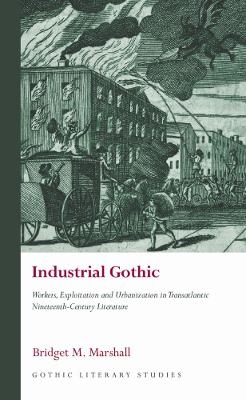
Industrial Gothic
Workers, Exploitation and Urbanization in Transatlantic Nineteenth-Century Literature
Seiten
2021
University of Wales Press (Verlag)
978-1-78683-770-7 (ISBN)
University of Wales Press (Verlag)
978-1-78683-770-7 (ISBN)
- Titel z.Zt. nicht lieferbar
- Versandkostenfrei
- Auch auf Rechnung
- Artikel merken
The Gothic is more than just maidens-in-peril fleeing supernatural villains in another age. Historically, it was a form used to depict and critique the dangerous labour conditions faced by workers during the Industrial Revolution.
This study carves out a new area of study, the 'industrial Gothic', placing the literature of the Industrial Revolution in dialogue with the Gothic. It explores a significant subset of transatlantic nineteenth-century literature that employs the tropes, themes and rhetoric of the Gothic to portray the real-life horrors of factory life, framing the Industrial Revolution as a site of Gothic excess and horror. Using archival materials from the nineteenth century, localised incidences of Gothic industrialisation (in specific cities like Lowell and Manchester) are considered alongside transnational connections and comparisons. The book argues that stories about the real horrors of factory life frequently employed the mode of the Gothic, while nineteenth century Gothic writing (stories, novels, poems and stage adaptations) began to use new settings - factories, mills, and industrial cities - as backdrops for the horrors that once populated Gothic castles.
This study carves out a new area of study, the 'industrial Gothic', placing the literature of the Industrial Revolution in dialogue with the Gothic. It explores a significant subset of transatlantic nineteenth-century literature that employs the tropes, themes and rhetoric of the Gothic to portray the real-life horrors of factory life, framing the Industrial Revolution as a site of Gothic excess and horror. Using archival materials from the nineteenth century, localised incidences of Gothic industrialisation (in specific cities like Lowell and Manchester) are considered alongside transnational connections and comparisons. The book argues that stories about the real horrors of factory life frequently employed the mode of the Gothic, while nineteenth century Gothic writing (stories, novels, poems and stage adaptations) began to use new settings - factories, mills, and industrial cities - as backdrops for the horrors that once populated Gothic castles.
Bridget M. Marshall is Associate Professor of English at the University of Massachusetts, Lowell, where she teaches courses on the Gothic, New England witchcraft trials, and disability in literature.
List of Illustrations
Acknowledgements
Introduction: Weaving a Transatlantic Gothic Industrial History
Chapter 1: The Industrial Gothic Novel
Chapter 2: Industrializing the Gothic Victim/Heroine: Mill Girls and Factory Girls
Chapter 3: The Carceral Gothic and the Cotton Industrial Complex
Chapter 4: Old and New Industrial Horrors: Monsters and Disabled Bodies
Chapter 5: The Industrial Environment: EcoGothic Horrors
Epilogue: Unravelling the Industrial Gothic
| Erscheinungsdatum | 16.06.2021 |
|---|---|
| Reihe/Serie | Gothic Literary Studies |
| Zusatzinfo | No |
| Verlagsort | Wales |
| Sprache | englisch |
| Maße | 138 x 216 mm |
| Themenwelt | Geschichte ► Teilgebiete der Geschichte ► Wirtschaftsgeschichte |
| Geisteswissenschaften ► Sprach- / Literaturwissenschaft ► Anglistik / Amerikanistik | |
| Geisteswissenschaften ► Sprach- / Literaturwissenschaft ► Literaturwissenschaft | |
| ISBN-10 | 1-78683-770-6 / 1786837706 |
| ISBN-13 | 978-1-78683-770-7 / 9781786837707 |
| Zustand | Neuware |
| Informationen gemäß Produktsicherheitsverordnung (GPSR) | |
| Haben Sie eine Frage zum Produkt? |
Mehr entdecken
aus dem Bereich



aus dem Bereich
wie Tech-Konzerne und Großmächte die Welt unter sich aufteilen
Buch | Hardcover (2025)
C.H.Beck (Verlag)
CHF 39,20
Aufstieg und Fall der Deutschland AG
Buch | Hardcover (2025)
Suhrkamp (Verlag)
CHF 41,95


