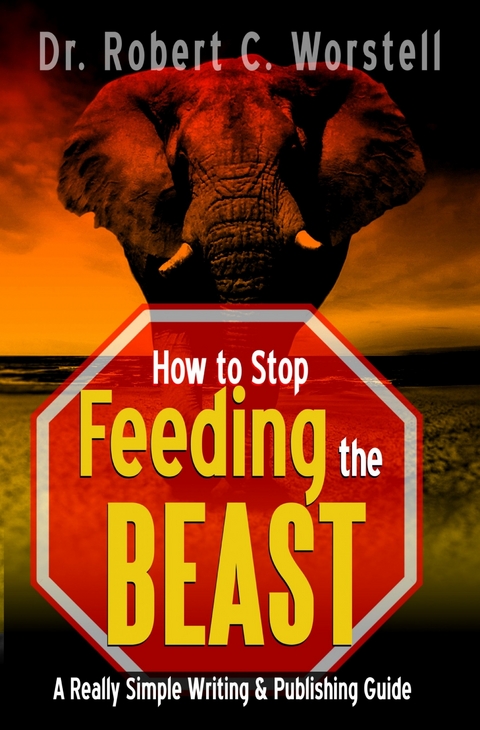
How to Stop Feeding the Beast (eBook)
169 Seiten
Midwest Journal Press NPD (Verlag)
661000005191-5 (EAN)
Want to Quit Sacrificing Your Book Income?
Would you like to start making a decent living from your writing instead?
This is the story of how any author can get their life back. Just stop 'Feeding the Beast.' The one that has been consuming their livelihood, novel by novel.
As our story begins:
The great beast Zon has been playing favorites again. It's preying on naïve and innocent writers. The ones who dare enter its chamber with offerings of their works.
With a single withering glance, a rapid pounce, the gnashing of teeth, your author-dream is dead. The hope of a livable passive income from vast numbers of readers buying your masterpiece is spit out. It joins the massive, growing bone pile at the beast's feet.
We all should have taken warning when we had to pass through miles of depressing ebook graveyards that line the entrance to its chambers.
The long lines moved fast, though. The beast must receive its food. One observer from years ago saw that the beast consumed two books per minute, every hour of every day, year in and year out. The beast never sleeps, stays always hungry.
Regardless, we stayed the course. Hearing the clanking chains, smelling the rank musk of decay, we steeled ourselves and swallowed our fears, at last to stand before it. You raised up your offering, just to see it snatched and shoved into the massive maws of Zon the Beast. Your hopes then quick-crushed along with the bones of your darling. All these now lay down in the murky depths of the Unknown Tomes.
While leaving the chamber, you see a special line for those precious few who the beast recognizes and fawns over. Their offerings prized as tasty morsels. And yet the wary eyes of those offering testify that they recognize the beast can revolt anytime it wants. It can deny them their riches as they depart, even ban them from ever coming to feed it again.
Yet they do each leave with their burden of precious metals, jewels, and crystals.
Those in the line, both coming and leaving, all want to hope that one day, they too will can quit their wage-slave labor at the J.O.B. mines. They even buy the undertaker's trinkets as they leave, so that a talisman may protect their next effort.
We know there are other ways. We all heard the stories of those whose books somehow lived to tell their own tales. Those authors had somehow learned to feed the beast the diet it wants and earned their rewards. It's not just the prattle of the undertakers we learn this from. Many authors wrote their own success stories of wresting riches from the beast.
Those exceptional authors alone can feed the beast with impunity, and leave the chamber as their routine, taking all the riches they can carry.
Out of the thousands of hopeful authors who enter the chamber, almost all leave with nothing but dashed hopes. Only four out of ten thousand will leave with only enough to sustain them until they can again return to give offerings to the beast. Only two out of those will leave with heaped riches, a staggering load to bear.
Where in the real world are the undertakers selling their talisman that 'guarantee bestseller status' to those who buy their over-priced trinkets?
You know in the depths of your heart that you aren't required to leave with nothing. Certainly life can be more rewarding. This is not a necessary ending.
Your challenge on this quest is to seek these rich authors to find their real secrets. Don't believe the false secrets that the undertakers preach to the multitudes as Gospel. Your challenge is to test everything you read, hear, watch, or experience. The truth is out there. It may be hard to catch and hold-if you can figure out how to trap it at all.
You are here because there's a book inside you that is crying for release. But you dare not give life to it, only to see it killed on the altar of the beast. Yet still it cries out...
Your choice awaits. Riches may flood your arms. Or leave you holding only a glad memory - of the book-that-once-was.
There is a way to avoid this, to publish your book regardless of Zon or other publishing beasts that require feeding.
Are you up for the challenge?
How To Outline and Plot at Pulp Speed
Dean Wesley Smith tells it simply: Don't.
That might work for him. For the rest of us, we don't have his half-century of experience.
Granted, if you read and write daily, and you read the perennial-selling classics, you'll train yourself fast enough.
Most of us have spent considerable time at studying plot basics and perhaps took some English courses where we've been carefully mis-taught. Or perhaps we've received advice from well-meaning agents and publishers who have been drinking the corporate-publishing Kool-Aid (and expect a book to take at least a year in production before it can get published.)
This section is augmented by some boiled-down references mentioned in the Appendix, as well as numerous classic textbooks I've uncovered and re-published in this area.
And it was surprising to find, once I finished all these studies, I could throw it all away. Because I'd internalized it to such a degree that I only needed to practice writing to improve it. (Using pen-names, of course, since my earliest work wouldn't be my finest.)
How To Outline, Plot, and Internalize All That Stuff
The point is to utilize your native genius, and what you know readers expect out of a great book.
Most authors think that you build your story from the plot and genre.
They might be half-right.
Meaning that they are missing out on the most effective and easiest way to write their fiction.
Some students of plotting say that the Joseph Campbell "Hero's Journey" is the core basis for all stories, just as it was for all myths and legends.10
They may be right. Or they may be missing the boat.
Earlier than Campbell was an incredibly prolific author, William Wallace Cook, who held that it was simpler than that.11
Cook understood that while all readers and authors were looking for their own happiness, all stories were built from the threat of not achieving it.
When you look around through the various plotting books and articles, you see that they all agree that what really drives a story and makes it effective is Conflict.
That term itself, as well as misconceptions of how to apply it, has delivered more stories to the graveyard than to the bestseller lists.
You'd be better off calling it Tension.
Conflict, per Cook, is developed by having a goal opposed. That might look simple, but his exact phrase was:
"Purpose, expressed or implied, opposing Obstacle, expressed or implied, yields Conflict."
And now you can see how books built from Campbell's monomyth actually work. The usual expression is that the Hero wants something, but the Villain wants it, too. And that conflict/tension is what runs the story. Add in a location and progressive complications and then you have your blockbusters.
The genre is just the trappings of the story. The difference between a cozy mystery and a hard-boiled mystery are in the conventions and obligatory scenes. Westerns, for instance are historical in basis and fit within a certain 40-year timeline. But if they have science fiction mixed in (as in the movie "Cowboys and Aliens" or the classic series “Firefly.”) then they are in a sub-genre.
When you strip the specifics of genre out of it, you're left with the actual structure.
Cook laid it out simply in his book "Plotto."12
Again, all stories have tension or conflict, and that is simply "a goal opposed by an obstacle."
In this, a protagonist has a goal, he/she takes action to attain, acquire, or achieve it. That action has a result.
Cook considered that every book had "masterplots" or themes with 15 possible protagonist clauses, 62 action clauses, and 15 resolution clauses. Together, there are 13,950 possible combinations.
Once you have your theme, you can then compose your plot.
When Cook released his masterplot clauses to fellow writers, many were still stumped coming up with plots to fit those themes.
Below your theme are potential conflicts. Cook laid out a book with 1462 interconnected conflict clauses. A near infinite number of plot combinations when taken with the thousands of themes.
A separate study found three distinct plot structures which run through all stories, in different combinations.
These are romance, mystery, and adventure.
When you look through Plotto conflict clauses, you'll see that the various conflicts align that way. Cooks conflict clauses were aligned to Romance (including marriage), Adventure, and Mystery.
When you look through various books you've read, you'll see these three plot structures. (But you're welcome to let me know if you find more.) Horror? No, those are usually mystery or adventure. Science fiction? No, those can be any of the three.
Except: If they are non-fiction. And that structure is mostly a recipe card full of steps to take. Like baking a cake.
The greatest stories ever written or performed had all three of the fiction plot structures in them. The greatest non-fiction stories are usually narrative, meaning that they incorporate some or all of the three fiction structures to be effective. But they are still describing fact.
And historical fiction as a genre has some fact in it. So all four can (rarely) occupy the same story. Many stories in the Bible are like this. They are supposed to be telling a factual occurrence, yet have mystery, romance, and adventure in them. Legends are just that, because the truth in them is no longer believed to be factual. Maybe it is, maybe it isn't. Either way, its great entertainment.
The best stories, classics and modern blockbusters, one structure will be dominant, the others present as minor story arcs. They may or may not complete in that particular book, but that is what series are for. All the "Indiana Jones" movies were adventure-based, but had a mystery to solve, and also a love-interest. But it wasn't until the last movie that the romance story-arc completed. Same with the Die Hard movie series.
Usually, you can tell in the first few minutes or pages of a story what the main plot structure is. There is often an action teaser to get you into the story, but you'll quickly see that it's a romance, adventure, or mystery shortly after that. (Of course, the best stories may leave you also wondering...)
Of course, there is more to plotting than this. All that's being pointed out here is how you can master the core principles and then master your genre. As you do master these content structures, you should be able to move into and among multiple genres simply and profitably.
While that works fine for Adventure stories, how does that work for the other two fiction content structures of Romance and Mystery?
That difference is what makes these structures work.
Romance is two people wanting to get together, separated for some reason, and then finally getting together to their mutual satisfaction.
Mystery is almost the adventure story in reverse. Something bad happens, and the main character has to find out who did it, how they did it, and why.
You see the "conflict" in each type of content structure.
(Yes, of course it can be made more complex than this. That's how non-fiction writing books and courses entice their way into your pocketbook.)
The point here is to give you the basics. Then you can internalize them any way you want.
Speeding up your writing will include making this all second-nature.
That doesn't mean it happens overnight. And you might have considerable mis-training to let go (Dean Wesley Smith said it took him seven years.) Myself, I still like to work out the characters backstory and quirks before I start on the story. But all my writing improves and speeds up every day, so “that, too, shall pass.”
You can use the above to quickly reverse-engineer any story, in print or as a movie or video. It will be one of those four plot structures, or combinations of them. You'll also see story arcs that continue through a long or short story-series without resolving the conflict.
You can use your copy of “Plotto” to figure out the theme. As you go through the story, you can also see what genre conventions and obligatory scenes it uses. Read, Dissect, Write.
(You can also then figure out why some fairy tales and fables fall flat, then fix them with a theme, and adding more story structures. Walt Disney did this for his feature animations.)
Your daily reading should now be far more educational as...
| Erscheint lt. Verlag | 5.2.2018 |
|---|---|
| Reihe/Serie | Really Simple Writing & Publishing | Really Simple Writing & Publishing |
| Sprache | englisch |
| Themenwelt | Literatur ► Biografien / Erfahrungsberichte |
| Geisteswissenschaften ► Sprach- / Literaturwissenschaft | |
| Schlagworte | author • authorship • content structure • follow your biiss • Passive income • pulp speed • Writer • writing fiction |
| Informationen gemäß Produktsicherheitsverordnung (GPSR) | |
| Haben Sie eine Frage zum Produkt? |
 EPUB (Adobe DRM)
Größe: 1,1 MB
Kopierschutz: Adobe-DRM
Adobe-DRM ist ein Kopierschutz, der das eBook vor Mißbrauch schützen soll. Dabei wird das eBook bereits beim Download auf Ihre persönliche Adobe-ID autorisiert. Lesen können Sie das eBook dann nur auf den Geräten, welche ebenfalls auf Ihre Adobe-ID registriert sind.
Details zum Adobe-DRM
Dateiformat: EPUB (Electronic Publication)
EPUB ist ein offener Standard für eBooks und eignet sich besonders zur Darstellung von Belletristik und Sachbüchern. Der Fließtext wird dynamisch an die Display- und Schriftgröße angepasst. Auch für mobile Lesegeräte ist EPUB daher gut geeignet.
Systemvoraussetzungen:
PC/Mac: Mit einem PC oder Mac können Sie dieses eBook lesen. Sie benötigen eine
eReader: Dieses eBook kann mit (fast) allen eBook-Readern gelesen werden. Mit dem amazon-Kindle ist es aber nicht kompatibel.
Smartphone/Tablet: Egal ob Apple oder Android, dieses eBook können Sie lesen. Sie benötigen eine
Geräteliste und zusätzliche Hinweise
Buying eBooks from abroad
For tax law reasons we can sell eBooks just within Germany and Switzerland. Regrettably we cannot fulfill eBook-orders from other countries.
EPUB (Ohne DRM)Digital Rights Management: ohne DRM
Dieses eBook enthält kein DRM oder Kopierschutz. Eine Weitergabe an Dritte ist jedoch rechtlich nicht zulässig, weil Sie beim Kauf nur die Rechte an der persönlichen Nutzung erwerben.
Dateiformat: EPUB (Electronic Publication)
EPUB ist ein offener Standard für eBooks und eignet sich besonders zur Darstellung von Belletristik und Sachbüchern. Der Fließtext wird dynamisch an die Display- und Schriftgröße angepasst. Auch für mobile Lesegeräte ist EPUB daher gut geeignet.
Systemvoraussetzungen:
PC/Mac: Mit einem PC oder Mac können Sie dieses eBook lesen. Sie benötigen dafür die kostenlose Software Adobe Digital Editions.
eReader: Dieses eBook kann mit (fast) allen eBook-Readern gelesen werden. Mit dem amazon-Kindle ist es aber nicht kompatibel.
Smartphone/Tablet: Egal ob Apple oder Android, dieses eBook können Sie lesen. Sie benötigen dafür eine kostenlose App.
Geräteliste und zusätzliche Hinweise
Buying eBooks from abroad
For tax law reasons we can sell eBooks just within Germany and Switzerland. Regrettably we cannot fulfill eBook-orders from other countries.
aus dem Bereich