


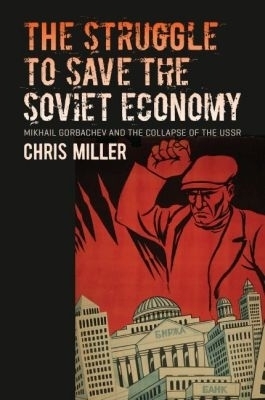
The Struggle to Save the Soviet Economy
Mikhail Gorbachev and the Collapse of the USSR
Seiten
2020
The University of North Carolina Press (Verlag)
978-1-4696-6153-7 (ISBN)
The University of North Carolina Press (Verlag)
978-1-4696-6153-7 (ISBN)
Making use of never-before-studied documents from the Soviet politburo and other archives, Chris Miller argues that the difference between the Soviet Union and China - and the ultimate cause of the Soviet collapse - was not economics but politics.
For half a century the Soviet economy was 'inefficient' but stable. In the late 1980s, to the surprise of nearly everyone, it suddenly collapsed. Why did this happen? And what role did Soviet leader Mikhail Gorbachev's economic reforms play in the country's dissolution? In this groundbreaking study, Chris Miller shows that Gorbachev and his allies tried to learn from the great success story of transitions from socialism to capitalism, Deng Xiaoping's China. Why, then, were efforts to revitalize Soviet socialism so much less successful than in China?
Making use of never-before-studied documents from the Soviet politburo and other archives, Miller argues that the difference between the Soviet Union and China--and the ultimate cause of the Soviet collapse--was not economics but politics. The Soviet government was divided by bitter conflict, and Gorbachev, the ostensible Soviet autocrat, was unable to outmaneuver the interest groups that were threatened by his economic reforms. Miller's analysis settles long-standing debates about the politics and economics of perestroika, transforming our understanding of the causes of the Soviet Union's rapid demise.
For half a century the Soviet economy was 'inefficient' but stable. In the late 1980s, to the surprise of nearly everyone, it suddenly collapsed. Why did this happen? And what role did Soviet leader Mikhail Gorbachev's economic reforms play in the country's dissolution? In this groundbreaking study, Chris Miller shows that Gorbachev and his allies tried to learn from the great success story of transitions from socialism to capitalism, Deng Xiaoping's China. Why, then, were efforts to revitalize Soviet socialism so much less successful than in China?
Making use of never-before-studied documents from the Soviet politburo and other archives, Miller argues that the difference between the Soviet Union and China--and the ultimate cause of the Soviet collapse--was not economics but politics. The Soviet government was divided by bitter conflict, and Gorbachev, the ostensible Soviet autocrat, was unable to outmaneuver the interest groups that were threatened by his economic reforms. Miller's analysis settles long-standing debates about the politics and economics of perestroika, transforming our understanding of the causes of the Soviet Union's rapid demise.
Chris Miller is assistant professor of international history at the Fletcher School of Law and Diplomacy at Tufts University and co-director of the school's Russia and Eurasia Program.
| Erscheinungsdatum | 17.07.2020 |
|---|---|
| Reihe/Serie | The New Cold War History |
| Verlagsort | Chapel Hill |
| Sprache | englisch |
| Maße | 155 x 233 mm |
| Gewicht | 333 g |
| Themenwelt | Geisteswissenschaften ► Geschichte ► Regional- / Ländergeschichte |
| Geschichte ► Teilgebiete der Geschichte ► Wirtschaftsgeschichte | |
| ISBN-10 | 1-4696-6153-5 / 1469661535 |
| ISBN-13 | 978-1-4696-6153-7 / 9781469661537 |
| Zustand | Neuware |
| Informationen gemäß Produktsicherheitsverordnung (GPSR) | |
| Haben Sie eine Frage zum Produkt? |
Mehr entdecken
aus dem Bereich


aus dem Bereich
wie Tech-Konzerne und Großmächte die Welt unter sich aufteilen
Buch | Hardcover (2025)
C.H.Beck (Verlag)
CHF 39,20
Aufstieg und Fall der Deutschland AG
Buch | Hardcover (2025)
Suhrkamp (Verlag)
CHF 41,95


