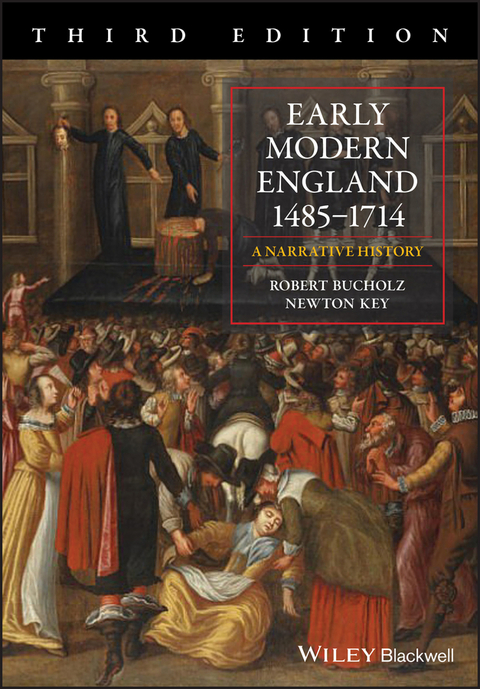
Early Modern England 1485-1714 (eBook)
John Wiley & Sons (Verlag)
9781118532218 (ISBN)
The new, fully-updated edition of the popular introduction to the Tudor-Stuart period-offers fresh scholarship and improved readability.
Early Modern England 1485-1714 is the market-leading introduction to the Tudor-Stuart period of English history. This accessible and engaging volume enables readers to understand the political, religious, cultural, and socio-economic forces that propelled the nation from small feudal state to preeminent world power. The authors, leading scholars and teachers in the field, have designed the text for those with little or no prior knowledge of the subject. The book's easy-to-follow narrative explores the world the English created and inhabited between the 15th and 18th centuries.
This new edition has been thoroughly updated to reflect the latest scholarship on the subject, such as Henry VIII's role in the English Reformation and the use of gendered language by Elizabeth I. A new preface addresses the theme of periodization, while revised chapters offer fresh perspectives on proto-industrialization in England, economic developments in early modern London, merchants and adventurers in the Middle East, the popular cultural life of ordinary people, and more. Offering a lively, reader-friendly narrative of the period, this text:
- Offers a wide-ranging overview of two and half centuries of English history in one volume
- Highlights how social and cultural changes affected ordinary English people at various stages of the time period
- Explores how the Irish, Scots, and Welsh affected English history
- Features maps, charts, genealogies and illustrations throughout the text
- Includes access to a companion website containing online resources
Early Modern England 1485-1714 is an indispensable resource for undergraduate students in early modern England courses, as well as students in related fields such as literature and Renaissance studies.
Robert Bucholz is Professor of History at Loyola University, Chicago, USA. He is the author of several books on English history including The Augustan Court: Queen Anne and the Decline of Court Culture and, with Joseph Ward, London: A Social and Cultural History 1550-1750.
Newton Key is Professor of History at Eastern Illinois University, USA. He has authored articles and book chapters on feasting, preaching, politicking, and conspiring in early modern England, Scotland, Ireland, and Wales.
They both have co-edited the companion sourcebook Sources and Debates in English History, 1485-1714.
Robert Bucholz is Professor of History at Loyola University, Chicago, USA. He is the author of several books on English history including The Augustan Court: Queen Anne and the Decline of Court Culture and, with Joseph Ward, London: A Social and Cultural History 1550-1750. Newton Key is Professor of History at Eastern Illinois University, USA. He has authored articles and book chapters on feasting, preaching, politicking, and conspiring in early modern England, Scotland, Ireland, and Wales. They both have co-edited the companion sourcebook Sources and Debates in English History, 1485-1714.
List of Plates vii
List of Maps ix
Preface to the Third Edition xi
Preface to the Second Edition xv
Preface to the First Edition xvii
Acknowledgments xxi
Conventions and Abbreviations xxiii
Introduction: England and its People, ca. 1485 1
1 Establishing the Henrician Regime, 1485-1525 33
2 (Dis-)Establishing the Henrician Church, 1525-1536 67
3 Reformations and Counter-Reformations, 1536-1558 95
4 The Elizabethan Settlement and Its Challenges, 1558-1585 121
5 The Elizabethan Triumph and Unsettlement, 1585-1603 143
6 Merrie Olde England?, ca. 1603 163
7 The Early Stuarts and the Three Kingdoms, 1603-1642 221
8 Civil War, Revolution, and the Search for Stability, 1642-1660 261
9 Restoration and Revolution, 1660-1689 291
10 War and Politics, 1689-1714 331
Conclusion: Augustan Polity, Society, and Culture, ca. 1714 369
Chapter 0 'Medieval Prologue: the Wars of the Roses and their Antecedents,1377-1845' Available online at www.wiley.com/go/bucholz/earlymodernengland
Glossary 411
Select Bibliography 421
Appendix: Genealogies 437
1 The Yorkists and Lancastrians 438
2 The Tudors and Stuarts 439
3 The Stuarts and Hanoverians 440
Index 441
Introduction: England and Its People, ca. 1485
Long before the events described in this book, long before there was an English people, state, or crown, the land they would call home had taken shape. Its terrain would mold them, as they would mold it. And so, to understand the people of early modern England and their experience, it is first necessary to know the geographical, topographical, and material reality of their world. Geography is, to a great extent, Destiny.
This Sceptered Isle
The first thing that most students think that they know about England is that it is an island. In fact, this is not strictly true. England is, rather, the southern and eastern portion of a group of islands (an archipelago) in the North Sea known as the British Isles (see Map I.1). Although the whole of the archipelago would be ruled from London by the end of the period covered by this book, and although the terms “Great Britain” and “British” have, at times, been applied to that whole, it should never be forgotten that the archipelago is home to four distinct peoples, each with their own national histories and customs: the English, the Irish, the Scots, and the Welsh.1 This book will concentrate on the experience of the first of these peoples. But because that experience intertwines with that of the other three, the following pages draw upon their histories as well.
Although the English may share their island, they have always defined themselves as an “island people.” That fact is crucial to understanding them, for an “island people” are likely to embrace an “island mentality.” One place to begin to understand what this means is with a much‐quoted passage by England's greatest poet, William Shakespeare (1564–1616):
This royal throne of kings, this sceptr'd isle,
This earth of majesty, this seat of Mars,
This other Eden, demi‐paradise:
This fortress built by Nature for herself
Against infection and the hand of war;
This happy breed of men, this little world,
This precious stone set in the silver sea,
Which serves it in the office of a wall,
Or as a moat defensive to a house,
Against the envy of less happier lands:
This blessed plot, this earth, this realm, this England.
(Richard II 2.1)
Map I.1 The British Isles (physical) today.
John of Gaunt's dying speech from The Tragedy of King Richard II is justly famous, not least because it says a great deal about how the English view themselves and their land. The most obvious point to make about these words (apart from their overt chauvinism) is that they portray the water surrounding the British Isles as a barrier. Specifically, England is separated from the mainland of Europe (and France, in particular) by the English Channel, a strait about 19 miles wide at its narrowest (see Map I.1). This is the “moat defensive” that “serves it [England] in the office of a wall.”
The Channel has, indeed, served England as a moat defensive against foreign invaders on a number of occasions. As we shall see in Chapter 5, in 1588 it prevented invasion by the armies of Philip II, who were to have been transported by the Spanish Armada. In 1805, after the period of time covered by this book, it would thwart a similar attempt by the armies of Napoleon Bonaparte. And in 1940, within the living memory of some readers, it would frustrate “Operation Sea Lion,” Hitler's plan for invasion and occupation by the forces of Nazi Germany. Thus, the English Channel and Great Britain's island status have been crucial to the preservation of England (and, later, Britain) as a sovereign country, with its own distinct traditions of government and social customs. Indeed, an important strain of English patriotism defines itself against Europe – most recently by some in the debates over Brexit.
As this implies, the English have sometimes thought that the English Channel shielded them from continental ways and ideas. One of the most obvious facts about the English is that they are not the French or the Dutch. Their political, social, and cultural institutions developed along different lines from those of their continental neighbors. This has sometimes led the English to believe that they are set apart from those neighbors, a “little world,” protected by their watery moat from “infection and the hand of war.” To believe that one is set apart is very close to believing that one is unique. This is, in turn, just a step away from believing that one is somehow superior to others, “the envy of less happier lands.” Indeed, early modern Englishmen and women believed that they were an elect nation, a chosen people. English governments have sometimes acted, first toward the other inhabitants of the British Isles, and later toward the subjects of a worldwide British Empire, as if “God was an Englishman” and that the remaining inhabitants of the planet had been given by Him to be instructed, directed, manipulated, conquered, exploited, or even enslaved, by His chosen people. But, for the most part, the “island mentality” is not so much hostile or aggressive as it is indifferent, even mildly condescending, toward Europe. Hence a famous, if apocryphal, nineteenth‐century headline: “Fog in Channel; Continent Cut Off.”
Of course, most of the time, there is no fog in the Channel and England and the continent are not cut off from each other. This brings us to the other side of the watery coin: the “island mentality” is, to a great extent, a sham, for the English Channel has more often acted as a highway or a bridge to Europe than as a barrier. For most of human history, before the invention of the airplane, the automobile, or modern superhighways, the easiest and safest way to get from place to place was by water. It is true that the Channel, and England's control of it, prevented the invasions of 1588, 1805, and 1940. But England faced many other invasions in its history, most of which the Channel facilitated. In fact, the people and polity of early modern England were the long‐term result of successful, and often violent, migrations by the Celts from about 800 to 200 BCE (before the common era, see Conventions and Abbreviations), the Romans in the first century CE (during the common era, see Conventions and Abbreviations), the Angles, Saxons, and Jutes in the fifth and sixth centuries, the Danes in the ninth and tenth centuries, the Normans in 1066, and, within the time frame of this book, the Dutch in 1688.
Because all of these people decided to settle in England, the notion of English uniqueness must be qualified by the realization that they were and are, like contemporary Americans, a mixture of many different ethnic groups and cultures: those noted previously; Welsh, Scots, Irish, and Huguenots during the period of this book; and, more recently, Africans, West Indians, Indians, Pakistanis, and many others. The people, the culture, even the language of England were forged in a melting pot. Take, for example, the English language. Today, commentators sometimes complain of the infusion of new words and phrases, slang or sloppiness of speech emanating from popular or youth culture or parts of the world distant in space and attitude from Oxbridge (a popular conflation of the names of the two oldest, most prestigious, universities in England, Oxford and Cambridge) or London elites. In their view, such emanations corrupt the “purity” of the Queen's English. The trouble with this view is that the Queen's English was never pure. It is, rather, a mongrel born of and enriched by Celtic, Latin, Anglo‐Saxon, Danish, French, and Dutch influences. Moreover, even within England itself (and certainly within the British Isles), it has always been spoken with a wide variety of regional accents, vocabulary, and syntax. In short, the English language was, and is, a living, evolving construct.
Migrations and invasions are not the only way in which new cultural influences have come to England. Because water surrounds the British Isles and water serves as a highway as well as a moat, it was probably inevitable that, in order to defend their country and buy and sell their goods, the English would become seafarers. (In fact, many had to be seafarers to get there in the first place.) This implies a naval tradition in order to protect the islands: this book will return again and again to the admittedly unsteady rise of English naval power. But it also implies traditions of fishing and overseas trade and the domestic industries that go with them (shipbuilding, carpentry, and cartography, for example). By 1714 the English would be the greatest shipbuilding and trading nation on earth, with London rivaling Amsterdam as its greatest money market. Though they have since relinquished those distinctions, trade and tourism, facilitated at the beginning of the present century by the Channel Tunnel and membership in the European Union (EU), continue to flow freely between England and the continent, and London remains one of the world's leading financial capitals. It remains to be seen how leaving the European Union might affect that traffic and leadership.
The wealth from trade and high finance would, in the eighteenth century, lead to military and naval dominance overseas and industrial growth at home. Another theme of this book is how England rose from being a puny and relatively poor...
| Erscheint lt. Verlag | 23.10.2019 |
|---|---|
| Sprache | englisch |
| Themenwelt | Geisteswissenschaften ► Geschichte ► Regional- / Ländergeschichte |
| Geisteswissenschaften ► Religion / Theologie | |
| Schlagworte | Early Modern British History • Early Modern England • early modern English history • Elizabethan history • England • Englische Literatur / Renaissance • English Civil War • English history textbook • English Reformation history • English Restoration • Geschichte • Geschichte der britischen Frühmoderne • Grossbritannien /Geschichte • History • Literature • Literaturwissenschaft • <p>English history • Renaissance English Literature • Stuart British history</p> • Stuart England history • Tudor England history |
| ISBN-13 | 9781118532218 / 9781118532218 |
| Informationen gemäß Produktsicherheitsverordnung (GPSR) | |
| Haben Sie eine Frage zum Produkt? |
 EPUB (Adobe DRM)
Kopierschutz: Adobe-DRM
Adobe-DRM ist ein Kopierschutz, der das eBook vor Mißbrauch schützen soll. Dabei wird das eBook bereits beim Download auf Ihre persönliche Adobe-ID autorisiert. Lesen können Sie das eBook dann nur auf den Geräten, welche ebenfalls auf Ihre Adobe-ID registriert sind.
Details zum Adobe-DRM
Dateiformat: EPUB (Electronic Publication)
EPUB ist ein offener Standard für eBooks und eignet sich besonders zur Darstellung von Belletristik und Sachbüchern. Der Fließtext wird dynamisch an die Display- und Schriftgröße angepasst. Auch für mobile Lesegeräte ist EPUB daher gut geeignet.
Systemvoraussetzungen:
PC/Mac: Mit einem PC oder Mac können Sie dieses eBook lesen. Sie benötigen eine
eReader: Dieses eBook kann mit (fast) allen eBook-Readern gelesen werden. Mit dem amazon-Kindle ist es aber nicht kompatibel.
Smartphone/Tablet: Egal ob Apple oder Android, dieses eBook können Sie lesen. Sie benötigen eine
Geräteliste und zusätzliche Hinweise
Buying eBooks from abroad
For tax law reasons we can sell eBooks just within Germany and Switzerland. Regrettably we cannot fulfill eBook-orders from other countries.
aus dem Bereich