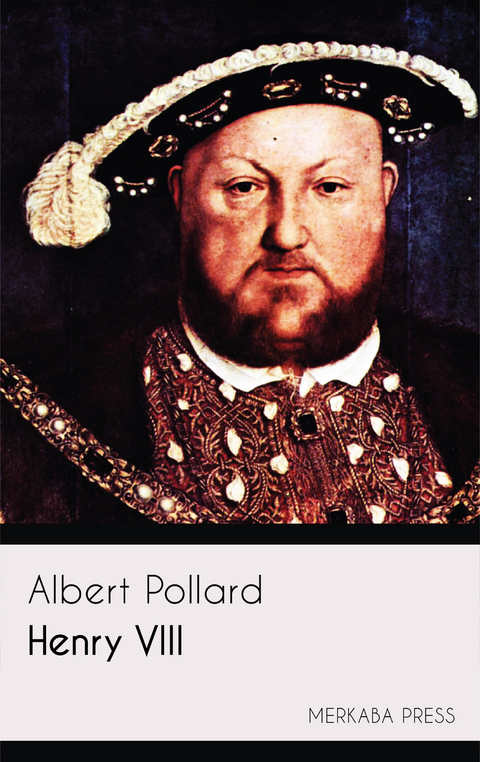
Henry VIII (eBook)
180 Seiten
Merkaba Press (Verlag)
9780000023704 (ISBN)
In the whole range of English history there is no monarch whose character has been more variously depicted by contemporaries or more strenuously debated by posterity than the 'majestic lord who broke the bonds of Rome'. To one historian an inhuman embodiment of cruelty and vice, to another a superhuman incarnation of courage, wisdom and strength of will, Henry VIII. has, by an almost universal consent, been placed above or below the grade of humanity. So unique was his personality, so singular his achievements, that he appears in the light of a special dispensation sent like another Attila to be the scourge of mankind, or like a second Hercules to cleanse, or at least to demolish, Augean stables. The dictates of his will seemed as inexorable as the decrees of fate, and the history of his reign is strewn with records of the ruin of those who failed to placate his wrath. Of the six queens he married, two he divorced, and two he beheaded. Four English cardinals [16] lived in his reign; one perished by the executioner's axe, one escaped it by absence, and a third by a timely but natural death. Of a similar number of dukes [17] half were condemned by attainder; and the same method of speedy despatch accounted for six or seven earls and viscounts and for scores of lesser degree. He began his reign by executing the ministers of his father, [18] he continued it by sending his own to the scaffold. The Tower of London was both palace and prison, and statesmen passed swiftly from one to the other; in silent obscurity alone lay salvation. Religion and politics, rank and profession made little difference; priest and layman, cardinal-archbishop and 'hammer of the monks,' men whom Henry had raised from the mire, and peers, over whose heads they were placed, were joined in a common fate. Wolsey and More, Cromwell and Norfolk, trod the same dizzy path to the same fatal end; and the English people looked on powerless or unmoved. They sent their burgesses and knights of the shire to Westminster without let or hindrance, and Parliament met with a regularity that grew with the rigour of Henry's rule; but it seemed to assemble only to register the royal edicts and clothe with a legal cloak the naked violence of Henry's acts. It remembered its privileges only to lay them at Henry's feet, it cancelled his debts, endowed his proclamations with the force of laws, and authorised him to repeal acts of attainder and dispose of his crown at will. Secure of its support Henry turned and rent the spiritual unity of Western Christendom, and settled at a blow that perennial struggle between Church and State, in which kings and emperors had bitten the dust. With every epithet of contumely and scorn he trampled under foot the jurisdiction of him who was believed to hold the keys of heaven and hell. Borrowing in practice the old maxim of Roman law, cujus regio, ejus religio, [19] he placed himself in the seat of authority in religion and presumed to define the faith of which Leo had styled him defender. Others have made themselves despots by their mastery of many legions, through the agency of a secret police, or by means of an organised bureaucracy. Yet Henry's standing army consisted of a few gentlemen pensioners and yeomen of the guard; he had neither secret police nor organised bureaucracy. Even then Englishmen boasted that they were not slaves like the French, [20] and foreigners pointed a finger of scorn at their turbulence. Had they not permanently or temporarily deprived of power nearly half their kings who had reigned since William the Conqueror? Yet Henry VIII. not only left them their arms, but repeatedly urged them to keep those arms ready for use. [21] He eschewed that air of mystery with which tyrants have usually sought to impose on the mind of the people. All his life he moved familiarly and almost unguarded in the midst of his subjects, and he died in his bed, full of years, with the spell of his power unbroken and the terror of his name unimpaired...
| Erscheint lt. Verlag | 25.7.2017 |
|---|---|
| Sprache | englisch |
| Themenwelt | Geisteswissenschaften ► Geschichte ► Regional- / Ländergeschichte |
| ISBN-13 | 9780000023704 / 9780000023704 |
| Informationen gemäß Produktsicherheitsverordnung (GPSR) | |
| Haben Sie eine Frage zum Produkt? |
 EPUB (Adobe DRM)
Größe: 407 KB
Kopierschutz: Adobe-DRM
Adobe-DRM ist ein Kopierschutz, der das eBook vor Mißbrauch schützen soll. Dabei wird das eBook bereits beim Download auf Ihre persönliche Adobe-ID autorisiert. Lesen können Sie das eBook dann nur auf den Geräten, welche ebenfalls auf Ihre Adobe-ID registriert sind.
Details zum Adobe-DRM
Dateiformat: EPUB (Electronic Publication)
EPUB ist ein offener Standard für eBooks und eignet sich besonders zur Darstellung von Belletristik und Sachbüchern. Der Fließtext wird dynamisch an die Display- und Schriftgröße angepasst. Auch für mobile Lesegeräte ist EPUB daher gut geeignet.
Systemvoraussetzungen:
PC/Mac: Mit einem PC oder Mac können Sie dieses eBook lesen. Sie benötigen eine
eReader: Dieses eBook kann mit (fast) allen eBook-Readern gelesen werden. Mit dem amazon-Kindle ist es aber nicht kompatibel.
Smartphone/Tablet: Egal ob Apple oder Android, dieses eBook können Sie lesen. Sie benötigen eine
Geräteliste und zusätzliche Hinweise
Buying eBooks from abroad
For tax law reasons we can sell eBooks just within Germany and Switzerland. Regrettably we cannot fulfill eBook-orders from other countries.
aus dem Bereich