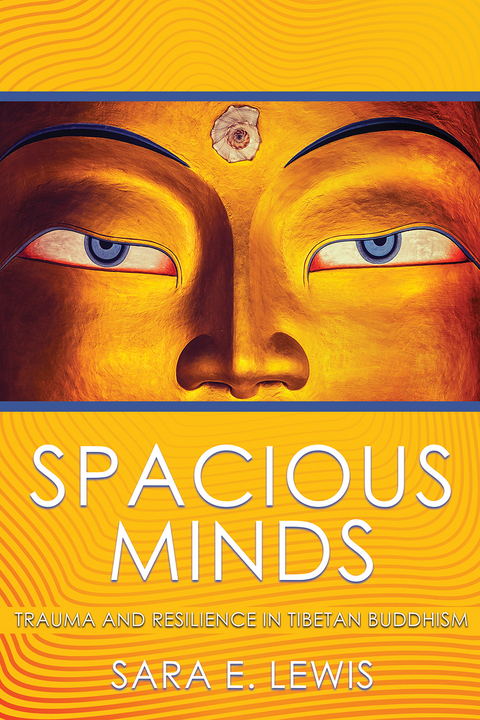
Spacious Minds (eBook)
252 Seiten
Cornell University Press (Verlag)
978-1-5017-1220-3 (ISBN)
Spacious Minds argues that resilience is not a mere absence of suffering. Sara E. Lewis's research reveals how those who cope most gracefully may indeed experience deep pain and loss. Looking at the Tibetan diaspora, she challenges perspectives that liken resilience to the hardiness of physical materials, suggesting people should "bounce back" from adversity. More broadly, this ethnography calls into question the tendency to use trauma as an organizing principle for all studies of conflict where suffering is understood as an individual problem rooted in psychiatric illness.
Beyond simply articulating the ways that Tibetan categories of distress are different from biomedical ones, Spacious Minds shows how Tibetan Buddhism frames new possibilities for understanding resilience. Here, the social and religious landscape encourages those exposed to violence to see past events as impermanent and illusory, where debriefing, working-through, or processing past events only solidifies suffering and may even cause illness. Resilience in Dharamsala is understood as sems pa chen po, a vast and spacious mind that does not fixate on individual problems, but rather uses suffering as an opportunity to generate compassion for others in the endless cycle of samsara. A big mind view helps to see suffering in life as ordinary. And yet, an intriguing paradox occurs. As Lewis deftly demonstrates, Tibetans in exile have learned that human rights campaigns are predicated on the creation and circulation of the trauma narrative; in this way, Tibetan activists utilize foreign trauma discourse, not for psychological healing, but as a political device and act of agency.
Sara E. Lewis is Associate Professor of Contemplative Psychotherapy and Buddhist Psychology at Naropa University. Follow her on X @DeathRebirthLab.
Acknowledgments
List of Abbreviations
Note on Transliteration
Central Characters
Introduction
1. Life in Exile
2. Mind Training
3. Resisting Chronicity
4. The Paradox of Testimony
5. Open Sky of Mind
Conclusion
Notes
References
Index
| Erscheint lt. Verlag | 15.2.2020 |
|---|---|
| Zusatzinfo | 3 b&w halftones, 1 map |
| Verlagsort | Ithaca |
| Sprache | englisch |
| Maße | 150 x 150 mm |
| Themenwelt | Geisteswissenschaften ► Geschichte ► Regional- / Ländergeschichte |
| Geisteswissenschaften ► Religion / Theologie ► Buddhismus | |
| Sozialwissenschaften ► Ethnologie | |
| Sozialwissenschaften ► Pädagogik | |
| Sozialwissenschaften ► Soziologie | |
| Schlagworte | Resilience, Trauma, Buddhism, Dharamsala, Tibetan |
| ISBN-10 | 1-5017-1220-9 / 1501712209 |
| ISBN-13 | 978-1-5017-1220-3 / 9781501712203 |
| Informationen gemäß Produktsicherheitsverordnung (GPSR) | |
| Haben Sie eine Frage zum Produkt? |
 EPUB (Adobe DRM)
Kopierschutz: Adobe-DRM
Adobe-DRM ist ein Kopierschutz, der das eBook vor Mißbrauch schützen soll. Dabei wird das eBook bereits beim Download auf Ihre persönliche Adobe-ID autorisiert. Lesen können Sie das eBook dann nur auf den Geräten, welche ebenfalls auf Ihre Adobe-ID registriert sind.
Details zum Adobe-DRM
Dateiformat: EPUB (Electronic Publication)
EPUB ist ein offener Standard für eBooks und eignet sich besonders zur Darstellung von Belletristik und Sachbüchern. Der Fließtext wird dynamisch an die Display- und Schriftgröße angepasst. Auch für mobile Lesegeräte ist EPUB daher gut geeignet.
Systemvoraussetzungen:
PC/Mac: Mit einem PC oder Mac können Sie dieses eBook lesen. Sie benötigen eine
eReader: Dieses eBook kann mit (fast) allen eBook-Readern gelesen werden. Mit dem amazon-Kindle ist es aber nicht kompatibel.
Smartphone/Tablet: Egal ob Apple oder Android, dieses eBook können Sie lesen. Sie benötigen eine
Geräteliste und zusätzliche Hinweise
Buying eBooks from abroad
For tax law reasons we can sell eBooks just within Germany and Switzerland. Regrettably we cannot fulfill eBook-orders from other countries.
aus dem Bereich