


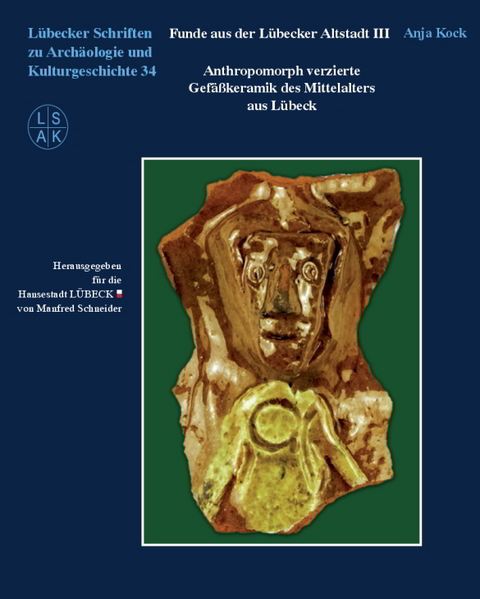
Funde aus der Lübecker Altstadt III
Anthropomorph verzierte Gefäßkeramik des Mittelalters aus Lübeck
Seiten
2019
|
1., Aufl.
VML Vlg Marie Leidorf (Verlag)
978-3-86757-434-1 (ISBN)
VML Vlg Marie Leidorf (Verlag)
978-3-86757-434-1 (ISBN)
The monograph presents a small group of pottery vessels of the Danish Baltic Empire in the 13th century which, due to the labourious production process, was a special luxury already at the time of its fabrication. The largest sub-group are stylised “monk’s faces” with a hood, that in reality belonged to round dancing women, probably at a maypole, but there are also individuals with a beard. Their occurrence concentrates at sites with easy accessibility from the sea. Because of their limited number, the associated jugs or flagons were no trade goods by themselves, but rather presents, souvenirs, personal items or trade byproducts. Mostly, the face alone survives, which was placed at the weakest point of the vessel and is most easily recognised during find analysis. Although it is taken for granted that several workshops existed, only the production site in Lübeck is proven by pottery wasters. A characteristic stamp attests that products of a single workshop were transported over long distances. There are parallels with vessels from Flanders and England, although the type of decoration might also have emerged three times independently. Die Monographie präsentiert eine kleine Keramikgruppe des dänischen Ostseereiches im 13. Jh., die durch den aufwendigen Herstellungsprozeß schon zu ihrer Entstehungszeit ein besonderes Luxusgut war. Die größte Gruppe bilden stilisierte “Mönchsgesichter” mit Kapuze, die in Wirklichkeit zu einem reigentanzenden Frauenfries und evtl. zu einem Maibaumbrauch gehörten, aber auch Bärtige kommen vor. Ihr Auftreten häuft sich an Orten mit guter Erreichbarkeit von See. Wegen der geringen Anzahl handelte es sich bei den zugehörigen Kannen oder Krügen um kein eigenes Handelsgut, sondern eher um Geschenke, Souvenirs, persönlichen Besitz oder Nebenhandelsprodukte. Erhalten ist meist nur das Gesicht, das an einem Schwachpunkt des Gefäßes saß und bei der Fundbearbeitung leicht erkennbar ist. Obwohl als sicher gilt, dass mehrere Werkstätten existierten, ist bisher lediglich für Lübeck durch Töpfereiabfall ein Produktionsstandort nachgewiesen. Ein charakteristischer Stempel bezeugt, dass Produkte einer Werkstatt weite Strecken zurücklegten. Parallelen zu Flandern und England sind feststellbar, obwohl die Verzierungsweise auch dreimal unabhängig entstanden sein könnte.
The monograph presents a small group of pottery vessels of the Danish Baltic Empire in the 13th century which, due to the labourious production process, was a special luxury already at the time of its fabrication. The largest sub-group are stylised “monk’s faces” with a hood, that in reality belonged to round dancing women, probably at a maypole, but there are also individuals with a beard. Their occurrence concentrates at sites with easy accessibility from the sea. Because of their limited number, the associated jugs or flagons were no trade goods by themselves, but rather presents, souvenirs, personal items or trade byproducts. Mostly, the face alone survives, which was placed at the weakest point of the vessel and is most easily recognised during find analysis. Although it is taken for granted that several workshops existed, only the production site in Lübeck is proven by pottery wasters. A characteristic stamp attests that products of a single workshop were transported over long distances. There are parallels with vessels from Flanders and England, although the type of decoration might also have emerged three times independently.
The monograph presents a small group of pottery vessels of the Danish Baltic Empire in the 13th century which, due to the labourious production process, was a special luxury already at the time of its fabrication. The largest sub-group are stylised “monk’s faces” with a hood, that in reality belonged to round dancing women, probably at a maypole, but there are also individuals with a beard. Their occurrence concentrates at sites with easy accessibility from the sea. Because of their limited number, the associated jugs or flagons were no trade goods by themselves, but rather presents, souvenirs, personal items or trade byproducts. Mostly, the face alone survives, which was placed at the weakest point of the vessel and is most easily recognised during find analysis. Although it is taken for granted that several workshops existed, only the production site in Lübeck is proven by pottery wasters. A characteristic stamp attests that products of a single workshop were transported over long distances. There are parallels with vessels from Flanders and England, although the type of decoration might also have emerged three times independently.
| Erscheinungsdatum | 28.05.2019 |
|---|---|
| Reihe/Serie | Lübecker Schriften zur Archäologie und Kulturgeschichte ; 34 |
| Verlagsort | Rahden/Westf. |
| Sprache | deutsch |
| Maße | 210 x 297 mm |
| Gewicht | 1420 g |
| Einbandart | gebunden |
| Themenwelt | Geschichte ► Allgemeine Geschichte ► Mittelalter |
| Schlagworte | Brauchtum • Handel • Handwerk • Stadtgeschichte |
| ISBN-10 | 3-86757-434-0 / 3867574340 |
| ISBN-13 | 978-3-86757-434-1 / 9783867574341 |
| Zustand | Neuware |
| Informationen gemäß Produktsicherheitsverordnung (GPSR) | |
| Haben Sie eine Frage zum Produkt? |
Mehr entdecken
aus dem Bereich


aus dem Bereich
Geschichte einer Augsburger Familie (1367-1650)
Buch | Softcover (2024)
Kohlhammer (Verlag)
CHF 47,60


