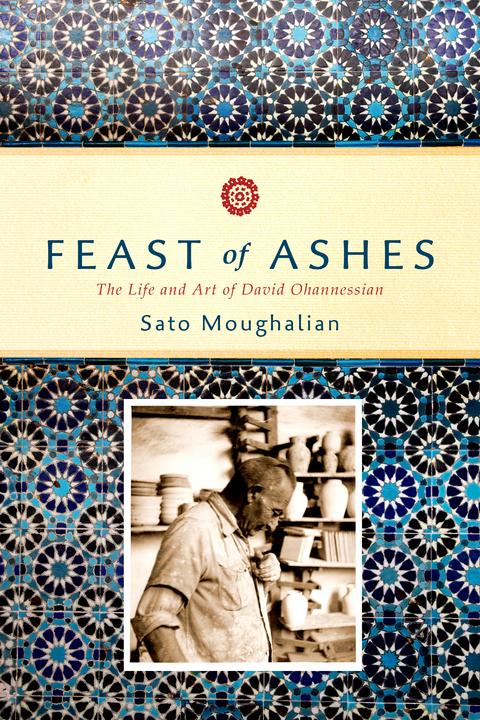
Feast of Ashes (eBook)
440 Seiten
Stanford University Press (Verlag)
978-1-5036-0915-0 (ISBN)
Sato Moughalian is an award-winning flutist in New York City and Artistic Director of Perspectives Ensemble, founded in 1993 to explore and contextualize works of composers and visual artists. Since 2007, Ms. Moughalian has also traveled to Turkey, England, Israel, Palestine, and France to uncover the traces of her grandfather's life and work, has published articles, and gives talks on the genesis of Jerusalem's Armenian ceramic art.
Contents and AbstractsPrelude: Searching for my grandfather chapter abstractPrelude: The author, an immigrant growing up in the United States, discovers a passion to discover more about the life and art of her grandfather, David Ohannessian, who founded the art of Armenian ceramics in Jerusalem in 1919. To learn about her heritage, she must confront her family's traumatic experience during the Armenian Genocide and search for the art and other traces her grandfather left behind.1Mouradchai—The Armenian Village chapter abstractThis chapter explores the ethnically Armenian mountain village in western Anatolia in which David Ohannessian was born in 1884 and where his ancestors lived for four centuries. The narrative describes daily life, wedding customs, the agriculture, and commerce of the village, and the encroachment of economic and social factors from the larger world on the inhabitants of this isolated hamlet at the end of the nineteenth century.2Eskishehir and the Engagement chapter abstractThe Ohannessian family resettles in Eskishehir, where David Ohannessian attends a French Catholic school, and discovers a variety of possible professions in a larger and more European-influenced city. The chapter briefly reviews the presence and distribution of Armenians in the Ottoman Empire and the challenges faced by this minority. David Ohannessian falls in love with Victoria Shahbazian and asks for her hand in marriage.3Constantinople, Learning the Art of Kutahya ceramics chapter abstractIn 1902, David Ohannessian spends several months in Constantinople and discovers his vocation: ceramic-making. He moves to Kutahya to apprentice in the craft and learns that the region is rich in the clays and other minerals that gave rise to the art of glazed painted ceramics around the fifteenth century. The chapter follows the tradition of ceramic making in Kutahya in the ensuing eras. By 1907, Ohannessian masters the art and following year, he married and deepened his connection to the city's longstanding Armenian community.4Kutahya—Princes, Sheikhs, and a Baronet chapter abstractOhannessian establishes an independent ceramics studio in Kütahya, the Société Ottomane de Faïence, and enters partnerships with Mehmet Emin and Garabed and Harutyun Minassian to tile the growing number of buildings in the new Ottoman revivalist style and to produce glazed pottery for domestic sales and export. The 1908 Revolution brought a surge of interest in nationalist architecture along with many orders for new works as well as tiles to restore important mosques through Ottoman and Arab territories—Bursa, Konya, Mecca, Damascus, and Cairo. Ohannessian meets Mark Sykes, who commissions several substantial orders for his baronial estate in Yorkshire, Sledmere House. As Ohannessian and his partners work with architect Ahmet Kemalettin on new buildings and restorations, they become intimately acquainted with ceramic traditions from the thirteenth through the eighteenth centuries and amass a technical knowledge and a wide-ranging decorative repertoire. The Great War begins.5Exile chapter abstractHuge numbers of Balkan Muslim refugees enter western Anatolia, posing new threats to Greek and Armenian communities. As the Ottoman Empire embarks on battles along its borders, the government places blame for early defeats on Armenians, painting them as traitorous and disarming Ottoman Armenian soldiers. On April 24, in the capital, Ottoman police and irregular forces round up more than two hundred of the most influential Armenian intellectuals, merchants, priests, and artists, and deport them into the interior, where many of them are murdered. The entire village of Mouradchai is deported on twenty-four hours' notice. In Kutahya, Ohannessian is arrested and then deported with his family.6The Mountains, Aleppo, Deir Zor chapter abstractThe Ohannessian family follows the path of deportation taken by Armenians living in the western provinces of Anatolia—traveling by train to Bozanti, and traversing the Taurus Mountains, the province of Adana, and the Amanus Mountains. The family enters the community of Armenian refugees in Aleppo, but is deported again, this time to Meskene, the site of a desert death camp near the Euphrates. The Ohannessians return to Aleppo. After the British take the city, Mark Sykes finds Ohannessian subsisting as a refugee and recommends him to Ronald Storrs, the new Military Governor of Jerusalem, to produce new tiles for the planned British restoration of the Dome of the Rock.7Jerusalem Part I: The Haven chapter abstractThe Ohannessians arrive in Jerusalem and join other Armenian survivors in the Convent of St. James. Ohannessian meets with Ernest T. Richmond, the consulting architect brought by the British to evaluate the Dome of the Rock. Ohannessian experiments with tile making using the unsatisfactory local materials. He returns to Kütahya to recruit workers and obtain clays and other minerals. Ohannessian trains Armenian orphans in the art of ceramic making. Outbreaks of violence between Jerusalem's Arab and Jewish communities in 1920 and 1921 lead to the establishment of the Supreme Muslim Council as a vehicle for greater Arab self-governance. The SMC appoints Ahmet Kemalettin to oversee the restoration of the Dome of the Rock and Al Aqsa Mosque. Ohannessian and his artisans are dismissed from the project, but continue to produce ceramics, perfect their technique given the lack of materials in Palestine's parched environment, and forge relations with distributors.8Jerusalem Part II: The Feast chapter abstractOhannessian's studio adds workers, begins to exhibit at international expositions, and receives many commissions for tiled works in Jerusalem, transferring the Ottoman tradition of glazed, painted tile ornaments for domestic architecture to Jerusalem and creating elaborate tiled installations in new government and private structures. He establishes distribution outlets in Europe, the United States, Africa and through the Middle East. Arab-Jewish tensions lessen with the outbreak of World War II, but intensify upon its conclusion.9The Scattering chapter abstractOne by one, members of the Ohannessian family leave Jerusalem, terrified by the intensifying violence. Thousands of Palestinian Armenians flock to St. James Armenian Convent seeking refuge. The Ohannessians leave for Damascus and then Egypt. Fimi Ohannessian finds a job in the British Council Library in Cairo and survives Black Saturday, the arson and violent destruction of 400 British and European-related businesses in the downtown district. The family flees Cairo's violence for Beirut and scatter after Ohannessian's death in 1953.Postlude: The Return chapter abstractThe author decides to write a biography of her grandfather and travels to the places in Turkey where he lived and worked. She locates the remnants of Ohannessian's birth village and travels there. She searches for his surviving works in the world today.
| Erscheint lt. Verlag | 23.4.2019 |
|---|---|
| Zusatzinfo | 39 color illustrations, 59 halftones, 1 map |
| Sprache | englisch |
| Themenwelt | Literatur ► Biografien / Erfahrungsberichte |
| Kunst / Musik / Theater ► Kunstgeschichte / Kunststile | |
| Geisteswissenschaften ► Geschichte ► Regional- / Ländergeschichte | |
| Schlagworte | Armenian culture • Armenian Genocide • British Mandate Palestine • Ceramics • David Ohannessian • Dome of the Rock • Jerusalem • Kütahya • mark sykes • Ottoman Empire |
| ISBN-10 | 1-5036-0915-4 / 1503609154 |
| ISBN-13 | 978-1-5036-0915-0 / 9781503609150 |
| Informationen gemäß Produktsicherheitsverordnung (GPSR) | |
| Haben Sie eine Frage zum Produkt? |
 PDF (Adobe DRM)
Kopierschutz: Adobe-DRM
Adobe-DRM ist ein Kopierschutz, der das eBook vor Mißbrauch schützen soll. Dabei wird das eBook bereits beim Download auf Ihre persönliche Adobe-ID autorisiert. Lesen können Sie das eBook dann nur auf den Geräten, welche ebenfalls auf Ihre Adobe-ID registriert sind.
Details zum Adobe-DRM
Dateiformat: PDF (Portable Document Format)
Mit einem festen Seitenlayout eignet sich die PDF besonders für Fachbücher mit Spalten, Tabellen und Abbildungen. Eine PDF kann auf fast allen Geräten angezeigt werden, ist aber für kleine Displays (Smartphone, eReader) nur eingeschränkt geeignet.
Systemvoraussetzungen:
PC/Mac: Mit einem PC oder Mac können Sie dieses eBook lesen. Sie benötigen eine
eReader: Dieses eBook kann mit (fast) allen eBook-Readern gelesen werden. Mit dem amazon-Kindle ist es aber nicht kompatibel.
Smartphone/Tablet: Egal ob Apple oder Android, dieses eBook können Sie lesen. Sie benötigen eine
Geräteliste und zusätzliche Hinweise
Buying eBooks from abroad
For tax law reasons we can sell eBooks just within Germany and Switzerland. Regrettably we cannot fulfill eBook-orders from other countries.
aus dem Bereich